How UNC wide receiver Beau Corrales lives and plays with type-1 diabetes
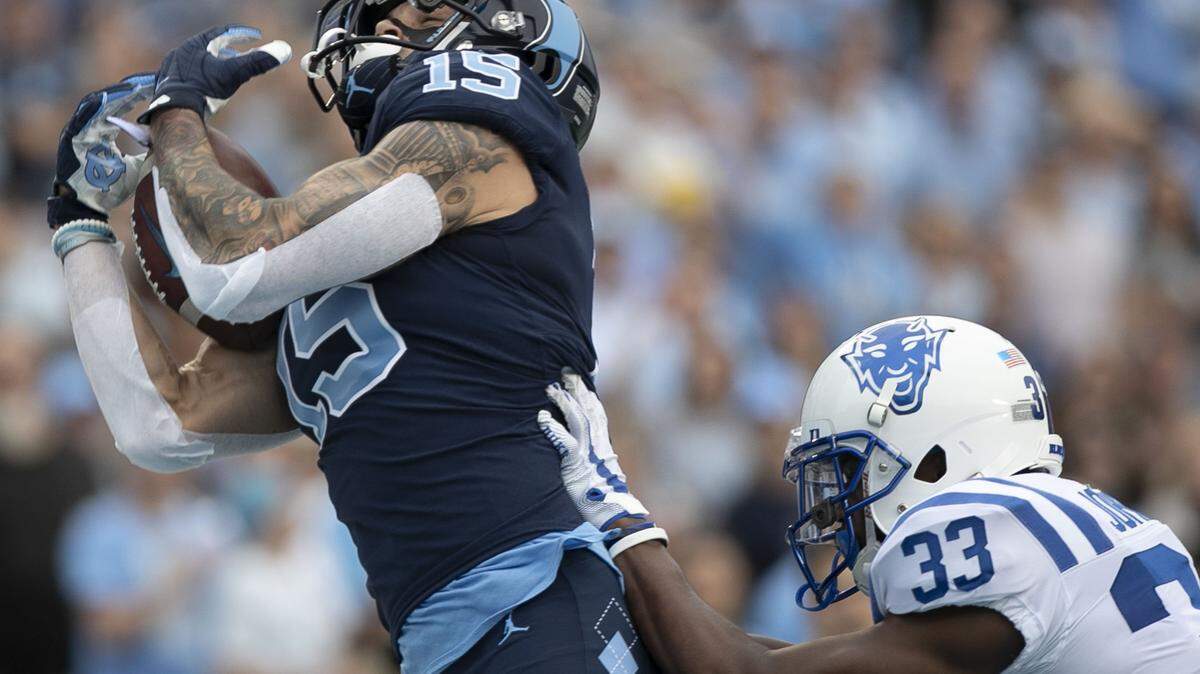
It’s 5:15 a.m. on a Tuesday, the sky is pitch black and Beau Corrales’ second alarm is going off. He’s groggy, but he knows he has to get up.
Corrales rises from bed, prays, then checks his iPhone, which shows the numbers from his glucose monitor. On this day, his sugar levels are higher than they should be. He pulls his insulin pen out of a Ziploc bag and injects the drug into his hip.
Then he gets himself ready for school, a 6:30 a.m. football meeting and 8 a.m. practice.
In the spring, when his blood sugar levels had gotten too low, Corrales twice had trouble waking up and was late to a morning lift and a morning meeting. His coaches were not pleased, and they told Corrales that if he couldn’t manage his type-1 diabetes then he should expect not to see the field.
“It was a wake up call,” Tammy Corrales, his mother, said.
Corrales wanted to play. So he tightened up his regiment.
Still on schedule, Corrales hops in his red Ford Escape. He’s the first of his roommates to leave the house, and he makes the five-minute drive from the off-campus home to UNC’s football facility. There, he eats breakfast — eggs, two slices of bacon and oatmeal — and injects more insulin.
Throughout the 6:30 a.m. meeting, he checks his phone. The glucose monitor is showing that his sugar levels are now too low. He injected too much insulin. He quickly grabs a Gatorade and chugs it until the numbers on his phone finally flat-line.
He’s finally ready for practice.
“In the real world, nobody cares,” Corrales says about having diabetes. “They just want to see production, which sounds kind of hard, but at the end of the day, that’s what I’m here for. I’m here to produce.”
This season, Corrales has produced. He’s third on the team with 27 receptions for 342 yards and five touchdowns. The 6-foot-4, 210-pound receiver has come a long way from struggling in the spring to being one of Sam Howell’s most reliable weapons.
And most of that can be contributed to making sure he’s on top of his health.
“He’s had the biggest turnaround I think I’ve ever seen from a young man when we got here to where he is today,” UNC coach Mack Brown said. “He’s on time to everything, he’s working himself to death in practice, so I’m really excited for him.”
Finding out he was Type-1
The first time Corrales remembers something wasn’t right, he was sitting in the back of a classroom in middle school and the words from the projector looked blurry. He always had 20/20 vision, he said.
In the summer before his seventh-grade year, Corrales began getting frequent headaches. He was constantly sick and he was starting to lose weight. His parents thought he was just going through puberty. He was an active 12-year-old, a star on the football and basketball teams.
But the headaches soon became migraines. His uncle, a neurologist, suspected he had a concussion. Nurses told him it was probably allergies.
By the time football season began in the fall of his seventh grade year, he dropped from about 110 pounds to 85 — he was almost 6-feet tall.
His symptoms reached the point where one afternoon he couldn’t finish a football game because he didn’t have enough energy. He kept having to go to the bathroom. His vision was blurry. He threw up.
Greg and Tammy Corrales, his parents, feared the worst.
“Neither one of us would say it out loud because we were both terrified thinking some kind of cancer or something,” Tammy Corrales said. “We just didn’t know.”
The next day, his father took him to see his pediatrician. His doctor took blood samples, and five minutes later came back with the results.
“He is type-1 and we’re ordering an ambulance to bring him down to Dell, because we don’t think he’s going to make it,” the doctor told Greg Corrales.
A support system
Type-1 diabetes is an autoimmune disease that occurs when a person’s pancreas no longer produces insulin, the hormone that allows cells to use sugars for energy. Approximately 1.25 million American children and adults live with type-1 diabetes, according to the American Diabetes Association.
Beau Corrales spent two weeks in the Dell Children’s Medical Center of Central Texas with his family, learning about the disease and how to properly take care of himself. He was now fully insulin dependent.
His family had to learn how to measure his sugar levels and give him insulin shots. They had to measure his food, just to know how much insulin to give him.
“It’s a really cruel disease in that it just mentally wears the child down,” Greg Corrales said.
Every morning at 3 a.m., his parents woke up to check his blood sugar levels while he was sleeping. Today, they’re still checking from home in Georgetown, Texas. They have an app on their phone connected to the glucose monitor he wears attached to his hip that alerts them when his levels are rising or dropping. If his levels take a dip while he’s sleeping, they’ll call him.
Dr. John Buse, an endochronologist and the director of the Diabetes Center at UNC-Chapel Hill, said there are many high-caliber athletes who have type-1 diabetes. However, that doesn’t mean it’s easy for those athletes, he said.
“The hardest thing for athletes is low blood sugar because your muscles metabolize sugars,” Buse said. “If you’re really working your muscles hard, you will use sugar in an insulin-independent way.”
He added that doing a lot of exercise over a short period of time changes how glucose is used by muscles.
“It’s an impressive thing to be an elite athlete and be able to control your blood sugar,” Buse said.
Corrales tries to keep his blood sugar levels between 140-170 milligrams. If it gets much higher or lower it can cause problems.
For instance, if a type-1 diabetic’s sugar levels are too low, they can go into a coma.
Corrales is fortunate that his blood-sugar levels have never gotten to that point. But they have gotten low enough where he has had trouble waking up.
One morning, Jordan Tucker, one of his roommates, woke up to his phone ringing. It was Greg and Tammy Corrales calling.
They said they noticed their son’s sugar levels had dropped, and they needed Tucker to check on him. They tried to call their son, but he didn’t hear his phone.
Tucker remembers pounding on his teammates’ door to no avail. Minutes went by, and finally Corrales answered. He said he was fine.
“He doesn’t remember those guys coming in,” Greg Corrales said, adding that confusion is one of the side effects of low blood sugar.
Corrales has emergency plans in case he ever needs it. He taught his roommates how to give him an insulin shot. And if, in the morning, they leave the house and his car is still in the driveway, they know to check on him because he’s likely asleep and can’t wake himself up.
A wake up call
Having a support system of friends like Tucker and offensive lineman Billy Ross, who Corrales first met on his official visit, is a big reason he chose to play at UNC.
It was also the support from the school.
On his official visit, former UNC coach Larry Fedora and assistant coach Gunter Brewer gathered the training staff and nutritionists to assemble a presentation on how they would help care for Corrales while he was away from home.
His parents had always been there for him to fall back on. Moving away from home was going to be a challenge and his parents were concerned.
But UNC’s staff assured his parents that Corrales would be well-taken care of. The school would provide him with an endocrinologist who specialized in diabetes, and provide the best care and medical equipment for him. It would also pay for all of his insulin and treatments.
“I sat there and cried,” Tammy Corrales said. “I was blown away.”
“No other place had gone that in-depth,” Greg Corrales said.
But while he has the support from the athletic staff, it’s still on Corrales to make sure he regularly takes his insulin, eats properly and exercising regularly. All of those factors can contribute to his blood-sugar levels, that’s why, back in February when he lacked punctuality for weight-lifting and meetings, his coaches felt they needed to address his health.
“And we told him, if you can’t wake up and you can’t get to meetings, then you’re not going to start, and you’re not going to get to play a lot,” Brown said. “So we’ve either got to figure out how to manage your medical situation better, and we’ll work with you, we’ll try to help you, we’ll research it, but you’ve got to show up like everybody else.”
Brown’s message was backed by offensive coordinator Phil Longo, whose eight-year-old daughter is also a type-1 diabetic. Longo told Corrales that he couldn’t use it as an excuse.
This wasn’t punitive. It was a wake-up call for Corrales. Longo was the one person who understood most what he was going through.
“I just knew what I had been doing wasn’t good enough,” Corrales said, “and I just had to really, really grow up some and figure out what it was I had to do to make sure I could take care of myself to be everywhere on time.”
So his regime now is strict.
He has two alarm clocks. He works out daily. He tries to eat the same meal before game days at the same times — loading up on carbs on Friday nights and light carbs on Saturday’s — so that he knows how exactly much insulin to take.
The change also had an affect on his sugar levels — he is now less likely to wake up with his levels too high or too low.
“Even though type-1 is something that is a very big part of me, I just had to learn to be able to manage it to the best of my ability,” Corrales said. “And even on my bad days, I’ve just got to bring it 100 percent.”
If he can do it, so can I
In the family section at Kenan Stadium, sits one of Corrales’ biggest fans. It’s not his parents.
It’s Gianna Longo, Phil Longo’s eight-year-old daughter, who is also a type-1 diabetic.
Gianna wants to be a competitive swimmer one day. And as an aspiring Division-I, she looks up to Corrales.
In the spring, Corrales sat with Gianna in Longo’s office and talked to her about his journey and how he goes about competing with the disease.
“She kind of applies some of the things he said — what snacks he eats to raise his blood sugar, and how he deals with lowering it, or how he manages it leading up to a game,” Longo said. “So now Gianna does the same stuff leading up to her swim meets and practices.”
Longo said he’s noticed that the talk Corrales had with his daughter has boosted her confidence. She enjoys watching Corrales practice and play because it’s a reminder that she can achieve her goals too, Longo said.
“When you’re a parent, you value those things and I’m very, very appreciative to Beau for having that kind of impact in the mind of my eight-year-old daughter,” Longo said.
Corrales said giving back is his main objective. His source of inspiration is Mark Andrews, a second-year tight end for the Baltimore Ravens, who is also a type-1 diabetic. Andrews, like Corrales, tries not to let the disease define him.
And Corrales wants kids to know that it’s possible to achieve your dreams with type-1 diabetes.
That’s why he continues to work hard on and off the field.
“Knowing that I can be that for some other kid somewhere, it’s a humbling feeling, and I’m grateful that I have this opportunity,” Corrales said. “It pushes me that much more knowing that there’s people like me, that would like to be where I’m at.”
UNC at Pitt
When: Thursday, Nov. 14, 8 p.m.
Where: Heinz Field, Pittsburgh, Pa.
TV: ESPN
Listen: WTKK-106.1, WCHL-97.9, WCHL-1360 in the Triangle; WBT-99.3, WBT-1110 in Charlotte
This story was originally published November 13, 2019 at 3:23 PM with the headline "How UNC wide receiver Beau Corrales lives and plays with type-1 diabetes."