ACC commissioner John Swofford will retire in June 2021 after 25 seasons
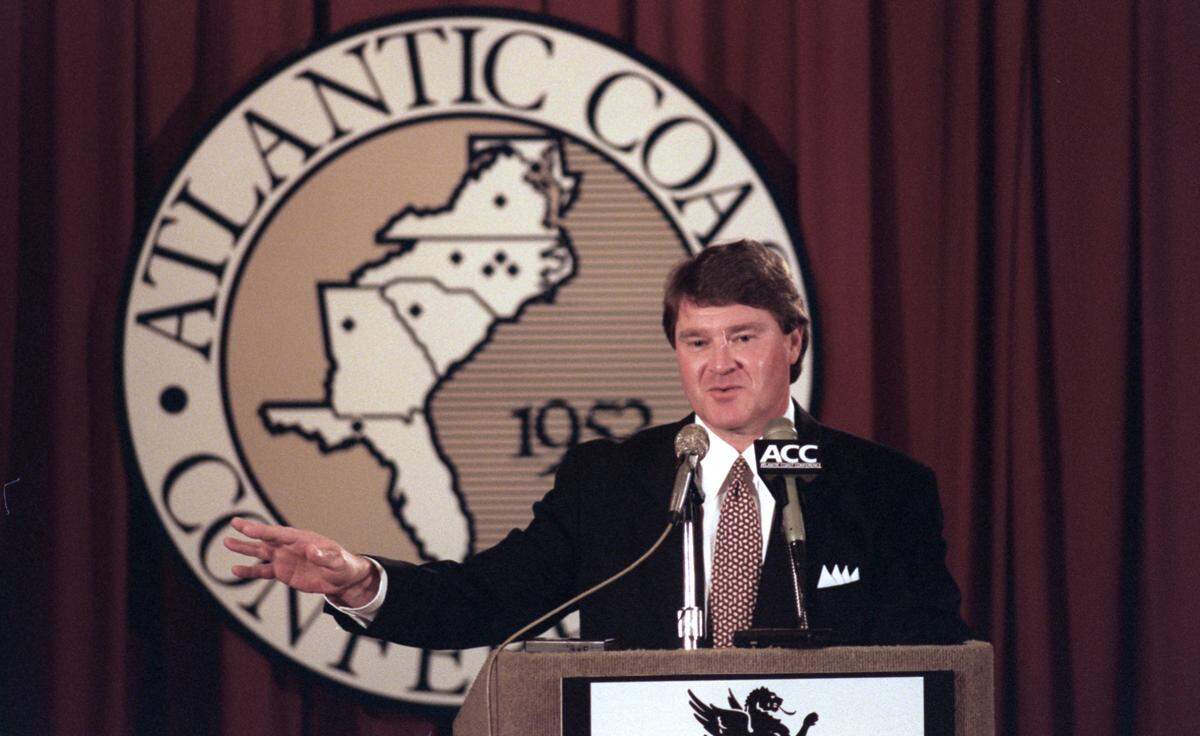
John Swofford, who in more than two decades as ACC commissioner ensured the league’s survival by expanding from nine teams to 15 and launching the ACC Network, will retire in June 2021, the ACC announced Thursday.
The news was first reported by the News & Observer.
Swofford, 71, became commissioner in 1997 after serving as athletic director at North Carolina, where he played football as a Morehead Scholar. A native of North Wilkesboro, he attended Wilkes Central High School and rose to become one of the most powerful figures in college athletics.
Swofford had conference calls with senior ACC staff, athletic directors and the full ACC staff on Thursday morning to announce his decision.
“We’ve had this planned for at least some time right around now,” Swofford told the N&O on Thursday. “We just didn’t know it would be during a pandemic. It’s the right time or us. I’ve really enjoyed what I’ve done in this league as a student-athlete, as an AD as a commissioner.
“I’ve spent my entire career in the ACC and that’s a blessing because I believe it’s the best league in the country. It’s what I grew up with as a kid, so it really has been an honor, a privilege and a blessing to be part of this league for that period of time and see all the challenges and the changes and the adjustments that have needed to be made to keep the league as one of the premier leagues in the country.”
“Nora and I have been planning for this to be my last year for some time and I look forward to enjoying the remarkable friendships and memories I’ve been blessed with long after I leave this chair.”
Earlier this week, the ACC announced it was placing formal control of the conference in the hands of the 15 presidents; previously, it had nominally been controlled by faculty athletic representatives even as the presidents wielded all power. But that was generally viewed on Monday as a long-overdue modernization and streamlining of conference governance, not a prelude to a leadership transition.
Whomever it is will have big shoes to fill. Swofford was the fourth ACC commissioner and he served seven years longer than any of his predecessors. On his watch, the ACC won four national titles in football, seven in men’s basketball, one in women’s basketball and ended a six-decade stretch of futility in the College World Series.
Over his more than two decades in charge, Swofford steered the ACC through a tumultuous era of college athletics, preserving the ACC’s status as a power conference by poaching Boston College, Miami and Virginia Tech from the Big East in the summer of 2003 to expand the conference to 12 teams — over the objection of some ACC schools at the time.
After the conference expanded again in 2011 by adding Pittsburgh and Syracuse and Notre Dame in everything but football a year later, the ACC moved quickly to replace charter member Maryland with Louisville when the Terrapins decided to leave for the Big Ten in 2012.
In the wake of Maryland’s departure, Swofford engineered a “grant of rights” that essentially tied the 15 schools to the ACC in perpetuity, currently through 2036. All of that laid the groundwork for the cardinal achievement of Swofford’s tenure, last August’s launch of the ACC Network in partnership with ESPN.
The financial success of the Big Ten Network and SEC Network pushed those conferences far ahead of the ACC; a bespoke network was essential to the conference’s future viability. The ACC had, years earlier, decided to stick with its traditional syndication agreement with Raycom, which left it playing catch-up in the television department. The new schools and markets made the numbers work for ESPN and the deal was sealed in 2016.
Swofford’s expansion machinations ensured the ACC’s financial future, paved the way for the launch of the network, preserved the ACC’s status as the country’s preeminent basketball conference and — with the rise of Clemson as a national power — burnished the ACC’s reputation in football.
“John Swofford oversaw and successfully navigated the Atlantic Coast Conference through the most dramatic era of change in its storied history,” Duke basketball coach Mike Krzyzewski said in a statement. “Since 1997, John worked to represent the best interests of all ACC institutions, now up to 15 after the latest round of expansion, in pursuit of making the league the best version of itself.”
All of that came at a cost. Maryland’s departure was humiliating for the league, a charter member departing for a more lucrative deal with a competing conference. Meanwhile, seven different ACC schools found themselves in trouble with the NCAA during Swofford’s tenure, including his alma mater North Carolina and repeat offender Louisville, whose recidivism after joining the conference has been a persistent embarrassment. The delays in launching the network, in part because Swofford refused to sever the league’s ties to Raycom, gave the Big Ten and SEC a headstart.
More recently, the ACC’s handling of the coronavirus pandemic during its abbreviated basketball tournament in Greensboro raised questions about Swofford’s leadership. The return of the tournament to Greensboro was a litmus test for the city’s chances of hosting in the future, an effort in which Swofford had considerable emotional investment.
After Swofford indicated the third day of the tournament would proceed as planned in the morning of Thursday, March 12, the ACC was left with no choice but to cancel it when Duke president Vincent Price told Swofford just before noon the Blue Devils were suspending all intercollegiate athletics and would not be coming to the Greensboro Coliseum for their game against N.C. State later that day. The tournament was canceled minutes later, while Florida State was on the floor warming up for the day’s opening game against Clemson.
The tournament won’t be back in Greensboro for another try until 2023. Swofford’s farewell, instead, will be in Washington.
“We are better off because John Swofford touched our university and our conference,” North Carolina football coach Mack Brown said in a statement. “We wish him nothing but the best as he moves onto the next chapter of his life next year.”
Top candidates to replace Swofford include West Virginia athletic director Shane Lyons, Atlantic 10 commissioner Bernadette McGlade and South Florida athletic director Michael Kelly — all former ACC executives — as well as Clemson athletic director Dan Radakovich and NCAA executive and former Florida State athletic director Stan Wilcox. The ACC presidents may also choose to follow the example of the Big Ten, which went outside those with connections to the league to hire Kevin Warren from the Minnesota Vikings last year.
“There are very significant challenges there that, I think, our league is in a very good position to address those challenges going forward because of our membership and the strength of our membership in terms of the quality of schools, the geographic footprint, the strength that those 15 schools have together going forward,” Swofford said. “I do think the league is extremely well positioned to do whatever it needs to do going forward.”
This story was originally published June 25, 2020 at 10:22 AM.