NC college football’s unique relationship with the military, even in divisive times
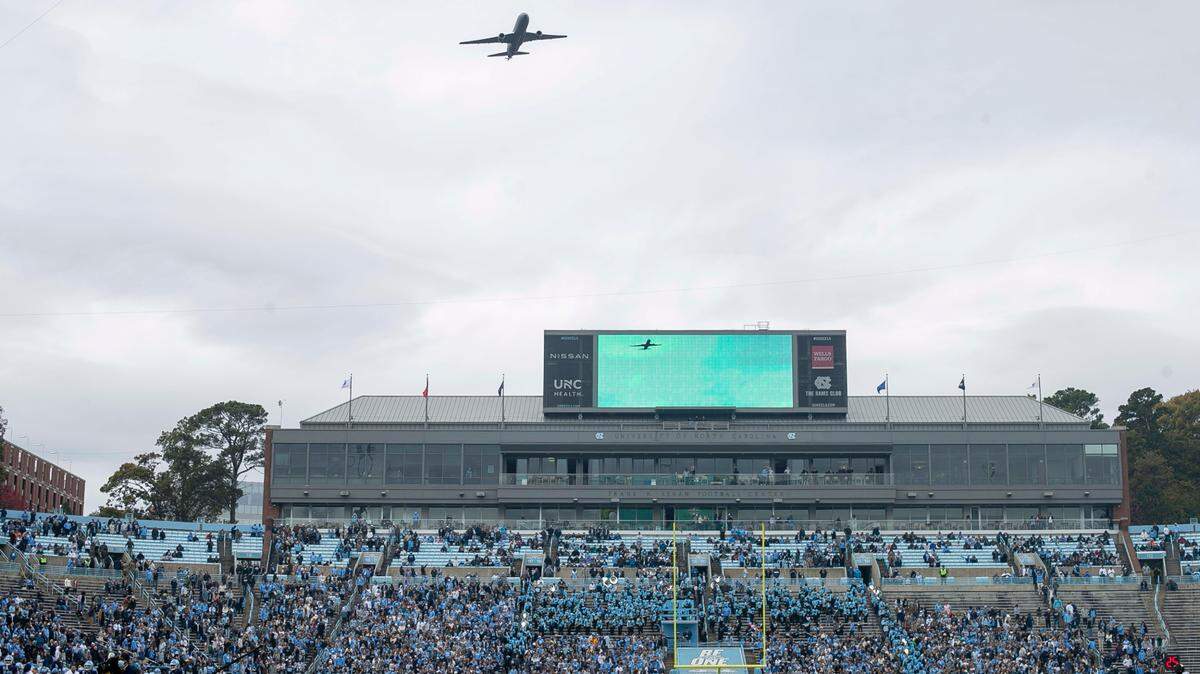
The Boeing KC-46 Pegasus accelerated down a runway at Seymour Johnson Air Force base in Goldsboro and took off at 10:29 on a recent Saturday morning. It was a relatively new plane, the military version of a 767, and one capable of aerial refueling and hauling 65,000 pounds of cargo.
It was painted a greenish-gray, windowless, a machine outfitted with “a number of self-protection, defensive and communication features,” according to the Air Force, that made it “more survivable in a contested environment.” It was on its way to a college football game.
After a few moments, the plane rose to a cruising altitude of 9,700 feet. It flew northwest, toward Interstate 95, then followed the highway before crossing over it while heading west.
It soared over the southern tip of Kerr Lake and into Virginia, briefly, before veering south, toward Greensboro. The plane turned again, southeast now, and somewhere above Burlington flew in an oval again and again — 11 loops while it descended to 2,700 feet.
Finally, it came time. The KC-46 exited its holding pattern and descended to 1,300 feet, then 1,200, and then, at last, to 1,100 feet while it approached and then passed over Kenan Stadium in the middle of North Carolina’s campus. For a second or two, the plane was visible as it flew overhead, west to east, moments before the Tar Heels’ game against Wake Forest.
Then, just as quickly, it was gone. The few seconds of visibility came at a cost of tens of thousands of dollars, paid by the Air Force, which argues that flyovers at sporting events offer an opportunity for crew members to earn flight training hours.
The game began, fans rising from their seats to cheer, while the KC-46 landed moments later at Raleigh-Durham International Airport. The flight spanned 504 miles, the flight path almost a circle, and lasted one hour, 45 minutes. All to fly over a stadium of thousands who might not have realized its presence until it had passed, if at all.
At UNC, it was Military Appreciation Day — one of many college football teams celebrate annually throughout the country and state. Duke and ECU recognized the military at football games on the same day. N.C. State and Charlotte will do so Saturday, before and during their games against Syracuse and Marshall, respectively. Appalachian State held its version, “Heroes Day,” last weekend during its game against South Alabama.
Wake Forest has held multiple flyovers this season and featured military appreciation during its Sept. 11 game against Norfolk State.
In college football, game days devoted to the military have become ubiquitous, as common as displays of the flag, which itself has long grown standard on helmets or uniforms or during the spectacle of pregame, carried out of a smoking tunnel the way, in a different time, a soldier might’ve carried it onto a battlefield.
In America in 2021, sports and the military are intertwined, and have long been. In college football, especially, patriotic displays have become ingrained — so much that most people don’t realize the potential implications or the power of the messaging, said Chris Knoester, an Ohio State sociologist who has studied the relationship between military and sport and its effect on the public.
“A great deal of research has looked at military displays, of militarism in sport, largely from a critical perspective,” Knoester said, “wondering about why those exist and particularly how they might be used — the displays and celebrations — to grease the wheels, so to speak, of going to war or enabling prodigious support for military investments.”
Knoester’s most recent study published earlier this month in the International Review for the Sociology of Sport. Titled Patriotism, competition, nationalism, and respect for the military in US sports: Public recognition of American institutionalized sports nationalism, it examined a separate but related dynamic to sport militarism.
“What we did that was unique in this study,” Knoester said, “is essentially exploring to what extent people recognize the sorts of messaging that occur. Respect for the military being one of them. Also, the extent to which sports teach people about how to be an American, the extent to which people think sports teach them to love their country and the extent to which people think that sports teach them that competition is a way of life.”
The study, based on data from almost 4,000 people who took hour-long surveys, found that the majority didn’t connect military symbolism in sports with the deeper messaging behind that symbolism. It found that most people were unaware of how patriotic displays at sporting events affected them, because they didn’t question those displays in the first place.
“We see all of these military displays (and) we could point to really dozens of reasons for them,” Knoester said. “Our particular area of interest was, you know, do people even recognize that they exist? Because the first step of questioning them or trying to understand whether or not they affect you in various ways is to recognize that they exist. And in our study, we find that over half of people don’t seem to recognize that they exist, that sports teach respect for the military.”
If a person had never before attended an American sporting event and then spent several autumn Saturdays in a college football stadium, the patriotic displays would be difficult to ignore. There would be the abundance of flags, both large and small, and there might be a flyover, too, or even camouflage or flag-themed touches on helmets or uniforms. Soon a question might emerge:
Why is the sport obsessed with the military?
Instead, though, such displays are accepted parts of the pageantry of the sport. Undoubtedly, history has a lot to do with it. The rise of commercialism and the proliferation of televised games have made college football’s military and patriotic undertones more visible, and perhaps more explicit, but the military has played a role from nearly the very beginning of college football.
Andrew McGregor, a historian at Dallas College who focuses on sports, noted that “football and the military have a long history,” one that includes the prevalence of former college football players among Theodore Roosevelt’s Rough Riders in the Spanish-American War of 1898. Coaches often served in military roles, even if they remained at home, throughout both World Wars and “you would be hard-pressed to find a coach during the 1950s-60s without military experience or service,” McGregor wrote in response to questions about militarism of college football.
Then there are all the less tangible ties. The allusions coaches have often made to battle; the comparisons, which critics argue are misplaced, between sport and war. Anecdotally, at least, coaches’ fascination with the military has never waned. A little more than three years ago, Larry Fedora, then the head football coach at North Carolina, argued that football had played a significant part in America’s rise as a global power. A general had told him as much, he said.
At the time, concerns about concussions and CTE were in the news, and a national dialogue was underway about how to make the game safer. Fedora worried football might become unrecognizable in the pursuit of safety and if the game went away, he warned, “our country goes down, too.”
Though the beginning of military flyovers at sporting events is difficult to pinpoint, McGregor tracked it to the late 1960s in the NFL, where then-commissioner Pete Rozelle “made a conscious effort to connect with military symbolism.” McGregor found record of at least one flyover that happened before then in college, before an Air Force-Arizona game in 1964. He found another record of a college football flyover in 1970, before a Texas-Texas A&M game.
“Then you have Vietnam, which is very unpopular, but football remains somewhat supportive,” McGregor wrote. “By the rise of football and TV and the arms race for facilities and money and new apparel deals in the 1990s/2000s, that’s when the commercialism tied to patriotism seems to take off. That’s when you get the uniforms, the more overt celebrations on TV and so on.”
In the days and months after 9/11, American flags and other patriotic displays proliferated throughout sporting events, from high school to the pros. Sports offered an opportunity to come together and express communal patriotism. In the 20 years since, sports have continued to be a conduit to promote nationalism, as Knoester’s study found, even if the public doesn’t often recognize it.
ECU, Duke and UNC all hosted Military Appreciation Days at their home football games on Nov. 6, and at Duke, fans could purchase “special ‘Salute A Soldier’ tickets in our Heroes Corner section for only $10,” with the proceeds going to military families. The UNC men’s basketball coaching staff wore camouflage-themed long sleeve shirts on the sideline during the Tar Heels’ victory against Brown last week. N.C. State’s Military Appreciation Day, meanwhile, is Saturday. A school spokesperson said the university is planning for a pregame flyover at Carter-Finley Stadium, moments before the Wolfpack’s game against Syracuse.
The most overt homages to the military throughout college athletics occur in November, tied to Veterans Day. Like a lot of people, Jeff Sherman, a retired Marine who served as a gunnery sergeant in Afghanistan and Iraq, hadn’t much thought about the deeper meaning behind the patriotic displays at sporting events. One thing he has noticed, given it’s impossible to ignore, is the increasing American political polarization.
It’s a division that calls into question the very idea of what patriotism is. Is it offering blind allegiance to the flag, without questioning how the country could improve? Is it holding America to a higher standard, and fighting to apply the ideals of its founding to minorities who are still striving for equality? Sports have in some ways become a battleground for these competing visions, lines drawn between the “shut-up-and-dribble” crowd and those who better understand why Colin Kaepernick took a knee during the national anthem, leading to his exile from the NFL, which is arguably the most patriotic sports league of them all.
Sherman, the retired Marine and the commander of a local veterans support organization in Cary, served in the Color Guard during military displays before sporting events when he was still in the service. He appreciated military flyovers for their symbolism and potential to unite. And yet he also understood the meaning of the movement Kaepernick started, and the dialogue it helped ignite.
“We don’t understand a lot of the political polarization stuff, quite frankly,” Sherman said of himself and fellow veterans. “You know, we love our country. We love our brothers and sisters, no matter who they are, it doesn’t matter to us. Colin Kaepernick, if he wants to kneel and that’s how he wants to get his point across, you know, great, good for him.
“That’s honestly why we do what we do to live in a free country.”
More than flyovers or commercialized displays of patriotism, Sherman said he’d like to see the country “try to understand veterans a little bit better.” The flyovers might symbolize military might and the large flags, some the size of football fields, might symbolize patriotism as the word is traditionally understood. But they don’t speak to what Sherman and countless others experienced.
“That’s the number one thing that was a big deal for me when I got back,” he said, was the lack of understanding, the disconnect that became evident when he’d notice someone treat an everyday triviality as some kind of a big deal. “You know, people are upset because their cellphones aren’t working and I was picking up body parts two weeks earlier.”
At UNC, the crew that piloted the KC-46 over Kenan Stadium returned for a brief on-field ceremony in the third quarter. Several members had attended UNC, and the flight counted toward training hours, said Laura Gebert, who is the assistant chief of scheduling at Seymour Johnson Air Force base. The Air Force views all sporting event flyovers as training missions, Gebert said, which is part of the justification for the military paying for them.
Gebert was unsure of the exact dollar amount of a KC-46 flyover, but to give an idea, she said, an F-15E costs $15,582 per hour of flight time. The F-15E is a fighter jet, considerably smaller than the KC-46. In addition to cost, another factor the Air Force considers before approving a flyover is the event and the potential size of the crowd that might see it. And then another consideration, Gebert said, is this: “How much is it going to benefit the morale of our guys?”
“Once we get to that point, if it is just a flyover and we can accomplish it from home station and we can include our training into it, it’s generally a go,” she said.
The members of the crew behind the recent flyover at UNC were all part of the reserve unit at Seymour Johnson. Gebert served in the reserves, too, and was also active duty in the Air Force. She has become familiar with the questioning of flyovers, the thought of why they’ve become a regular part of sporting events. At first, Gebert didn’t want to give her response. She doesn’t work in public affairs, after all, and she worried about not being politically correct.
But then she came back to the thought.
“My perspective is the reason why you’re sitting in that stadium, watching this aircraft go over is because of that aircraft,” Gerbert said.
At Kenan Stadium, the KC-46 lifted back toward the low-hanging gray clouds after it passed overhead. Moments later it was gone, out of sight, and the game began.
This story was originally published November 19, 2021 at 6:00 AM.