US Adaptive Open, full of inspirational stories, a reminder of sport at its purest
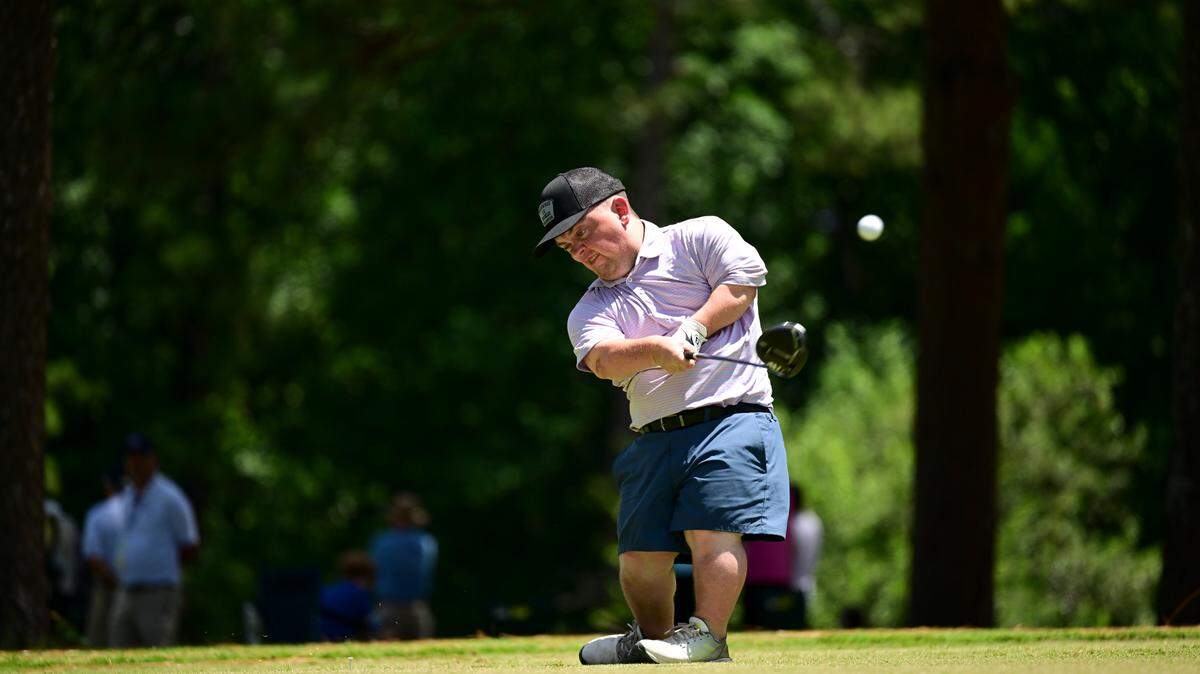
The most memorable part of Conor Ennis’ round here on Monday was not a particular golf shot or putt or par save throughout a long 18 holes on a hot day at Pinehurst No. 6. It was instead, he said, “just kind of sitting back and taking it all in.”
All around him, all around everyone on the first competition day at the inaugural U.S. Adaptive Open, were stories of inspiration and overcoming. Golfers missing one leg, or both, finding strength and balance on prosthetic limbs. Others who’d long learned to swing with one arm.
People who’d lost parts of themselves in wars. Or in accidents. Those, like Ennis, who just happened to be born the way they are, with impairments — neurological or physical or both. As Ennis made his way up No. 18 on Monday afternoon, his wife and his father stood near the green, glancing up at the scoreboard that stood in front of a cluster of tall longleaf pines.
For once in one of the country’s golfing meccas, though, scores hardly mattered. Not in a competition with a field full of those who’d long proven victorious in their larger battles. Ennis, who lived in Raleigh before moving to Wake Forest almost three years ago, was born with achondroplasia, a type of dwarfism.
Yet here he was on Monday, hitting it longer and straighter than most of the enthusiasts who come into town and pay a lot of money to prove themselves or be humbled, and along the way experience a part of American golf history and culture. This was history, too, in a way: the United States Golf Association’s first national open for people with disabilities.
Ninety-six golfers participated — men, women and teens among them — from 11 countries and 29 U.S. states. There was 80-year-old Judi Brush, her left leg amputated beneath the knee due to a club foot, and 15-year-old Sophia Howard, born without a right hand. There was Randy Shack, 38, injured by an IED while serving in Iraq, and Larry Celano, 53, who was shot in the spine when the U.S. invaded Panama in 1989.
There was a former PGA Tour pro, Ken Green, who won five tournaments on Tour and once finished in the top 10 of a U.S. Open. He lost a leg in an RV accident in 2009, and after a lifetime as a professional athlete his world changed in an instant. He’d been at the top, he said here on Sunday, and had competed in majors and the U.S. Amateur and had made a lot of money.
“But that was golf,” Green said. “You were just kind of a stud at golf. Whereas this (tournament) — everyone here has been dealt a bad hand, some numerous hands.
“They use golf to help them get out of the hole, so to speak ... it’s just a perfect way to showcase how people can come back from whatever disasters have befallen them.”
Green, 63, was perhaps the most experienced player here, or at least the one who’d experienced the highest level of the sport. He could remember what life was like before his accident, the way that some of the other competitors could remember how they’d been changed in a moment. Then there were those like Ennis, 31, who’ve never known anything different than what they’ve always endured.
“Everybody kind of has their story,” he said, as he began to share his own.
He grew up with three siblings and is the only person in his family with dwarfism. His parents “made some adjustments around the house,” he said, matter of factly, “but besides that it was kind of figuring it out on your own, like in the real world.”
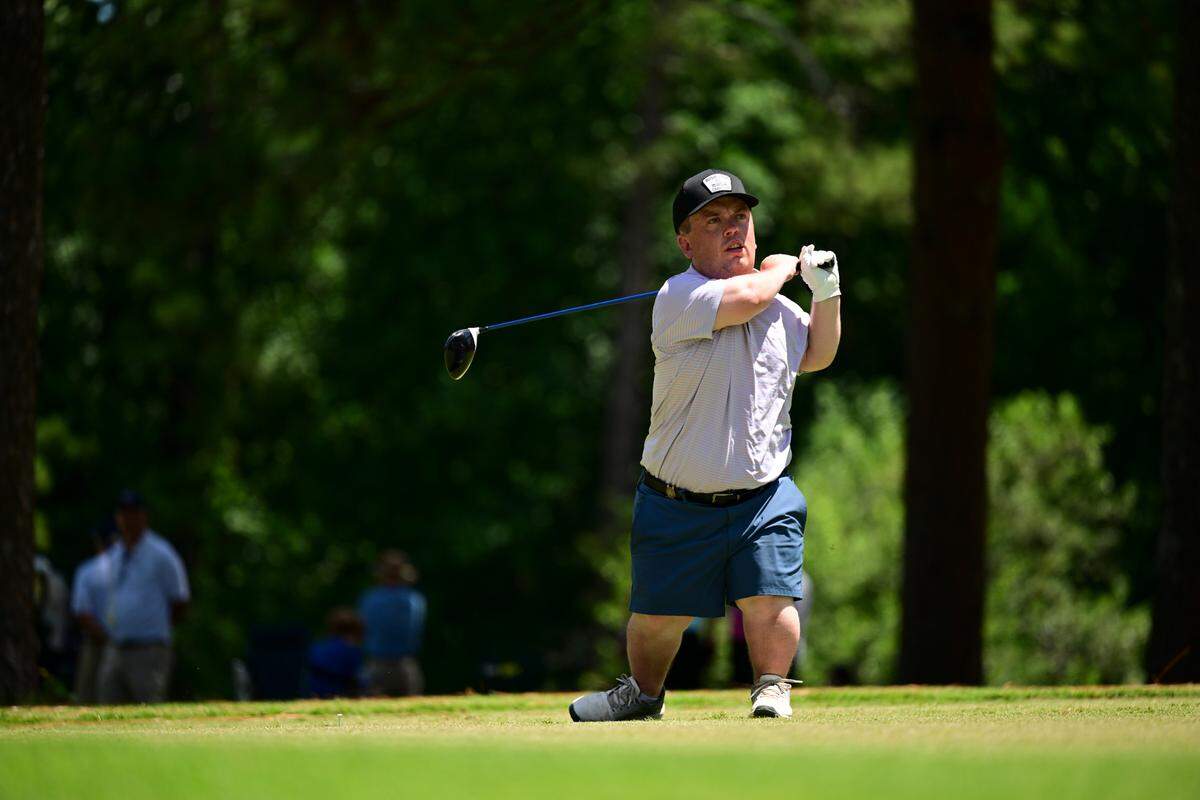
Despite his short stature, Ennis grew up playing any sport he could. He became more serious about golf, though, only in the past couple of years. During the pandemic he joined a local club and began playing more and competing in club tournaments. He worked his handicap down to a 13 and became more and more adept with the modified junior golf clubs he uses.
Ennis, an account manager for UPS when he’s not competing in national golf tournaments, finished with a 94 on Monday, 22 over par — but “I didn’t come here thinking I was going to win,” he said, without a hint of disappointment. “It was more for the experience.”
He spent a significant part of his round in awe of his three playing partners, and especially in awe of Chris Biggins, among the best players in the field despite being born with cerebral palsy. The disability makes it more difficult for Biggins, 30, to walk. Still, he walked all 18 holes while shooting a 2-over 74, which tied him for second among those with a neurological impairment.
“Incredible,” Ennis said, referencing Biggins’ will to walk the course, regardless of how arduous it might’ve been. That was the gift and the power of the Adaptive Open: it made competitors and spectators alike consider the burdens others carry. It provided proof, on every hole and in every grouping, that long odds were no match for endless perseverance.
While Ennis made his way around the course on Monday, his wife and father followed close by. His father, Kieran, could tell stories about the surgeries his son had endured, including a painful one, when he was a child, in which a surgeon had to cut and reset the bones in his legs to prevent them from bowing. Sports were always on the family television at home and even if Ennis’ height proved to be an obstacle “we never stopped him from doing anything,” Kieran said, and indeed he encouraged his son to do everything he wanted.
Ennis then developed a kind of self-confidence that can be rarer for people with dwarfism. That was one of the qualities that his wife, Katelyn, first noticed in him. She was born with achondroplasia, too, same as Ennis, and they’re both a part of an organization called Little People of America (LPA), a non-profit that offers support for people with dwarfism.
“When I was younger, I wasn’t as involved,” Katelyn said, “as far as being in the LPA community. And I think being able to see Conor live the life he does and go out there and do what he does made me realize, like, why should I hold myself back?”
Now she believes Ennis’ journey, and his pursuit of his goals despite his disability, will be an inspiration to their daughter. Shea Ennis is now seven months old, and there was talk on Monday of bringing her out for the final round here on Wednesday, for it’d make a good story one day: a father living out a dream, playing in a national tournament in Pinehurst, while he’d be able to look over on the edge of any particular hole and see his infant daughter.
Conor Ennis never thought anything like this would be possible for him, that he’d play in a national USGA-sponsored event. This is his first. And though he likely won’t be vying on Wednesday to finish near the top of the leaderboard among those in his disability category, that didn’t much matter after the first round.
The “short stature flight,” as the USGA describes it, is one of the eight competition fields at the Adaptive Open, which also includes categories for those with arm, intellectual, leg, neurological and vision impairments, as well as divisions for seated players and multiple limb amputees. That Ennis is out here at all — that any of the 96-member field is out here — is already something of a victory.
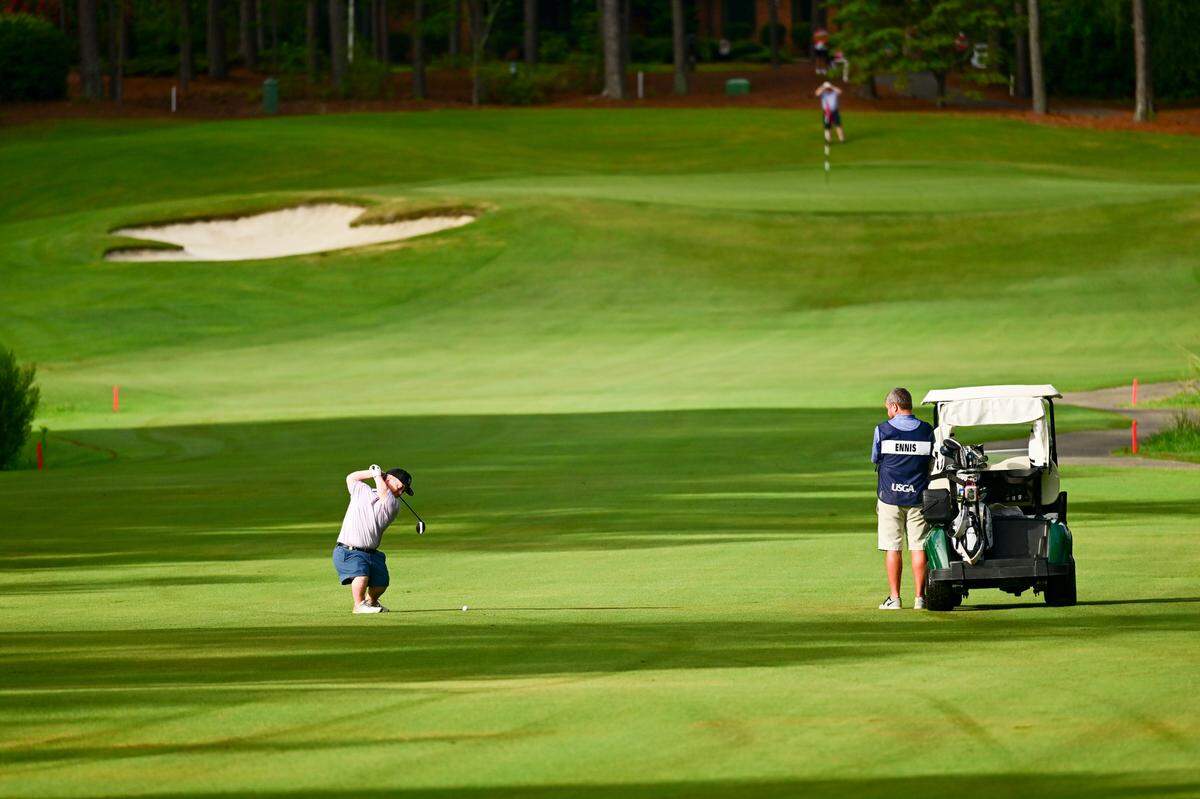
At one point on Monday, after Ennis’ foursome made the turn and the heat began rising near the end of a steamy morning, the group made its way to the 11th green. Ennis lined up a birdie putt, and made it, while members of his family stood in the shade of a nearby pine.
His dad absorbed the scene in front of him — Conor competing; images of resilience on tee boxes and fairways and greens throughout the course. Kieran Ennis stood quietly, looking proud. In the next two rounds he planned on caddying for his son but now he was a spectator, taking everything in.
“What it does,” he said, “it makes you realize how lucky you are in life. Doesn’t it?”
This story was originally published July 19, 2022 at 6:10 AM.