For hope and states: Football provides focus for players living in NC’s poorest counties
Not long after 6 on Friday night, the line was already a dozen deep and growing at Big Jim’s, where yellow paper squares stuck to the wall behind the food counter advertised no less than a dozen specials: a catfish dinner for $6.50; a pork chop sandwich for $4.39; a double bologna burger, with cheese, for $4.99.
The line wrapped around the aisles of what is also a convenience store and a gas station, and many of the people there wore teal Northampton County sweatshirts. Anybody who was anybody made the drive an hour south, where the Jaguars of Northampton County High were playing their most significant football game in the school’s brief history.
Outside Big Jim’s, through the windows and past the gas pumps, the glare of stadium lights shined above the trees and stretched into the darkness. The Warriors of North Edgecombe High were playing their most important football game in quite a while, too, and all week the team’s 32 players fantasized about what it might be like to play for a state championship.
Now the Warriors and Jaguars were one game away. They were playing in the East regional final in the 1A division, home of the smallest high schools in the state and often the most rural. A victory would mean a trip to Durham, to Duke’s Wallace Wade Stadium, for the 1A state championship. The only thing in their way was each other, and four quarters against those from similar circumstances in two of North Carolina’s poorest counties.
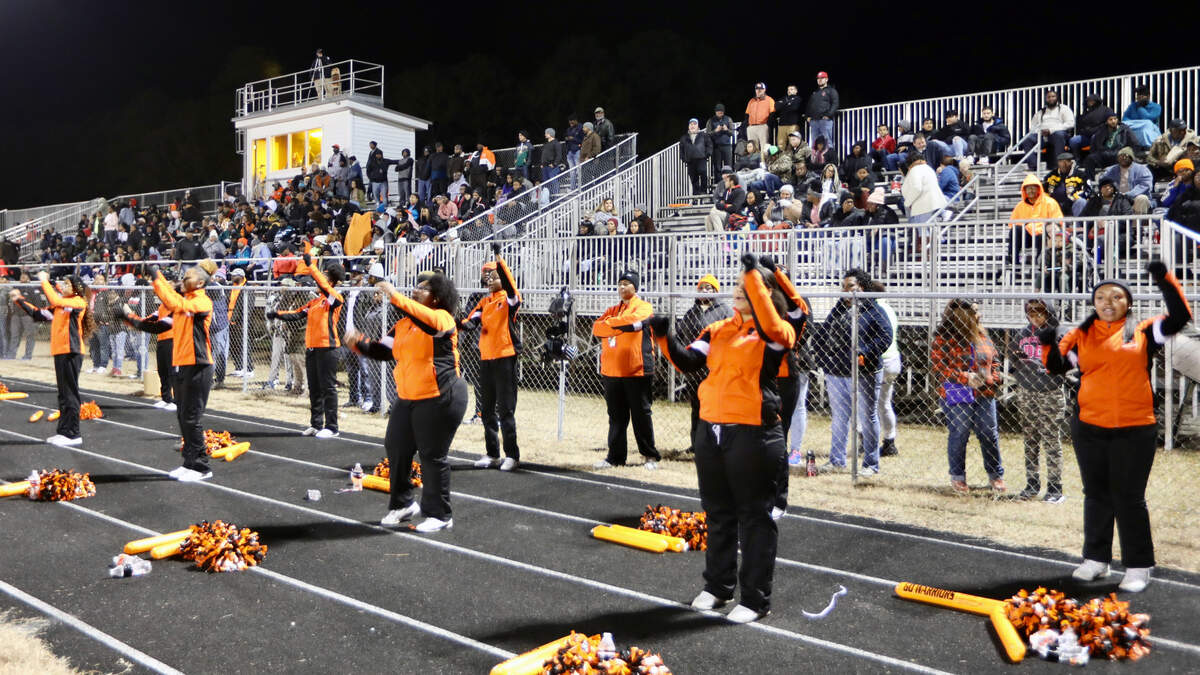
“It’s going to be a once in a lifetime experience,” Saquan Harrison had said earlier in the week. He is a senior at North Edgecombe, an offensive and defensive lineman, and on Friday night he and his teammates put on their orange jerseys and made their way to the field. The cheerleaders had prepared a long paper banner for the Warriors to run through, with a message to the Jaguars:
“Tide will get the dirt out, but this L is permanent.”
The bleachers slowly began to fill. Some came straight from Big Jim’s while others drove down dark country roads until they arrived at the intersection of state highways 33 and 97, the crossroads of Leggett. The town consists of one stoplight, a Dollar General on one corner, the gas station with Big Jim’s on another and, across the street, North Edgecombe High.
Now on Friday night, next to the visiting team bleachers, the Jaguars surrounded their coach, George Privott. He is a stocky man, 43, a former offensive lineman at Elizabeth City State University. He wears his head shaved. He long ago became used to buying meals and equipment for players unable to afford such things but this — coaching in a state semifinal — was something new.
Privott reminded his 42 players of what he’d told them months ago during summer workouts. He repeated an old message: “I’m not going to let nobody outwork us. I promised you if you stuck with me, I’d get you to this point.”
Now here they were. Soon the Warriors ran through that banner while the Jaguars huddled. And soon, for a little while, the obstacles those 74 teenagers faced — whether it was living without one parent or both, or working to keep the lights on, or not knowing where their next meal might come from — faded amid the sound of a whistle and the kick of a ball.
**
At kickoff, players on both sidelines became portraits of youthful exuberance. They jumped and they screamed and the moment they’d anticipated all week, and imagined for much longer, was finally here.
Near the field, spectators in the bleachers and along the fence shouted encouragement in loud country drawls. The Jaguars kicked off first — a short kick that bounced along the grass, and the biggest game any of these players had ever experienced had begun.
**
Outside of places like Edgecombe County, where the lights on Friday night faded into the emptiness of the rural countryside, parts of North Carolina are thriving. The growth in its largest cities, and along its southeast coast, have made it one of the nation’s fastest-growing states.
On the other side of a widening urban-rural divide are places like Northampton County, in the northeastern part of the state along the Virginia border, and Edgecombe County, about an hour east of Raleigh.
People are leaving those counties faster than they’re leaving any others in the state, according to U.S. Census data. Between 2010 and 2018 Northampton’s population shrunk to 19,676, and the 11 percent decline was the largest among North Carolina’s 100 counties. During the same span Edgecombe’s population fell by more than 4,500, the largest decrease of any county in the state.
The head football coaches at Northampton and North Edgecombe, then, defy the long-term trends of their counties: they have not sought an exit. They have remained in part to lead groups of boys who, in the minds of those coaches, are most in need in leadership and guidance.
“I feel like here, I can really make an impact in kids’ lives,” said Jason Miller, the head coach at North Edgecombe. He is 39, with a shaved head and the look of a linebacker. “And kids, as long as you show them here that you love them and care about them, they’ll do anything for you. ... I don’t get the sense that it’s that way everywhere.”
Both Privott and Miller play similar roles, beyond those most associated with coaching. At times they are transportation coordinators, or taxi drivers. Sometimes they find themselves providing meals or equipment to players in need.
Before a recent practice at North Edgecombe, Miller was more athletic trainer than coach. Several players sat on the bed of his pickup while he taped their ankles. At both schools players say similar things about both men, and their significance beyond football.
“My coach, he’s like a father figure,” Elijah Holland, a senior wide receiver at Northampton, said of Privott. “My dad, he died, like, two months ago. But Coach P — he took me in, just like his son.”
At North Edgecombe, Jamoryon Bryant, a junior linebacker, said he’d been “going through stuff” at home that he didn’t want to describe. That didn’t make him unusual among a lot of his classmates, he said, but he and his teammates had Miller.
“We all love him,” Bryant said.
Just as some players said the same things about their coaches, they also described in a similar way the root of some of the challenges their peers encounter in places with few opportunities. In both counties, there are not a lot of jobs. The counties are some of the most impoverished in North Carolina.
The obstacles in Northampton and Edgecombe affect African-Americans, in particular. In both counties, combined, blacks comprise 58 percent of the population. Among the football teams at both schools, 73 of the 74 players are black. Those players might not know the data — the population decreases and the poverty rates. Yet they understand what’s often missing: “A lot of kids, they don’t have their pops around here, man,” Harrison, the North Edgecombe lineman, said before a practice.
One of Harrison’s teammates, Nijel Eatmon, a junior running back, said neither one of his parents are in his life. He lives with an assistant football coach at North Edgecombe, he said, and “that’s what pushes me.”
All over the practice fields at Northampton and North Edgecombe last week, teenage boys could tell similar stories about themselves or each other, stories of going on without the kind of support the most fortunate among them might take for granted. Some without such support found it on those fields. They all knew others who’d never found it at all.
“We’ve got a lot of kids out here, or young men, that don’t play football,” Holland, the Northampton receiver, said. “They do a lot of drugs and gangs and stuff like that. The majority of them don’t have father figures … they feel like they need to join a gang to be loved, or to be a part of something. Well, football for me is my family.”
Northampton High is a product of its county’s regression. Years ago, there were two public high schools there: Northampton East and Northampton West. In 2012, after years of stagnation and population decline, East and West consolidated into one school.
The consolidation left some students with especially long commutes. Some of Northampton’s players, Privott said, are on a bus as early as 6:10 a.m. and face rides as long as 45 minutes. Privott has been at the consolidated Northampton High since its creation in 2012.
“It’s still shrinking,” he said one afternoon last week in the school’s auditorium, which was also a team meeting room and a film room, with a projector casting football plays onto a white wall. In front of Privott, his players were picking new white jerseys out of a plastic bin; the old ones had finally given way to rips and tears during their victory days earlier.
The new jerseys had been meant for a middle school, and so they were tight. Still, the players picked them out with enthusiasm, as if they were gifts, and posed for pictures.
**
Throughout the first quarter on Friday night, the crowd grew larger around the fence surrounding the field at North Edgecombe. The Warriors and Jaguars traded empty drives until North Edgecombe quarterback I’Jheaur Sharpe scored on a short run late in the first quarter.
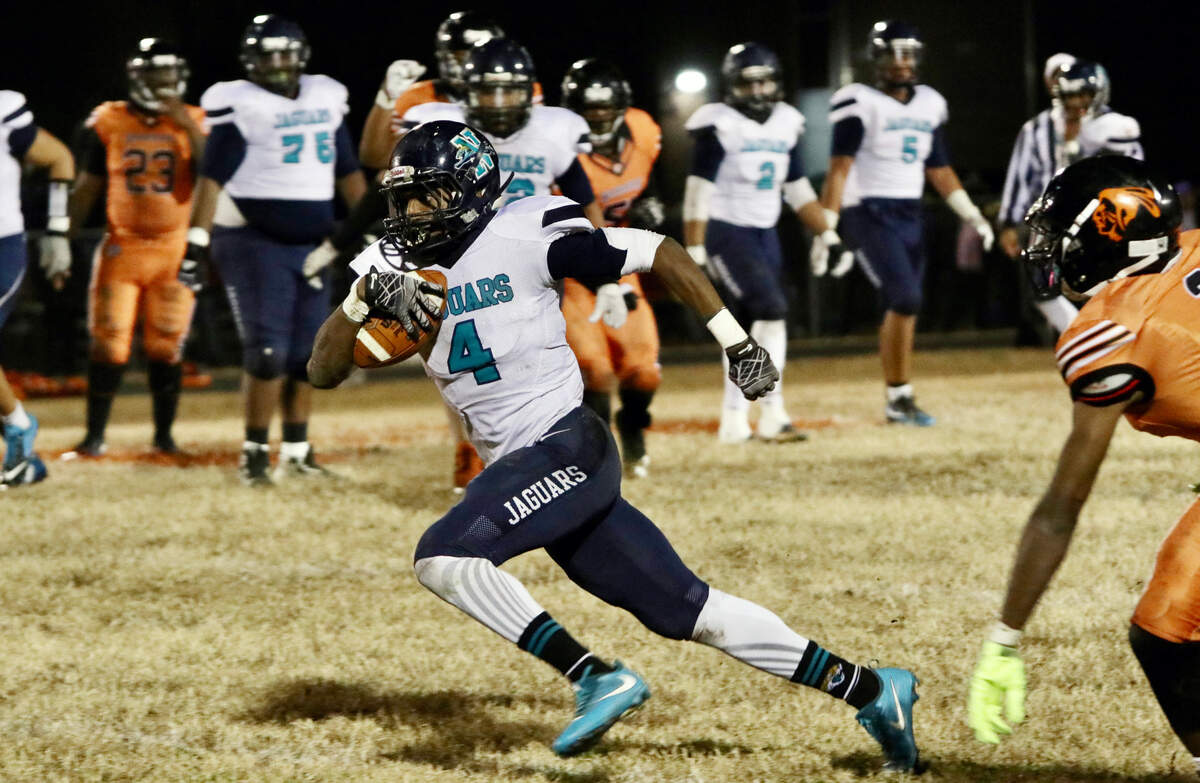
The home crowd roared. Moments later, the Jaguars responded with a scoring drive of their own. Zion Kendall, the Northampton quarterback, tied the game at 6 with a touchdown run. Then Na’Jae Newsome gave his team the lead when he ran for a two-point conversion.
Newsome returned to a jubilant sideline. His teammates embraced him.
**
When Newsome began his senior year at Northampton four months ago, he said he did not have a steady place to live. While he told his story one day before practice, he looked around the auditorium, at his teammates trying on their new jerseys and at the film playing on the wall.
“The only thing keeping me straight is this,” he said of his team, and his teammates. “I love it. Love it too much. I just love the guys so much. They’re willing to help me out. And I’m willing to help them by toting that ball for them.”
Newsome, 18, is a senior and the Jaguars’ starting running back. Several of his teammates said he was the player who most personified the kind of grit necessary to face the challenges of Northampton County, which has the 10th-highest poverty rate of any county in the state.
In Northampton, 25.4 percent of people live below the poverty level, according to the most recent U.S. Census data. Edgecombe is right behind at 11th in the state, with a poverty rate of 24.6 percent. In both counties, about 40 percent of people under the age of 18 live in poverty.
Newsome’s story brings life to the data. He started that story like this:
“I’m going to be honest,” he said. “I was kind of homeless.”
For a while, he said, he slept in a car, or on the floor of his grandmother’s small house. He tried living with his mom, but Newsome said she fought addiction and that he needed a new place to live. Finally, he said, he and his dad found a modest house in Seaboard, about a 20-minute drive from Northampton High.
“We wanted better,” Newsome said, “but it’s better than nothing.”
The house is big enough for only one bedroom, Newsome said, and so he and his dad share it. Newsome works part-time at the West Fraser sawmill — the same place his dad worked before learning, as Newsome described it, “that he was allergic to the sawdust.” And so now his dad is disabled, and Newsome picks up shifts so he can pay the electric and water bills.
Sometimes it means missing practices. Sometimes, if money is tight, it means missing classes.
“Whenever my boss needs me during the week, I talk to my principal, and he tries to work around my schedule,” Newsome said. “I (tell) him, me and my dad have to get the light bill right, so I’m going to have to be out of school on this certain day and stuff. But he works with me.”
At the sawmill factory, Newsome makes $11.50 an hour. If he works long enough shifts, he can earn almost $200 in two days and “that ain’t bad,” he said. He’d like to go to college but said he began his first two years of high school “with terrible grades” while he tried to overcome instability at home.
Eventually, football provided Newsome structure and routine and he came to appreciate the instant gratification it provided: “A good feeling,” he said, “just hitting somebody and just hearing your coach out there saying, ‘Good job.” On Friday night, months after starting his senior year without a home, Newsome gave Northampton a lead it fought to maintain.
**
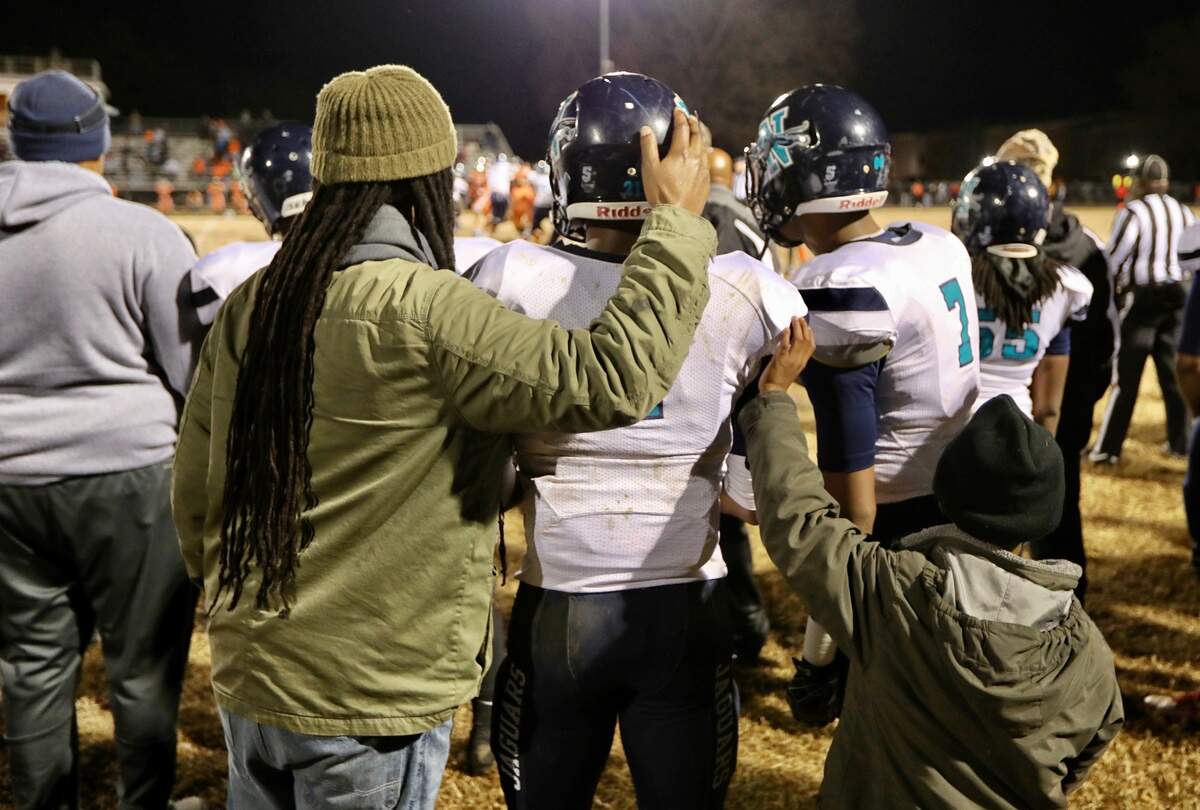
Both teams’ defenses dominated the second quarter. At halftime, Newsome’s two-point conversion was still the difference. Northampton held an 8-6 lead. Privott gathered his players and said, “Y’all need to wake up.” An assistant coach reminded them: “There is no tomorrow.”
Across the field, Miller, in his second season as the North Edgecombe head coach, tried to inspire his players. In the bleachers on the home side, a man in a North Edgecombe hoodie stood on the top row and told the Warriors they didn’t want it enough.
A makeshift pep band, full of North Edgecombe alums, pounded drums. The second half began.
**
Among the oldest of the 74 players on the Northampton and North Edgecombe football teams, none are being recruited to play major college football, or even non-major college football. There are no heralded prospects among the juniors and seniors, and likely not among the freshmen and sophomores, either.
Many of the players are smaller than those at the bigger schools, in bigger areas. The coaches, meanwhile, don’t wear headsets to communicate with each other -- a common sight at larger schools. At North Edgecombe, the scoreboard lights were missing a bulb or two, which only added to the aesthetic.
In some ways, 1A high school football is befitting of a simpler time and place, one where every little town might have had its own version of Big Jim’s, with people lined up for bologna burgers or catfish dinners. Now those places seem to be slowly disappearing, along with whatever opportunities they once might have provided.
For Privott and Miller, then, the hope for their players is not necessarily a college scholarship, or even that they might be a part of a lot of victories. More than anything the hope is that these practices and Friday nights help generate hope, amid all the data and everything else that gives their kids reason to doubt.
At Northampton High, nearly 90 percent of its students are behind academically before they arrive, according to North Carolina Department of Instruction data. Only 11.1 percent of ninth-graders are defined as proficient when they enter the school. The state defines proficiency as achieving grade-level performance in math and reading. Northampton is a D school, according to the state, and has been for the past five years.
Noah Rogers, in his first year as Northampton’s principal, declined to be interviewed for this story. A spokesperson for the school district emailed a statement from Pamela Chamblee, the superintendent: “Our young men are building momentum and inspiring others through their athletic success,” she said. “... Our goal is to keep our students focused and align their success on the field with their success in the classroom.”
North Edgecombe, meanwhile, was a D school as recently as 2017. But its performance scores — a measure of test scores and other data — have improved for three years. It’s now a C school, and the improvement was cause for the celebratory message on the marquee out front: “HIP HIP HOORAY! NORTH EDGECOMBE EXCEEDED GROWTH 3 YEARS IN A ROW.” Yet there, too, only 5 percent of students entered the school as proficient.
At both schools the rate of what the state describes as “economically disadvantaged” students is higher than the state average — nearly 50 percent at North Edgecombe and nearly 64 percent at Northampton. The state defines economically disadvantaged students as those eligible for free or reduced-price lunches under the National School Lunch Program. And at both schools, the four-year graduation rate is lower than the state average — 78 percent at North Edgecombe and 72 percent at Northampton.
And so that is the first priority for Privott and Miller: that their players graduate and give themselves a chance. And then?
“For me, I want them to go to college,” Privott said. “Some of them, with us being a poverty-stricken county, one of the most low-performing, academically, schools in the county — getting them to college is my role. It’s what I want for them.
“But a lot of them know ... they’re seeing that they goofed off early on, looking at their GPA and they’re like, ‘I can’t go anywhere like this.’ So a lot of them have already said, coach, I know I goofed off, I know nobody’s going to look at me, and help me get into a junior college.”
At both Northampton and North Edgecombe, the pool of football players is no longer large enough for junior varsity and varsity teams. There is now just a varsity — leaner and shorter freshmen and sophomores alongside seniors. At North Edgecombe, Miller said there hasn’t been a junior varsity since flooding from Hurricane Matthew displaced some students in 2016.
Both coaches have seen participation decline, meanwhile, amid safety fears — though, anecdotally, at least, those don’t seem to be as prevalent as in more affluent parts of the state. (In recent years some high schools in Orange County, home to UNC-Chapel Hill, have not fielded football teams due to lack of participation).
At North Edgecombe and Northampton, players struggled to describe what their lives would be like without football. One, North Edgecombe senior running back Erick Moss, said some would “probably be at home, chilling, or doing something they ain’t got no business doing.” For many it provides structure they might otherwise lack.
**
The Jaguars’ drive to start the second half lasted more than eight minutes. It ended with a touchdown that gave them a 14-6 lead entering the fourth quarter. Less than two minutes into the quarter, though, North Edgecombe cut its deficit to 14-12 on Devonte Barnes’ short touchdown run.
The people in the bleachers, many of them native to these counties, began to stand. Every play felt more important than the last.
**
In front of the visiting team bleachers on Friday night, Ivan and Tony Clayton stood near the fence, walking the length of it to follow the game. They’re both Northampton natives and graduates of Gaston High, which closed long ago, and both can recite moments from their glory years on the high school football team.
These days Ivan Clayton, 57, is the self-described “number one fan” of the Jaguars. He has been going to high school football games in Northampton County for 25 years, he said, and he spent most of Friday night screaming encouragement from the fence: “DEFENSE GUYS ... HIT ‘EM ... TOO MANY YARDS ... GET HIM ... LET’S GO.”
“We’re trying to make it to the states,” Ivan said, his voice raspy, and he knew it’d been a long time since any team in the county had a chance to make it as far as this one. His brother, Tony, 58, stood by more quietly. Back in 1979, he said, he made the state’s All-East team, but decades later he said he remembers the feeling football gave him more than the accolades.
“It gave us positivity to do better on this Earth, man,” said Tony, who said he works in a food processing factory. He looked out on the field in front of him, at the kind of scene he’d been a part of 40 years earlier. “It’s good for the kids because it gives them hope, man.”
The seconds ticked away on the scoreboard and, on both sides of the small stadium, people stood in the bleachers early in the fourth quarter. It was a two-point game, Northampton with a 14-12 lead but now, after a Jaguars turnover, North Edgecombe threatened to take the lead. The Warriors had possession deep in Jaguars territory when North Edgecombe attempted a rare pass.
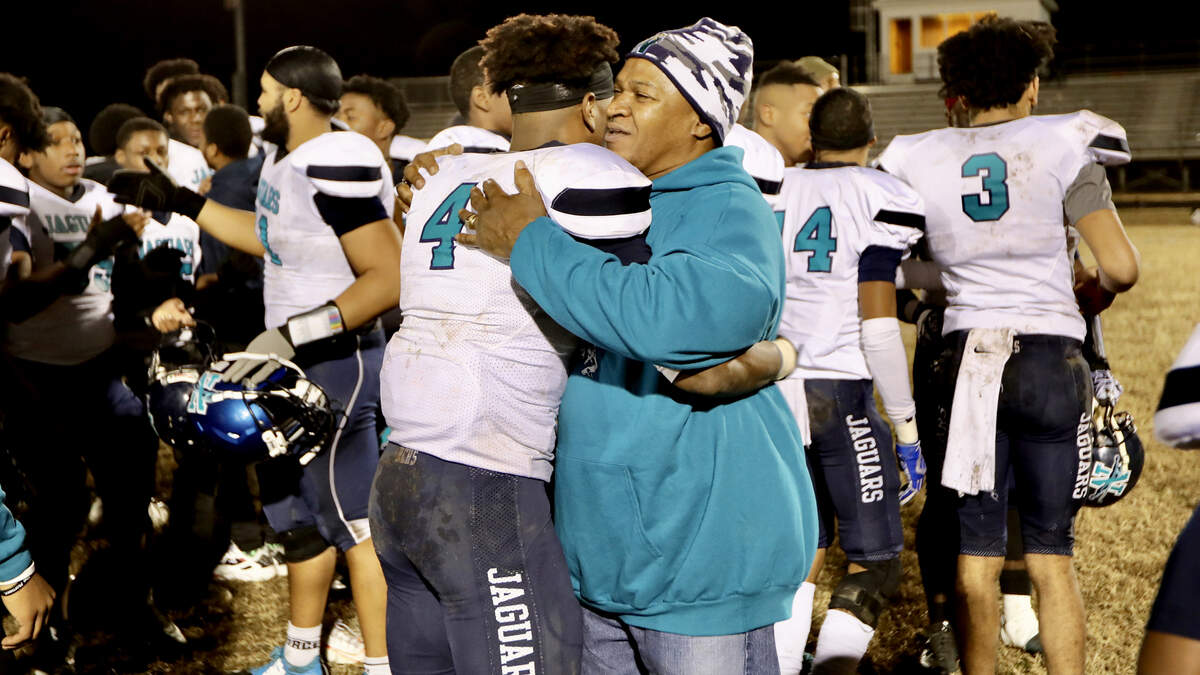
Chad Broady, a 5-foot-6, 160-pound junior defensive back for Northampton, positioned himself for the interception. He caught it and returned it for a 95-yard touchdown. Northampton’s lead grew to 20-12 with eight minutes remaining. The Jaguars’ defense held and their offense ran out the clock, and when it ended they emptied their water bottles over Privott, who’d bought a lot of them meals over the years, and equipment and, to many, had become more father than coach.
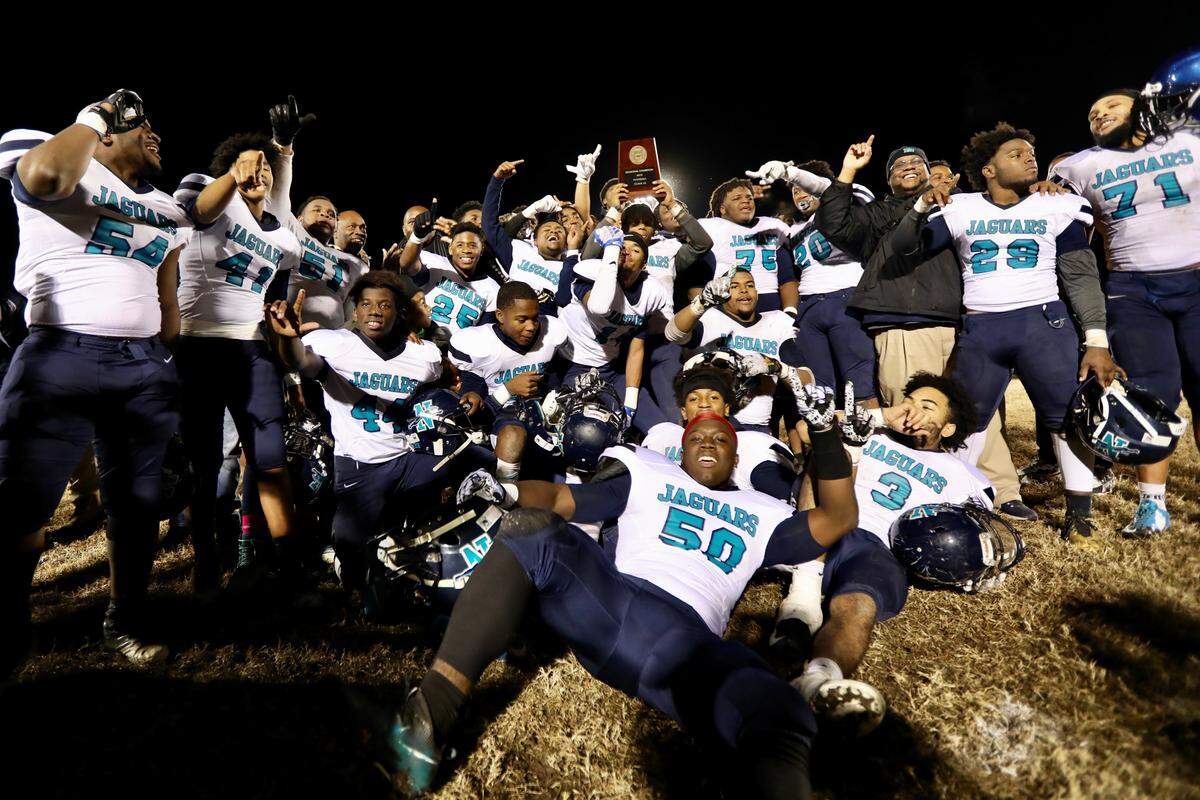
Then the players celebrated while some of the cheerleaders spoke softly about going to Durham for the state championship, and one of them heard that the state even paid for a hotel for everybody. And when the players received a the trophy for winning the east region, they posed for pictures, smiles wide, and a lot of them held up their index fingers to say they were No. 1.
And a lot of them knew that Northampton County isn’t often No. 1 in anything and if it is, it might be for things that aren’t good. But now, for one Friday night, the Jaguars were No. 1 on the field and they had this moment they’d remember forever and they were going to states.
This story was originally published December 12, 2019 at 2:15 PM.