Hurricanes coach Rod Brind’Amour addresses perceived penalty disparity, NHL analytics
.JPG "Washington Capitals’ Anthony Mantha (39) takes Carolina Hurricanes’ Jordan Staal (11) off his skates during the first period of an NHL hockey game in Raleigh, N.C., Friday, March 18, 2022. (AP Photo/Karl B DeBlaker)")
In the age of analytics, some NHL coaches rely on them more than others.
Rod Brind’Amour of the Carolina Hurricanes is not one of them.
”Analytics have been around for 100 years, it’s just now they put it on paper,” Brind’Amour said this past weekend. ‘With the analytics, you know from coaching or playing that you want to score on the rush. You know on the power play you have to go east/west. Because you’ve done it enough and you’ve watched it enough that you know that’s what has to happen.
”I don’t need some handy piece of paper to tell you that has to happen. Now, it’s nice to see that and say, ‘Oh, yeah, good, thank you.’ But you kind of know all this stuff already.”
‘Good nerds’
That’s not to say that Brind’Amour is some old-school hockey dinosaur who judges everything on an eye test. The Hurricanes have an analytics staff headed by assistant general manager Eric Tulsky that is highly respected in the league.
Every game, by every NHL team, is analyzed to the nth degree. Puck possession, zone entries, scoring chances ... it’s all there. There’s a breakdown for how many feet each player skates per period, who had the hardest shot, longest shift, you name it.
Boston Bruins coach Bruce Cassidy recently referred to his analytics staff as “good nerds” in praising them. He noted the Bruins’ analytics people prepare 10-game sample sizes to track trends — good, bad or indifferent.
Cassidy, talking with the Boston media, quipped that the analytics staff keeps adding new columns to their reams of statistics, joking that’s fine because it “keeps them busy, keeps them upstairs and not downstairs.”
Brind’Amour appreciates the work done by the Canes’ analytics staff, especially in looking at a team — the Minnesota Wild, for example — that Canes only play twice a season. An analytical breakdown can help put together a scouting report.
”Then it’s kind of like a cheatsheet,” Brind’Amour said.
Canes captain Jordan Staal said he rarely looks at the analytics, noting players “understand the game they’ve played and the extra stuff, we let the (analytics) guys figure that out.”
It can only help so far. An analytical breakdown on Wild star Kirill Kaprizov might tell you a lot about the winger’s tendencies, then you get on the ice and he beats your No. 1 goalie with a world-class shot from a tight angle. Kaprizov did that Saturday in the Wild’s 3-1 win over the Canes at PNC Arena, beating Frederik Andersen.
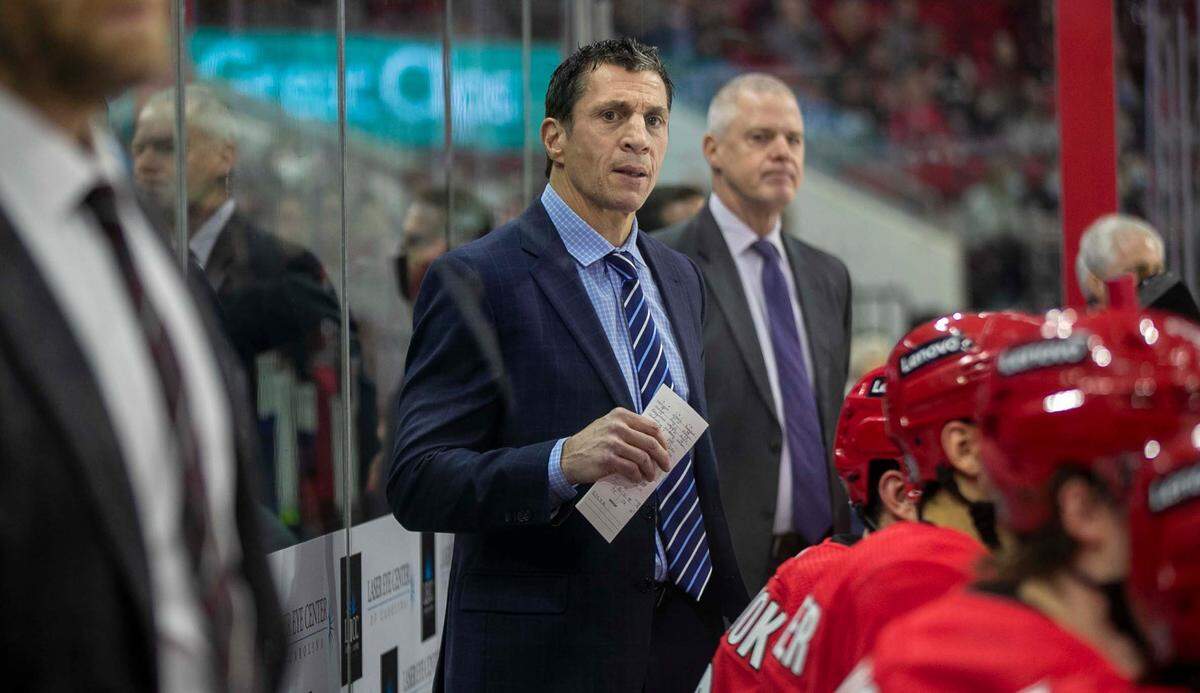
”If truth be told, all the coaches if they’re relying on that, they’re fooling themselves,” Brind’Amour said. “They know already what’s going on. This is just a tool.”
Canes penalty disparity
There are some analytic trends that catch Brind’Amour’s eye. A recent story by TSN’s Travis Yost on NHL penalties noted the Hurricanes and Colorado Avalanche, two of the league’s best teams, are “polar opposites” in penalty differential in the past three seasons.
The story noted the Avs then were plus-96 in penalties — those committed vs those drawn — and the Canes minus-83 in the three seasons, despite both teams being highly skilled and playing a fast-paced game. It called that disparity a “significant gulf” and “staggering.”
The biggest disparity was in hooking calls. The Avs were plus-34 and the Canes minus-27 in that category. The biggest for the Canes: They had been called for holding 83 times while drawing 52 holding calls from 2019-22.
“It blew my mind,” Brind’Amour said. “It is what it is. It’s been a little frustrating for our group. I think we own the penalties we take. I don’t really complain too much about the amount of penalties we take. I don’t like taking penalties, but it’s rare when I say, ‘That’s a bad call.’
”I think it will even itself out. If I go back seven years to when we weren’t very good, I was running the power play and we always had more power plays. Now it’s turned the other way. The drastic part (disparity) is what is shocking but it we revisit this in three more years it will probably be even.”
Brind’Amour noted Andrei Svechnikov, who plays a power game, has been flustered at times and reacted when calls are made against him but opponents, in his mind, aren’t called for the same infraction. Svechnikov, after Sunday’s games, was minus-9 in penalty differential.
”He’s his own worst enemy at times, but he’s gotten better,” Brind’Amour said. “It’ll all even out.”
Of note: The TSN story appeared March 30. In the Canes’ two games since, against Montreal and the Wild, the Canes have been called for five penalties and opponents six penalties.
This story was originally published April 4, 2022 at 2:09 PM.