Carolina Hurricanes push back at ‘soft’ talk against Flyers, in all the right ways
No one dropped the gloves at puck drop Saturday night as the Carolina Hurricanes opened their second-round series against the Philadelphia Flyers with a 3-0 shutout win.
For most playoff games, that would track. Playoffs get physical, yes, but fights? Off the opening faceoff? Almost never.
Thing is, Ottawa tried that in Round 1, Game 1, when Senators captain Brady Tkachuk asked, and Canes captain Jordan Staal obliged. And that was on brand for Ottawa, which had players drop the gloves 21 times in the regular season.
But for the Canes? That was fight No. 9 of the season. For those keeping track at home — and many are — that’s easily the lowest fight total in the NHL. The next closest? Colorado, with 10 in the regular season. In fact, 19 teams in the NHL had more fights by themselves than Carolina and Colorado combined.
What do Carolina and Colorado have in common? Only that they were the top two teams in the NHL’s regular season, locking down the No. 1 seeds in their respective conferences.
It doesn’t always work out that way, of course. Plenty of physical teams have succeeded in the NHL’s regular season. But it does at least temporarily silence those who believe physicality is the only way to success.
Playoffs are different, though. Any player, coach or executive with playoff experience will tell you that element of the game ramps up in the postseason.
And that’s been a knock on the Canes in recent years, despite their ability to make the playoffs in eight consecutive seasons. Depth, timely goaltending and toughness, mostly in that order, have been the team’s sticking points.
It’s possible, in one fell swoop, that this year’s edition of the team has proven it has overcome all of those — certainly the “tough” factor.
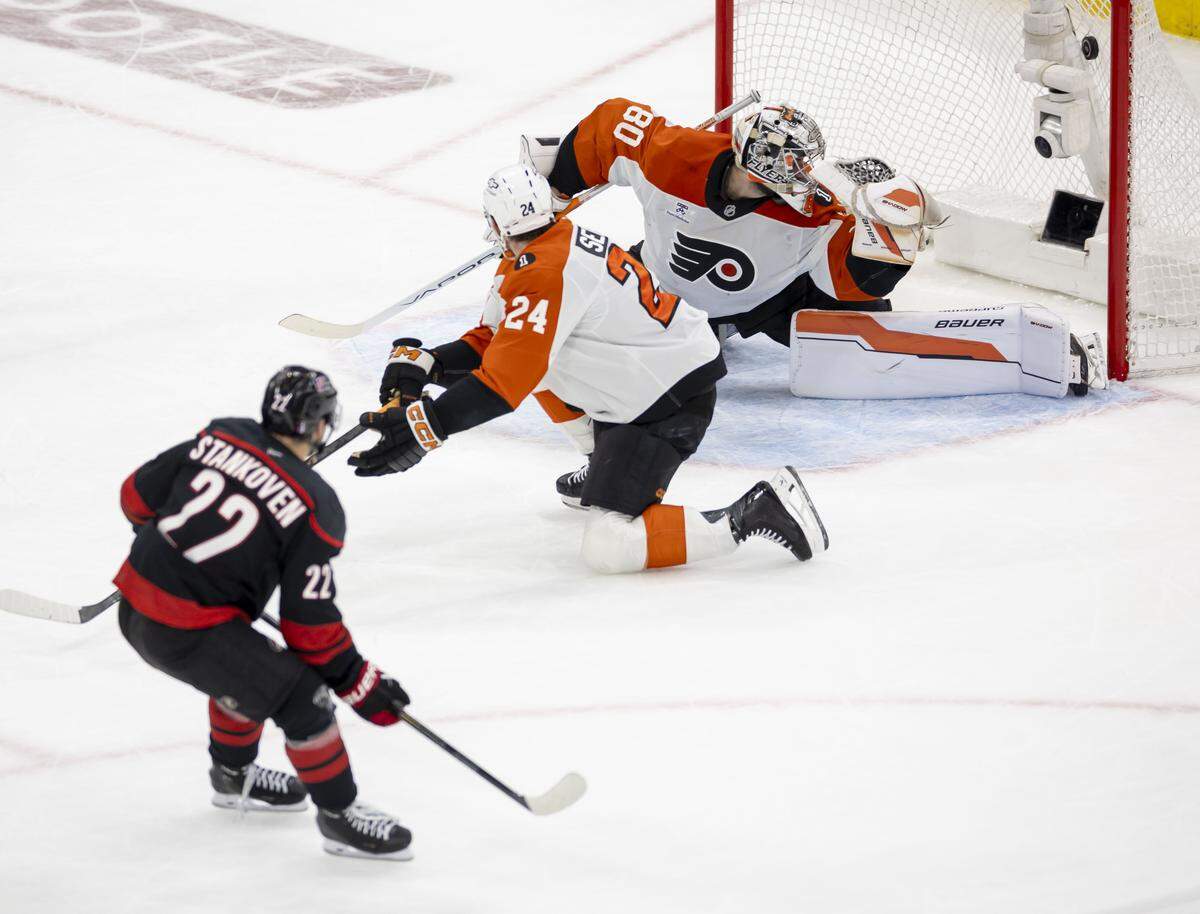
That was evident in Game 1. Logan Stankoven scored twice more — his fifth and sixth in five playoff games — and became the youngest player in NHL history to begin the Stanley Cup Playoffs on a five-game goal streak, as the Hurricanes rumbled past the Flyers on a supercharged Saturday night in Raleigh.
Frederik Andersen, as he did in Game 1 against Ottawa, looked fresh, stopping 19 shots in the shutout.
The Hurricanes locked the Flyers down early, allowing just four shots on goal while absorbing 17 hits in the opening period. Most importantly for Carolina, it also scored twice on 12 shots — Stankoven and Jackson Blake with the honors — while dishing out 12 hits and killing two penalties.
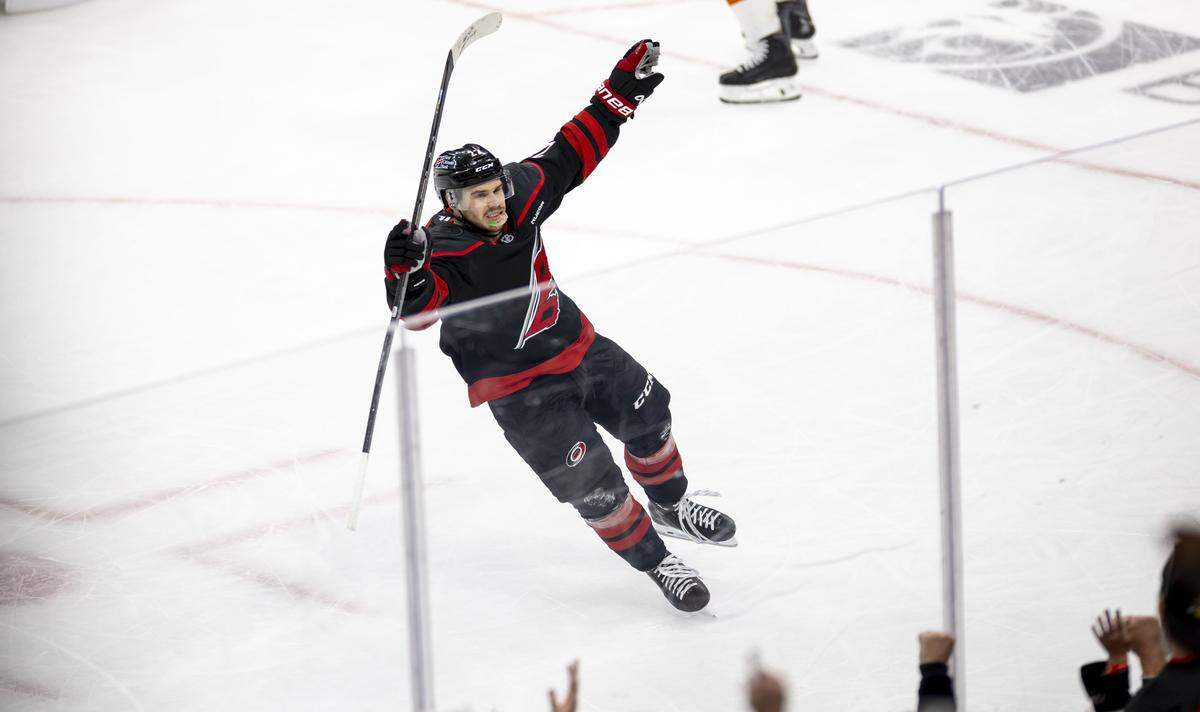
The Flyers, trying to find a spark, also outhit the Canes in the second, 13-6, and Tyson Foerster took a whack at Andrei Svechnikov’s knee for good measure late in the frame, for which he was assessed a penalty. But Stankoven added his second of the night to push the Canes’ lead to 3-0.
In the third, Taylor Hall smushed Christian Dvorak into the boards early in the period, again setting a tone that the Canes were not going to lay back — offensively or physically. Hall’s hit drew a small crowd, but officials didn’t blow a whistle and play continued.
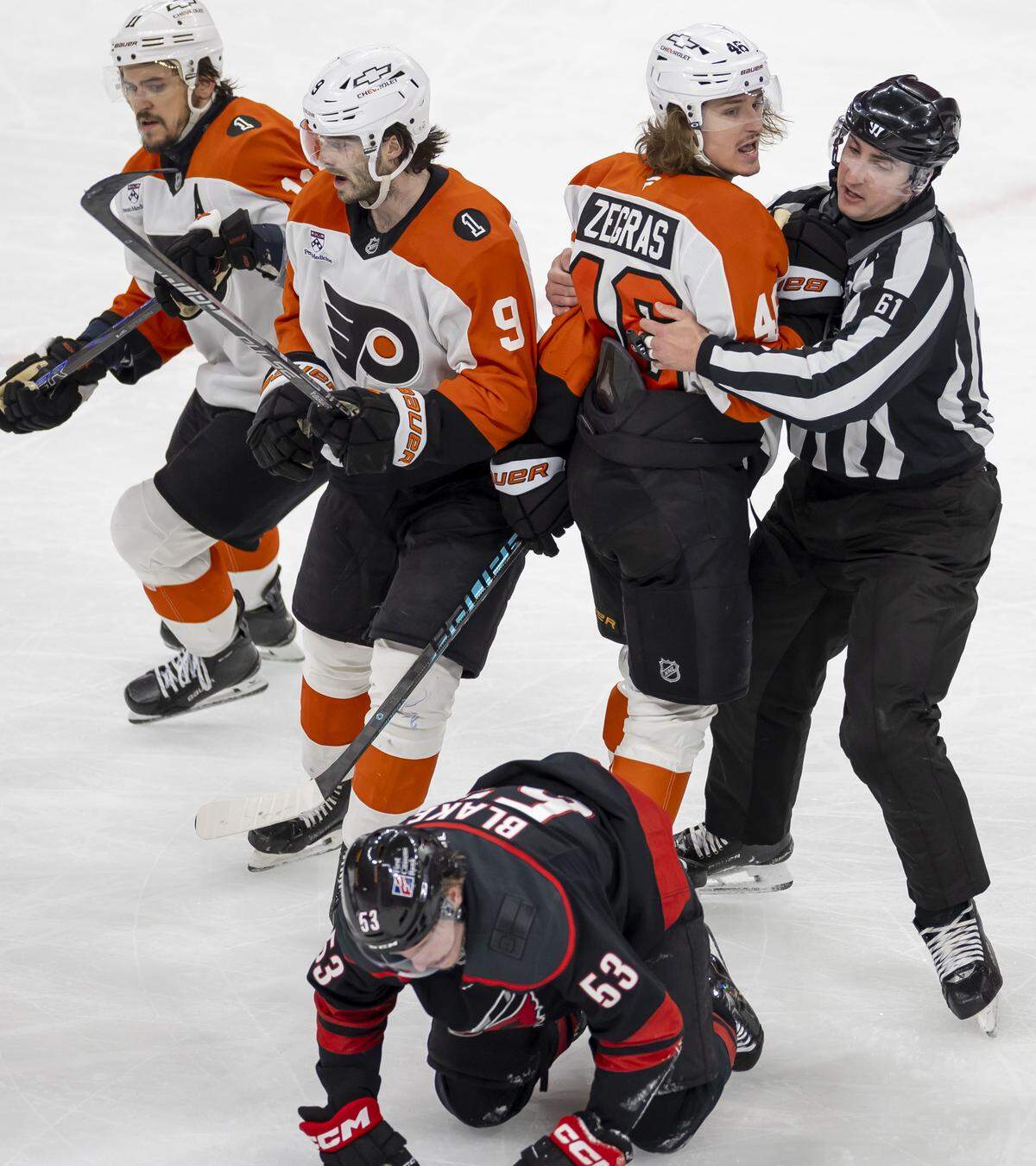
Later in the third, Blake and the Flyers’ Trevor Zegras jousted their way down the ice. Zegras picked up an extra minor, both were assessed misconduct penalties, ending their nights. Carolina defender Shayne Gostisbehere and Flyers defender Nick Seeler also exited after matching misconduct penalties as officials tried to maintain control of the contest.
Hurricanes match teams’ physicality
The Hurricanes’ ability to play physical — yet mostly clean — hockey has been on display all season, and the raw numbers back that up.
After Sunday’s Game 7 between Montreal and Tampa Bay (Has there been a more entertaining series in the past two years? I would argue “no”), there will be eight teams remaining in the 2026 Stanley Cup Playoffs. But, given they’re both technically still “in,” we’ve included them here for analysis.
Tampa, in a complete reversal of a year ago, led the league with 44 fighting majors and, as a result, 1,207 penalty minutes. But those altercations aside, the Lightning were actually in the middle of the pack in hits per game at 19.82. They are an outlier, in terms of fights and penalties per game among remaining playoff teams, but right there among those with a higher total of hits.
Of the nine remaining playoff teams, Carolina is seventh in penalty minutes assessed per 60 minutes, sixth in total penalty minutes, seventh in hits and as previously mentioned, ninth in fighting majors. Colorado, the gold standard for success in the NHL this season, is ninth, seventh, ninth, and eighth.
The Flyers — whom the Hurricanes/Whalers had never faced in a playoff series prior to Saturday night — have earned a reputation over the years as a rough-and-tumble team; the Broad Street Bullies in their early years, the Legion of Doom some 30 years ago. The Hurricanes’ own head coach, Rod Brind’Amour, knows that latter group well.
This season, the Flyers were fourth overall in the NHL in hits per game with 22.46, just one place behind Ottawa, the Hurricanes’ first-round opponent. They were fourth in fights (25), seventh in total penalties taken (322), and ninth in penalty minutes (785). Among remaining playoff teams, Philly was tops in total hits, fourth in penalties and third in fights.
Saturday, the Flyers started the game having been assessed 96 penalty minutes over six playoff games, an average of 16 per game. The Canes had 47 minutes in four games, a shade fewer than 12 per game. It was Carolina, though, that went to the box early in Game 1, taking two penalties to Philly’s one in the opening frame.
Amid the parade to the penalty box in the third as the Flyers tried to scratch and claw their way back into the game, the Hurricanes again held their own, responding in kind when challenged, dishing out hits when warranted.
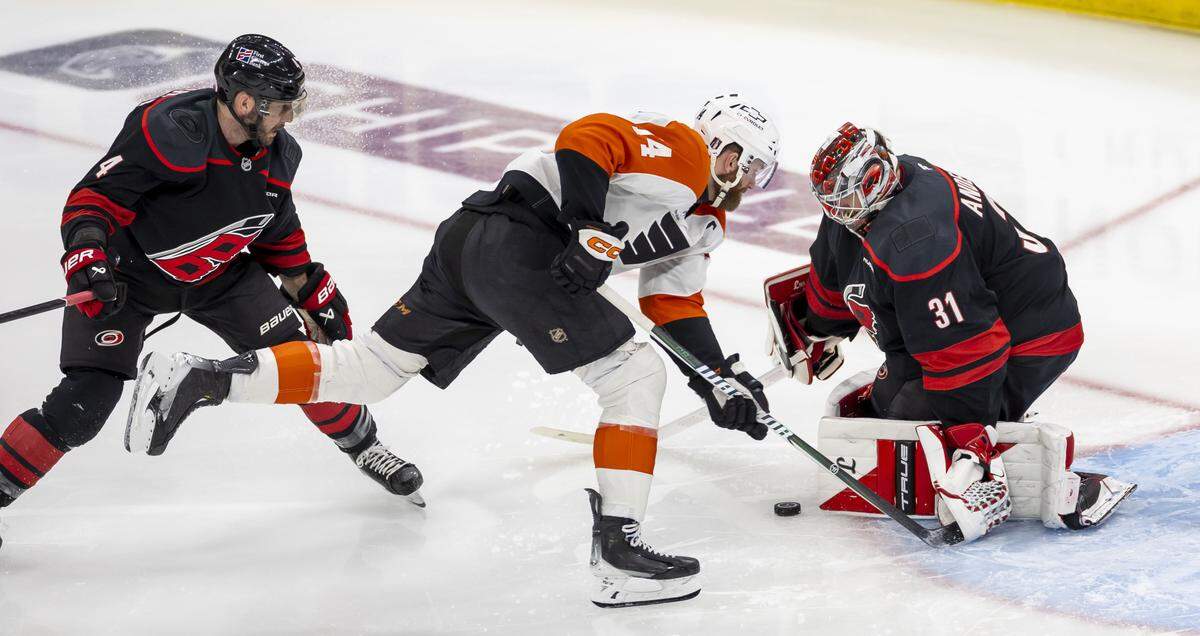
Are the Hurricanes without flaws? Of course not. Andersen has been elite, but he has been in the first two rounds in the past, as well.
The injury bug bit the Hurricanes at the end of the Ottawa series: Alexander Nikishin was still unavailable Saturday, perhaps the only true casualty of “physical play” in that opening series. But that will test the Canes’ depth on the blue line, and Mike Reilly stepped into the fray.
The Hurricanes may yet struggle in these 2026 Stanley Cup Playoffs, but it’s safe to say, at least for this run, it won’t be due to a lack of physicality.