How raw data, numbers confirm Carolina Hurricanes roster choices ... or do they?
AI-generated summary reviewed by our newsroom.
- Article questions whether raw data and numbers truly validate Hurricanes roster choices.
- Text observes fan bias shifts when players leave or join the Hurricanes organization.
- Piece argues perceptions of traded or signed players change based on team allegiance.
We always hold in higher esteem the proverbial “one that got away,” don’t we?
Unless you’re a hockey fan, of course, with a fervent allegiance to a single franchise. Then, all players on opposing teams are garbage, until you trade for them or sign them in the offseason. Then, they’re “yours,” and therefore all of a sudden “better.”
Sounds about right, doesn’t it?
It works that way, too, it seems, for players who leave, whether for ostensibly greener pastures and the lure of more money, or via trade. Then, the “one that got away” becomes, “good riddance, we never liked you anyway.”

What happens when you strip away names and images, though, and just compare
Short of gathering a focus group on Fayetteville Street in downtown Raleigh, or corralling ticket holders in line at Lenovo Center, an in-person player comparison in this setting is a bit tough.
But we can still play with numbers a bit.
Forward comparisons
Let’s play a game, then, called, “Which player would you rather have?” All statistics in each of the first three examples are small sample sizes, encompassing only the 2025 and 2026 Stanley Cup Playoffs, trying to give a better picture of “what have you done for us lately.” The fourth example extends back five seasons, to the 2022 Stanley Cup Playoffs.
The first example:
Player 1: 24 games played; 10 goals; 19 assists; 29 points; minus-11; 22 PIM; 64 shots; App. 21:45 ice time per game; 29 years old.
Player 2: 21 games played; 11 goals; 4 assists; 15 points; plus-6; 4 PIM; 51 shots; App. 16:00 ice time per game; 23 years old.
This one is probably easy to suss out given the number of memes circulating across the Internet this week, focused mostly on the number of goals scored. But a border analysis of the stats (and we could go into advanced analytics for days), paints a much more complete picture of what each player has done in the past two postseasons.
In Player 1 here, you’re getting better point production overall, more grit, more shots and more ice time.
In Player 2, you’re getting efficiency, youth, upside, and when you add in advanced analytics, better all-around play beyond the raw numbers.
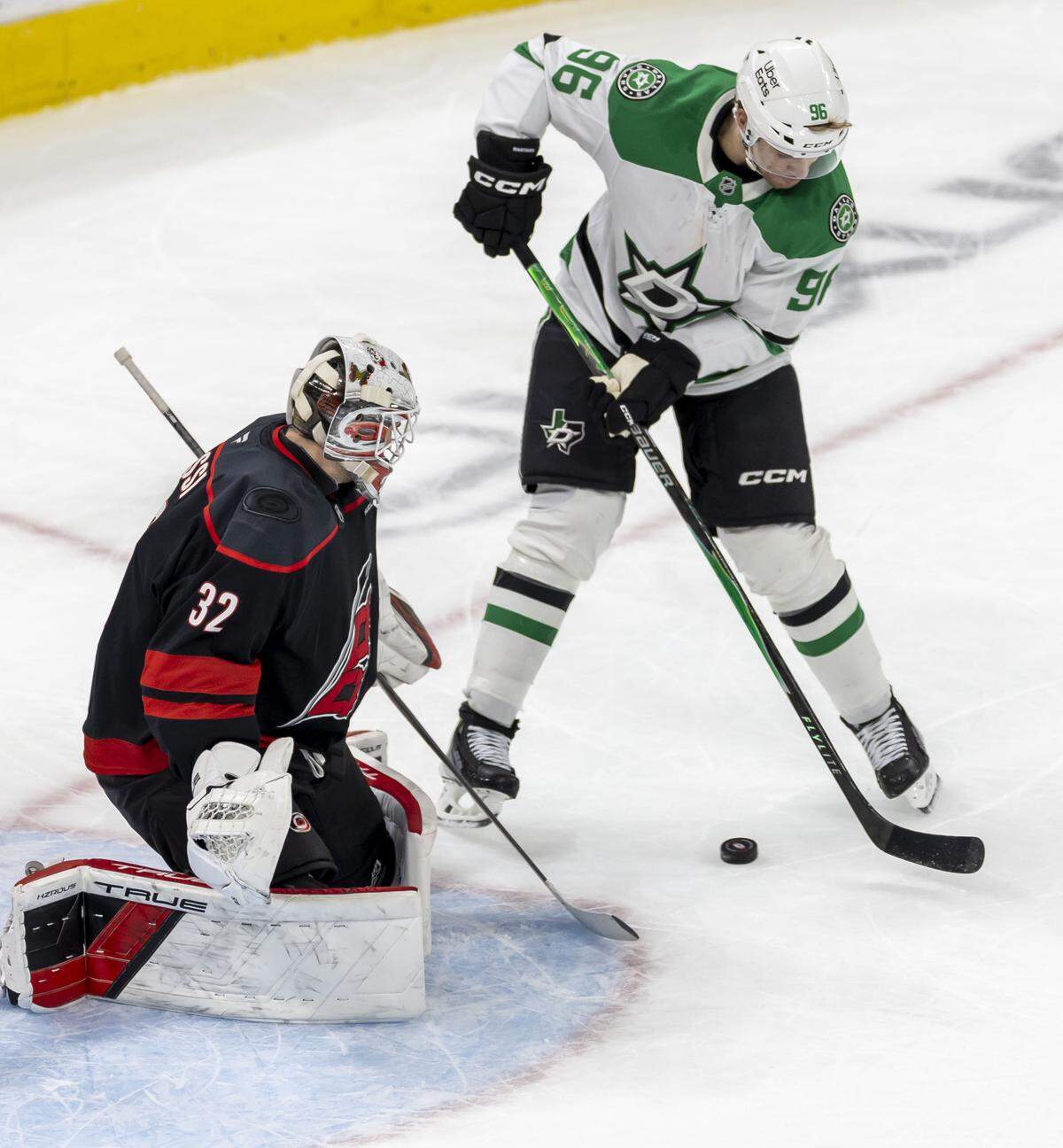
If it’s not painfully obvious already, Player 1 is Mikko Rantanen, now of the Dallas Stars and briefly a Hurricane. Player 2 is Logan Stankoven.
Hockey people won’t stop debating the “value” of each of these players until both have retired, and even though neither are yet 30, the way-too-early analysts are already digging in their heels.
While I won’t entirely dig in my heels, Stankoven has already been more of a “Hurricanes-type-player” than Rantanen ever had a chance of being. Whether their final numbers swing in one team’s favor or another is at the moment irrelevant. It is worth noting Rantanen does have one important piece of hardware that young Stankoven is still chasing: a Stanley Cup ring.

The second example:
Player 1: 13 games played; 2 goal; 10 assists; 12 points; plus-9; 2 PIM; 33 shots; App. 19:45 ice time per game; 27 years old.
Player 2: 21 games played; 10 goals; 8 assists; 18 points; plus-4; 12 PIM; 53 shots; App. 20:18 ice time per game; 28 years old.
Player 3: 21 games played; 5 goals; 10 assists; 15 points; plus-1; 10 PIM; 47 shots; App. 15:10 ice time per game; 34 years old.
Player 4: 21 games played; 8 goals; 5 assists; 13 points; plus-4; 38 PIM; 60 shots; App. 18:30 ice time per game; 26 years old.
This one is a bit tougher because the games played are significantly different, but with a bit of math, Player 1’s points per game ratio (12/13, 92.3%) is better than Player 2 (18/21, 86%), and Player 3 (14/21 (67%).
Also, I am going to allow a small cheat here and divulge that three of Player 2’s 10 goals, and three of Player 4’s eight goals, were into an empty net.
Given the above information, I still believe Player 2’s blind stats are best and would probably choose that option, though Player 1’s points-per-game average and time on ice are just as attractive if not more so. And when you take out three ENG from Player 4, 10 points in 21 games is not as good as 10 in 12. And, Player 4’s penalties could be seen as a liability.
But man, that’s close.
Player 3 is red-hot Taylor Hall, who started the week as the Hurricanes’ leading point getter in the 2026 playoffs.
Player 2 is Sebastian Aho, a player who has been a playoff rock for the Hurricanes over the years, but has struggled in six games this postseason, registering just one goal against a goalie (and two into an empty net).
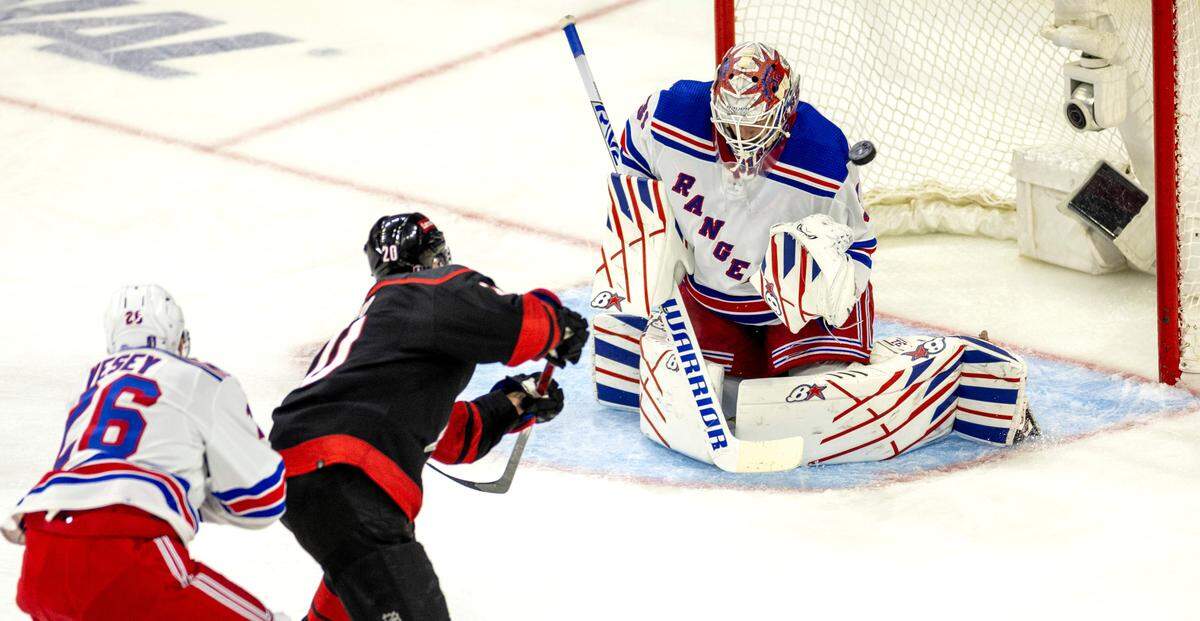
Player 4 is Andrei Svenchnikov, who like Aho has been a bit sluggish to start the 2026 playoffs. But his numbers even a year ago were lower over 15 games (eight points against a goalie) than they probably ought to be.
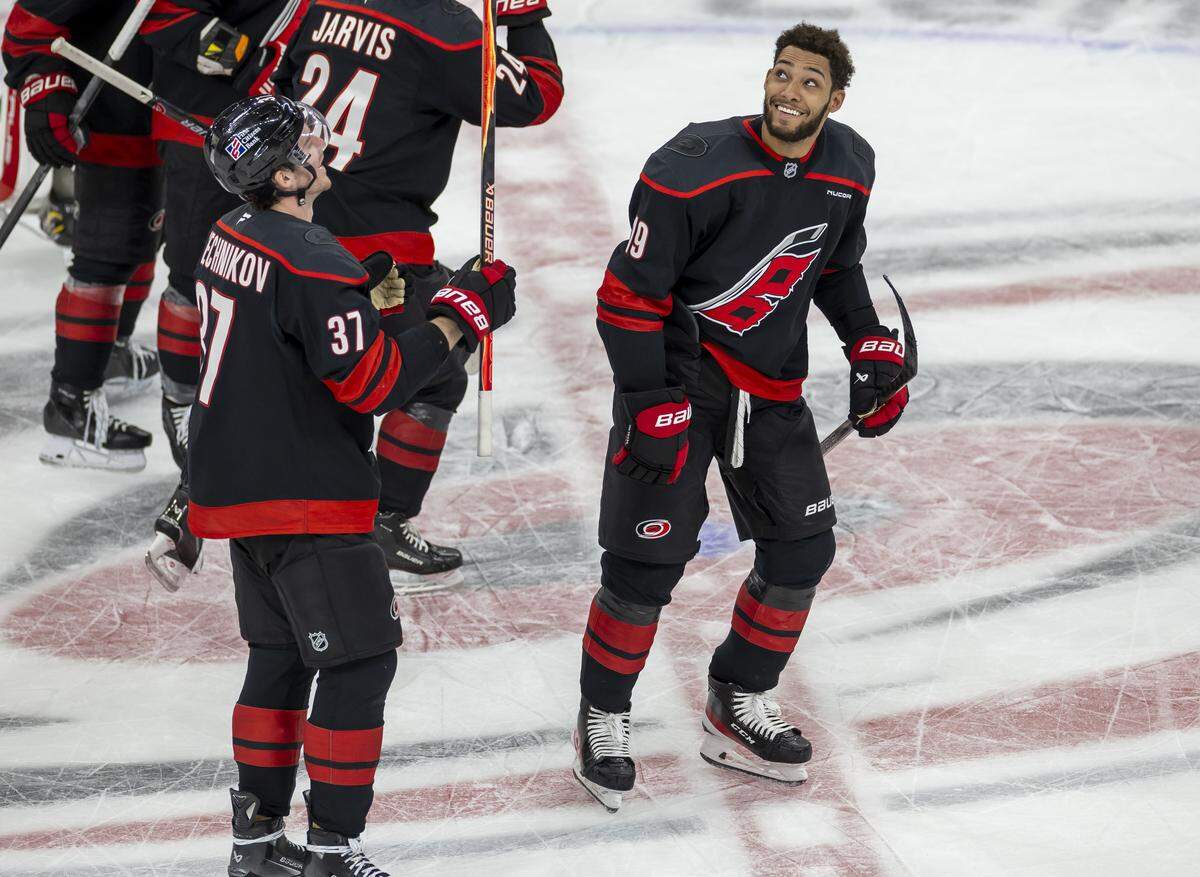
Player 1 is … Martin Necas, who Hurricanes fans love to bury as a playoff black hole — and for mostly good reason. His numbers allow for that, particularly when Carolina wasn’t quite as deep as it is now, and the Canes needed more from him.
But what this comparison shows is that the divide in recent playoff years between Necas and Aho or Svechnikov isn’t as wide and many may previously have believed.
Defense comparison
Player 1: 22 games played*; 1 goal; 7 assists; 8 points; plus-7; 10 PIM; 18 shots; 41 hits; 32 blocks; App. 22:00 ice time per game; 26 years old.
Player 2: 21 games played; 1 goal; 5 assists; 6 points; plus-3; 10 PIM; 34 shots; 18 hits; 23 blocks; App. 20:30 ice time per game; 40 years old.
The asterisk here in Player 1 is that we went back to 2023-24 to get one more playoff year to make the comparison more apples-to-apples. And the clear advantage here, of course, is age. But in terms of raw production, there isn’t much difference.
This, again, is a comparison many people watching the Hurricanes all season have been making, fairly or otherwise, vaulting one player over another in public discourse while discarding the actual data.
We also added hits and blocks to this comparison, given that the players are defenders, and that also substantially skews in favor of Player 1.
Player 1 is K’Andre Miller, who after acclimating to the Hurricanes’ tempo and style early in the season has been nothing but solid for the Canes in the back half of the season and the start of the playoffs.
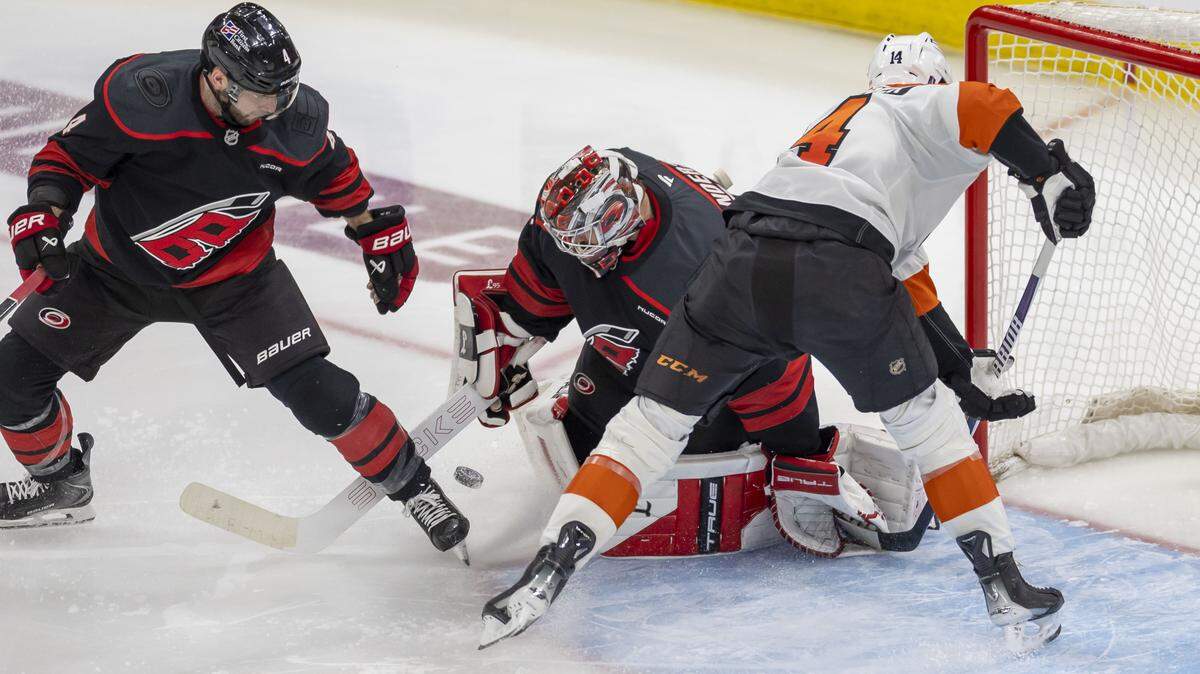
Player 2? That’s Brent Burns, a fan favorite in Carolina who did not sign in Raleigh in the offseason, choosing instead to play for Colorado.
The biggest difference here is, of course, age. Burns was a Hall-of-Fame defender in his prime, and while he’s still serviceable in the NHL, his numbers and ability to outright dominate his position have fallen off, while Miller’s are most certainly on the rise.
Goalie comparisons
Player 1: 76 games played; 43 quality starts; 12 really bad starts; 48 wins; 27 losses; 1,954 saves on 2,143 shots (.912); 2.50 goals against average; 6 shutouts.
Player 2: 46 games played; 26 quality starts; 9 really bad starts; 21 wins; 25 losses; 1,243 saves on 1,373 shots (.905); 2.95 goals against average; 2 shutouts.
Player 3: 38 games played; 26 quality starts; 8 really bad starts; 25 wins; 12 losses; 868 saves on 946 shots (.918); 1.96 goals against average; 4 shutouts.
Player 4: 43 games played; 33 quality starts; 2 really bad starts; 23 wins; 19 losses; 1,343 saves on 1,447 shots (.928); 2.30 goals against average; 0 shutouts.
Player 5: 69 games played; 42 quality starts; 15 really bad starts; 34 wins; 34 losses; 1,827 saves on 2,007 shots (.911); 2.59 goals against average; 2 shutouts.
Confirmation bias is real, because no matter how many stats or arguments you roll out, there is always another example out there of some “intangible” that can sway an opinion.
But using these numbers and these numbers alone, I would be hard-pressed to pick someone other than either Player 3 or Player 4. Player 3 has a sparkling GAA, and his win-to-start ratio (25/38, 66%) is the best of the bunch. His save percentage is second to Player 4, but it could be argued with so many fewer shots, that actually still skews in his favor.
The biggest negative for Player 3 is the ratio of bad starts, to total starts. It feels like he throws in a clunker once every five games which, in a playoff run trying to build momentum could be a concern. But the raw numbers feel too good there.
So who are these masked men?
Player 1 is Sergei Bobrovsky; Player 2 is Andrei Vasilevskiy; Player 4 is Igor Shesterkin; Player 5 is Jake Oettinger.
And Player 3? That’s Frederik Andersen.

The grass may not always be greener
It’s easy to romanticize that which we do not fully know, which is why the concept of the grass being greener on the other side of the fence exists. Clamoring for a particular forward at the deadline — or a defender, or a goalie — is what hockey people do. There’s always a sense that you can do something to make things better for the team, and give it more chances to win.
But sometimes, when you take a step back and look at the raw numbers, you find that what you have already may be exactly what you’re looking for.
The Hurricanes’ ultimate success — or failure — this postseason won’t hinge completely on the players highlighted here, of course (at some point, Aho, Andrei Svechnikov and Seth Jarvis have to get off the schneid, right? Right??).
But bemoaning the “should-haves” and “what-could-have-beens” is a pointless exercise, too, because as we’ve seen, there are no guarantees that any newcomers would have found success with Carolina.
Which is fine, because we never liked them anyway.