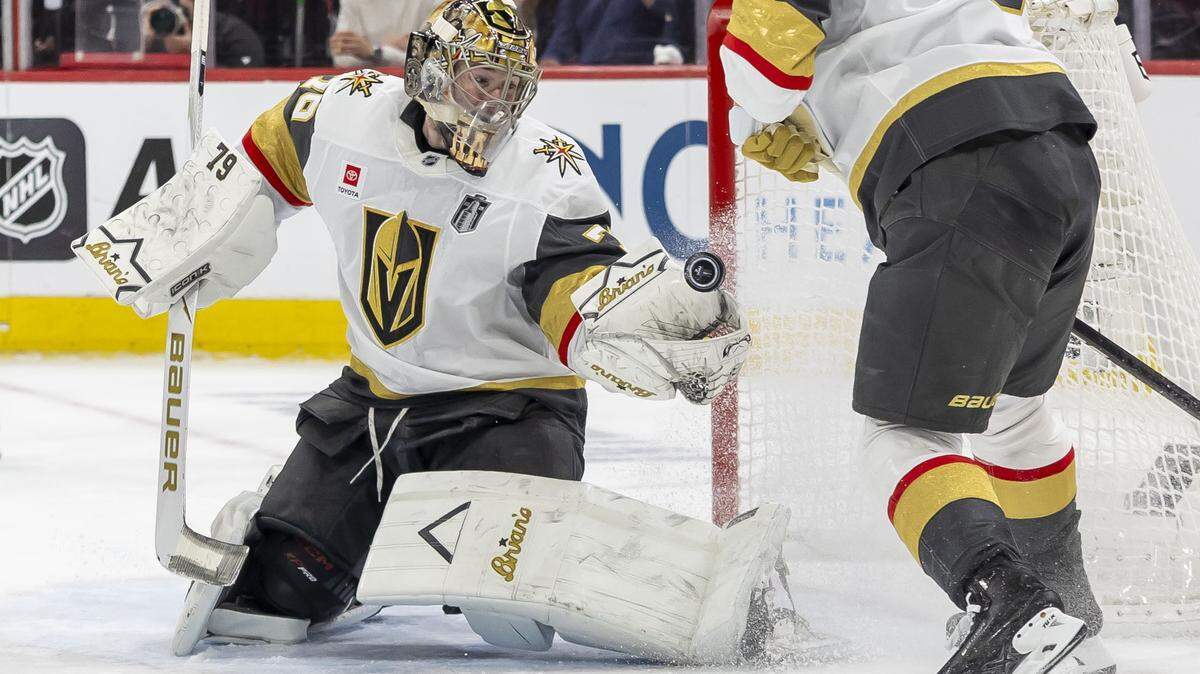
Canes fans chant ‘no means no’ at Vegas goalie Carter Hart after sex assault case
AI-generated summary reviewed by our newsroom.
- Canes fans chanted “No means no” at Knights goalie Carter Hart during Game 1.
- Hart was one of five Hockey Canada players charged in 2024 over an alleged 2018 assault.
- They were suspended nearly two years and reinstated last fall, eligible Dec. 1.
Editor’s note: This story discusses sexual assault. If you have been abused or sexually assaulted, contact RAINN’s National Sexual Assault Hotline at 800-656-4673, online at https://rainn.org/help-and-healing/hotline or text HOPE to 64673.
“No means no! No means no! No means no!”
With nine minutes left to play in the second period of Game 1 of the Stanley Cup Final on Tuesday, this was the chant emanating from Carolina Hurricanes fans.
The chant started in the upper deck and gradually grew louder and louder, turning heads and raising eyebrows. At that moment, the Vegas Golden Knights were up 3-2.
“No means no” is a common anti-rape slogan that stresses sexual consent. So what does that have to do with the Stanley Cup Final?
Vegas Golden Knights starting goalie Carter Hart was one of five Canadian hockey players accused of sexually assaulting a woman in 2018.
The accused players — Michael McLeod, Dillon Dube, Cal Foote, Alex Formenton and Hart — were members of the Hockey Canada U20 National Team at the time.
They were charged in 2024 for the alleged assault, which reportedly took place in a hotel room following the 2018 Hockey Canada Foundation Gala in London, Ontario.
Carter Hart, other players acquitted after sexual assault charge
Hart and his teammates were acquitted last July by the Canadian Superior Court after an eight-week trial. Justice Maria Carroccia said she did not find the plaintiff’s evidence “credible or reliable,” and the prosecution was unable to prove guilt beyond a reasonable doubt. No jury was present after being dismissed, citing jury prejudice. The case was not based on whether the events happened, but rather if the players engaged in sexual acts without the plaintiff’s consent.
Four of the players were skating in the NHL when the allegations surfaced in 2022, with one playing in Europe. Hart was the starting goalie for the Flyers at the time. They were all suspended for nearly two years while multiple investigations took place.
“The allegations made in this case, even if not determined to have been criminal, were very disturbing and the behavior at issue was unacceptable,” the NHL said in a statement about the verdict and the suspension.
Players reinstated by the NHL
The players’ reinstatement, including Hart’s, was announced last fall, and they were allowed to play beginning Dec. 1, 2025. The NHL and NHL Players Association negotiated the players’ eligibility this season.
The Golden Knights signed the 27-year-old Hart in October — following the ruling that the accused would be allowed to play — to a two-year, $4 million contract. He made his debut with the team on Dec. 2. He has largely been shielded by the organization, which has received criticism from fans, and a Monday media availability was cut short after a reporter asked Hart a question related to the trial.
The Canes were reportedly interested in signing McLeod and Hart. The franchise did not offer either player a contract amid some public backlash. The Chicago Wolves, the Canes’ AHL affiliate, signed Foote to a one-year deal last fall. He played 48 games this season.
The accusations and investigation
During the trial, prosecutors stated the female accuser met the players at a bar and returned to the hotel to have sex with McLeod. The other players later entered the room for sex. The defendants claimed all actions were consensual. The plaintiff alleged in court that she was intoxicated and was afraid of the men. During her testimony, the unnamed woman said she consented to sex with McLeod — not with anyone else.
The defense claimed the woman instigated the events, which included various forms of sexual activity, and regretted her actions.
Text messages, however, stated McLeod allegedly invited his teammates to the hotel room for sex. They also allegedly spoke in a group chat about “getting their story straight” regarding the woman’s consent. Screenshots of messages allegedly from McLeod were published last year. Additional communication from Brett Howden, a current Vegas forward who was not accused of wrongdoing, that described alleged acts, were not allowed to be used as evidence.
Videos were presented at the trial, one of which was reportedly taken without the woman’s knowledge. She was seen speaking normally, smiling and “did not appear to be in distress,” Carroccia said. Carroccia said the video undermined the prosecution’s argument that the woman was in fear and noted inconsistencies.
However, the prosecution stated intoxication does not automatically equal unreliable testimony. It also stated the woman did not have motive to fabricate the story due to when she initially reported the incident.
The woman reported the incident to Canadian police in 2018 and lawyers claimed in previous reports that law enforcement did not properly interview the accused players nor did they properly investigate at the time. Prosecutors stated the length of time between the alleged assault and the trial led to minor inconsistencies and difficulties collecting evidence.
Additionally, the judgment focused on the alleged victim’s narrative inconsistencies, despite reports of similar inconsistency and unreliability from the plaintiffs. Howden’s text message was ruled inadmissible because he could not recall the events when questioned last year. Carroccia said reliability and accuracy could not be proved.
The case initially came to light in 2022, when the woman sued Hockey Canada and settled for $3.5 million CAD ($2.5 million USD), using a portion of member fees, from its “National Equity Fund” to pay settlements in sexual misconduct cases.
This story was originally published June 3, 2026 at 3:58 PM.