The most hated man in Hartford has mixed feelings about Whalers revival
The most hated man in Connecticut, still, will be watching Sunday when the Carolina Hurricanes take a step back into their past and wear the green-and-white of the Hartford Whalers for the first time in more than 20 years. But Peter Karmanos, now merely a minority owner of the Hurricanes, isn’t sure how he’s going to feel about that.
“I’m going to watch the game with morbid curiosity,” Karmanos said. “I’ll let you know how I feel afterward.”
While a great number of people in the Nutmeg State have their Cooperalls in a bunch over what they see as the Hurricanes’ cultural appropriation of their beloved Whalers, their primary antagonist – the man they blame for the loss of the team, with all the bile that comes with that – isn’t quite as bothered. Having sold the team to Tom Dundon a little less than a year ago, he’s as operationally detached from the day-to-day operations as he is emotionally detached from everything that seemed so important two decades ago.
Without relitigating what led to the move, there was more than enough blame to go around on both sides, and to be sure, bad blood on both sides. For Karmanos’ part, he did everything he could to sever the ties with the Whalers when he moved the team to North Carolina. The logo was banished to trademark purgatory. Retired numbers were unretired (although no one, still, has worn Gordie Howe’s No. 9). The banners were left hanging in the Hartford Civic Center, like laundry out to dry.
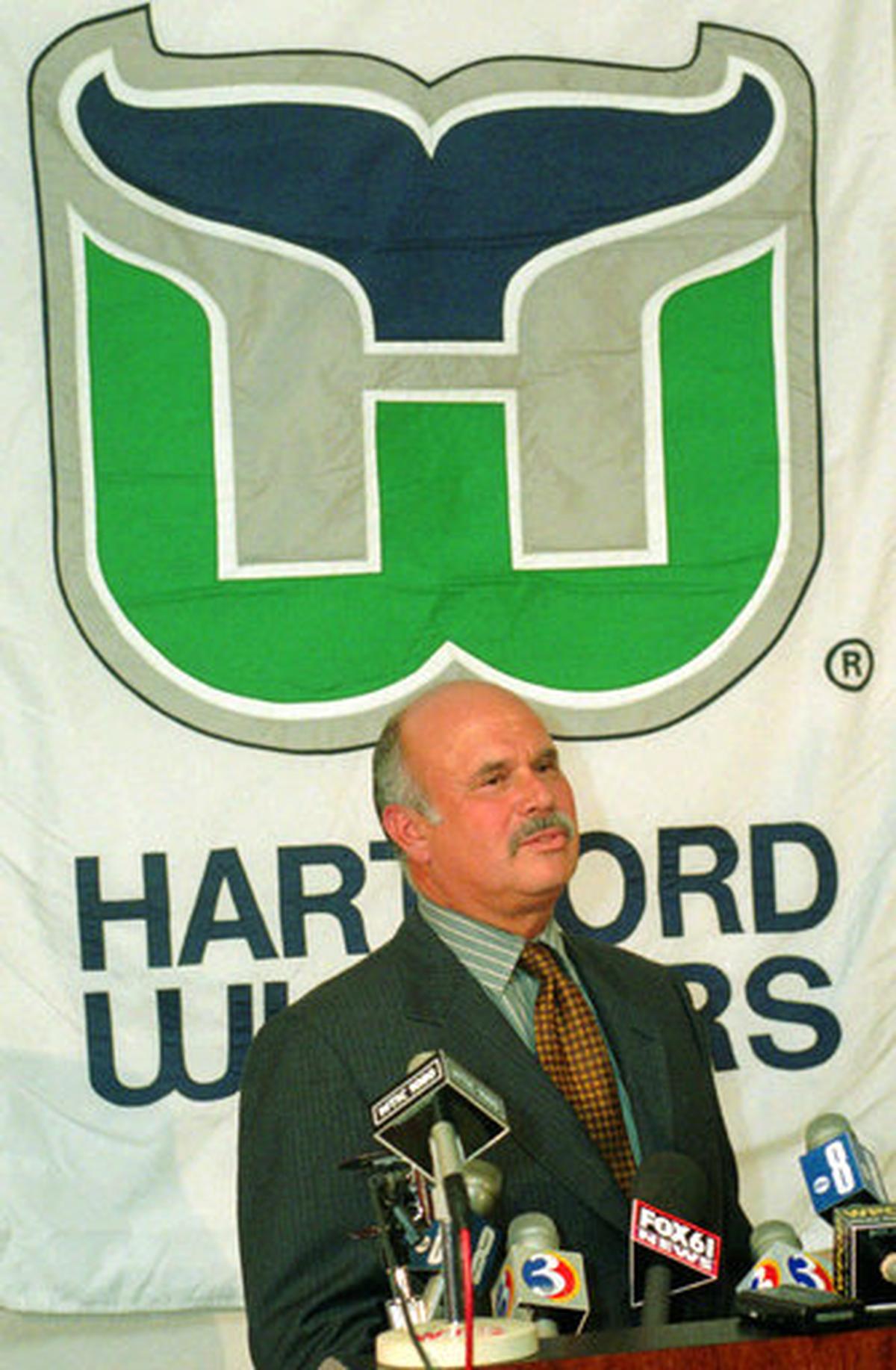
Basically, as long as Karmanos didn’t have to see it, the Whalers lineage was treated as a single continuity. Ron Francis and Glen Wesley and Skip Cunningham all became Hurricanes legends in their own right, completely detached from anything they had done before the move.
Meanwhile, the always-popular Whalers logo became a cult hockey brand, a secret handshake of true fans, propelled to some degree by ESPN’s rise, since the Whalers were always the “home” team for network personalities and employees in nearby Bristol.
Those powerful market forces collided with Karmanos’ sale of the team. When Dundon, in the days after the sale, brought his friends like Tony Romo to see his new toy, they all wanted to wear Whalers gear instead of Hurricanes gear, a hint of things to come. The brand is so powerful that is moment was inevitable as soon as Karmanos was out the door, no matter who bought the team.
It almost goes without saying this isn’t exactly to Karmanos’ taste.
“I guess you would like to do a lot of things to generate interest in the team,” Karmanos said. “I’d rather do it by winning. I’m not into that kind of stuff. Right or wrong, that’s just not me.”
Cynics might say it’s just a transparent money grab, a chance to cash in on nostalgia. Which it is. But so is professional sports. What’s a third jersey if not an excuse to sell someone who already has two jerseys a new one? The Hurricanes have at least as much of a reason to wear jerseys from their past as the Miami Heat does to wear jerseys inspired by a television show, but the end purpose is the same: To move money from you to the franchise.
This is really a reckoning with the past the Hurricanes should have had long ago. It is possible to appreciate the team’s success here – it wasn’t long ago this was considered a model non-traditional market, and could be again – without denying its history there.
But it took time, and the people whose feelings were strongest had to move along. As they have. If Hartford had ever gotten another NHL team, then there could have been a clean break. It hasn’t, for all the structural reasons the team moved in the first place – the lack of a state-of-the-art building and a small media market – even beyond the two personalities primarily involved in the argument over a new arena, Ponytail Pete and a crooked governor who ended up in prison. That stew was so toxic Karmanos decided to move the team before he had even the faintest idea where it was going.
Twenty years and a Stanley Cup later, Hartford’s pain has been Raleigh’s ongoing gain.
“I have no ill will toward Hartford or the organization,” Karmanos said. “I enjoyed owning the Hartford Whalers. There’s a lot of stuff the poor team needed, sitting in the middle of 20 other pro teams trying to compete for advertising and stuff like that almost an impossible situation. I was willing to stick it out, but then the governor made it impossible.”
That last sentence is going to provoke screams of protest from Hartford fans who insist they were betrayed by Karmanos and Karmanos alone, but what’s done is done, what’s gone is gone. Until it’s back, with all the conflicted emotions that come with it. On both sides.