Seven decades later, the team that stood up for a teammate stands up to be honored.
On Friday night, Lafayette College will induct its 1948 football team into the school’s Hall of Fame. For a while, it looked like no players would be able to make it, an entirely appropriate state of affairs, as that team’s greatest accomplishment was deciding not to show up for its most important game.
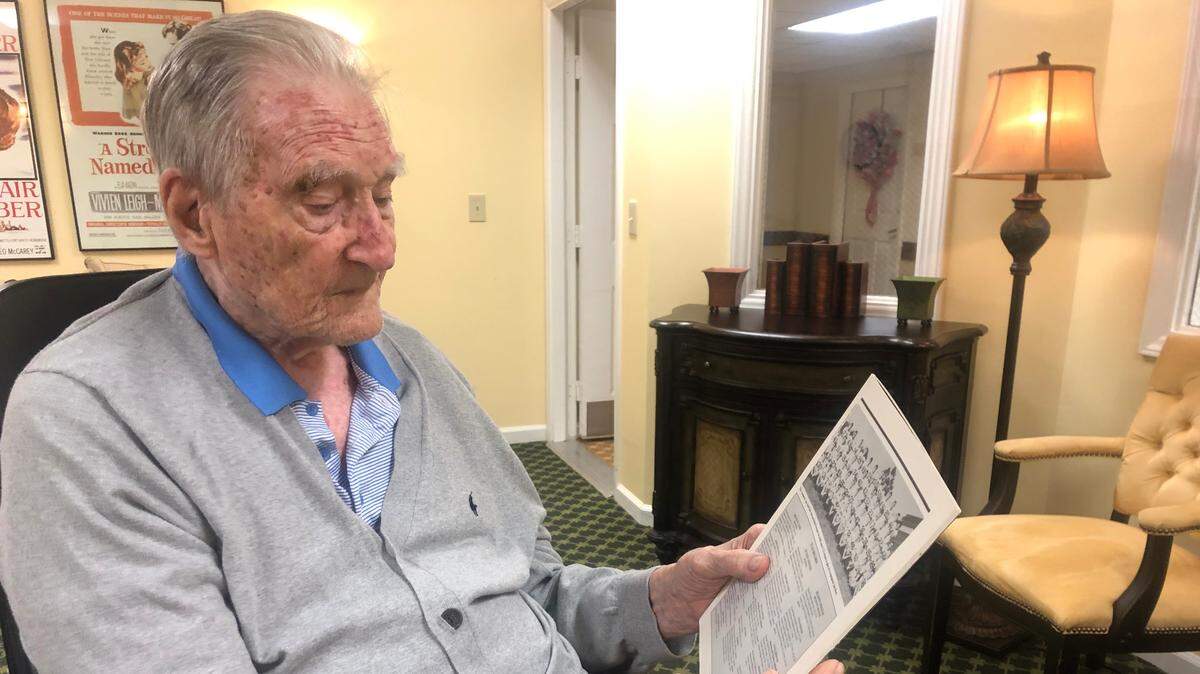
Age and mortality have taken their toll on those men. And while the college is now expecting at least one player to make the event, Richard Durstein, a junior end on the team, will be staying home in Raleigh. At 93, he uses a motorized wheelchair now and there’s no easy way to get him to Easton, Pennsylvania. But his mind is still sharp enough to recall games — even individual plays — from that season, and especially the way it ended.
That team’s decision to boycott the 1949 Sun Bowl because the bowl committee wouldn’t allow the Leopards’ one black player to take the field has been all but lost to history, but it caused a furor at the time, making it all the way to President Truman’s desk in the White House. In the days before the Civil Rights movement gathered momentum, there were singular events like this that hinted at the progress — and at more turbulent days — ahead, when Lafayette refused to leave its teammate behind.
David Showell had been a Tuskegee airman during World War II. Like many of his war veteran teammates, he was older than the typical college student. Unlike any of his other teammates, he was black. When the Sun Bowl realized he was on the team, the invitation suddenly came with an asterisk. Showell couldn’t play. Neither, as it turned out, would the Leopards.
“If you can imagine, he’s been fighting for the U.S. and going to flight school,” Durstein said in an interview in Raleigh recently. “It just baffles me. ...
“I certainly still agree with what we did. It was kind of a bad thing to hit you.”
Durstein went to Lafayette straight out of the Navy to study engineering on the GI Bill. Like so many of their college peers in the immediate postwar years, it was an older group that had seen the world. That included Showell, one of only a handful of black students on campus. The yearbook pages about the team barely mention Showell while waxing poetic about a little-used backup fullback, but Showell scored a few touchdowns and was a stalwart on defense, the lone black face in a team photo of buzz-cut white boys. Two of those were Dursteins from Delaware: Richard, who at 6-foot-5 towered over many of his teammates, and his younger brother Ralph, a lineman and kicker.
Lafayette was a football powerhouse during the last of the days when the Ivy League and service academies dominated the college game. The Leopards rumbled through the season at 7-2, including a win over archrival Lehigh, and for a rare moment the big-city media turned its attention to eastern Pennsylvania. Lafayette was rewarded an invitation to one of the few bowl games at the time, the Sun Bowl in El Paso, to play the Texas College of Mines — which would later become Texas Western and then UTEP, a school that played an important role of its own in the integration of college sports a few years later.
But 1966 — when Texas Western’s all-black starting five beat Kentucky’s all-white starting five for the national title — was a long way from December 1948, especially in El Paso. Black players had played in the Cotton Bowl, but the Sun Bowl committee was unwilling to make an exception. Showell could travel to the game with the team, but he couldn’t stay at the same hotel and he couldn’t play.
The team put it to a vote. Durstein says Showell pleaded with his teammates to go without him, but there was no contest. The Leopards voted to turn down the invitation. The faculty voted the same way.
When word got around, the campus was in an uproar. Students didn’t immediately understand why the invitation had been refused, and surrounded the school president’s house. After he explained the situation to the mob, he agreed to make a long-distance call to the bowl president and ask again for an exception for Showell. When none was forthcoming, a student group sent a telegram to Truman: “Denied Sun Bowl game because we have a negro on our team. Is this democracy?”
“(Showell) was really hurt, just the worst thing that could happen,” Durstein said. “But we kept saying, we don’t want to go down there and play in that place if they’re going to act like that. It was a difficult time.”
West Virginia went instead, and Durstein graduated from Lafayette that spring with a degree in metallurgical engineering and took a job working with a new metal: titanium, a career that took him to Pittsburgh and South Florida and finally to Raleigh to be near his children. Showell was killed in a car crash in Philadelphia seven years later. Only lineman Frank Cinelli, a junior on the 1948 team, will represent his teammates when they are inducted on Friday.
Durstein has been telling the people in his senior living community about the bowl controversy, and for some it does connect with threads tangled deep in their memories from many decades ago. Even those who were alive at the time can’t necessarily comprehend the courage it took the Lafayette players to take that stand, now being honored as much for what they didn’t do as anything they did.
This story was originally published November 21, 2019 at 10:00 AM.