ACC basketball and the terrible, horrible, no good, very bad season
If seven different teams had held the No. 1 ranking in The Associated Press poll — so far! — because they kept beating up on each other in epic games that entered the lore and legend of college basketball, that would be one thing. The fact that all seven have treated the top spot like a live grenade is emblematic of a college basketball season where everything feels a hair off.
This is a season that’s all questions and no answers. There’s no “best” team in college basketball, not even many “better” teams, just a dozen that aren’t as bad as the others. And after a run of incendiary talent that fueled the game and rivalries alike, both young and seasoned, there isn’t a compelling player or drama in college basketball this season.
“The top 25,” Duke coach Mike Krzyzewski said, “could be a top 50.”
Zion Williamson, where have you gone?
“The talent level is definitely down,” ACC Network analyst Matt Doherty said. “There’s no ifs ands or buts.”
As elite programs have come to rely increasingly on one-and-done talent, the lack of it this season has shifted the balance of power toward lower-profile teams that may have veteran players — Baylor, Dayton, San Diego State — but lack the usual pizzazz of the blue bloods.
In a down year for college basketball, the ACC is at the head (or the back) of the class. Traditional powerhouses like North Carolina, Virginia and Syracuse are all struggling. Road teams are winning ACC games at a 48.4 percent clip, almost always a sign of general weakness, still on pace to break a record set in 1955 even after home teams went 6-0 on Saturday. (Home teams are winning at a historic rate in the Big Ten, statistically the strongest conference this season.) At the moment, the ACC is fourth in Ken Pomeroy’s efficiency ratings, on pace for its worst relative finish since 2013.
Two of the three best teams in the ACC have lost to Stephen F. Austin (Duke) and Pittsburgh (Florida State), and the third, Louisville, couldn’t beat Florida State. In Washington Post bracketologist Patrick Stevens’ projections, the ACC is in line for six NCAA tournament bids, which would be the fewest since 2015 — and it’s possible the ACC could end up with as few as three for the first time since 2000, when it was a nine-team league, if everything goes south in the right (wrong) way.
If what’s good for the ACC is good for basketball (and it is), it turns out what’s bad for the ACC is bad for basketball as well.
“People say they like parity,” North Carolina coach Roy Williams said. “I don’t think they do. I think they like to have outstanding teams out there.”
So why aren’t there any out there this season? And why aren’t there any in the ACC?
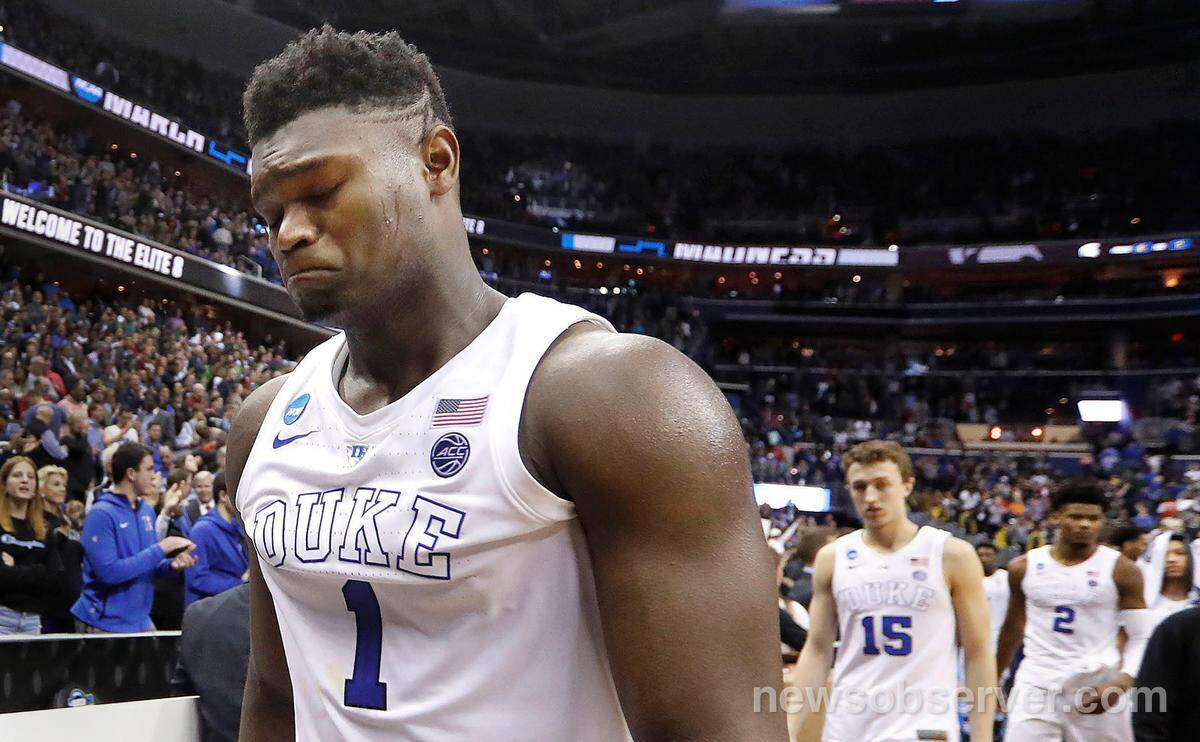
Zion withdrawal
While there are several reasons for the lack of buzz surrounding college basketball this season, the primary one is the most basic and elemental. Not only is there no Zion Williamson in this freshman class, there are few stars in this freshman class at all. Combine that with an exodus of talent after last season — especially in the ACC — and there’s an overall lack of starpower, especially compared to recent seasons.
Start with Zion: His one year at Duke was such a supernova that almost anything would have been a letdown in comparison. His absence has been felt as keenly as his presence was.
“I know we don’t have the megastar or stars or certainly the Zion factor,” Notre Dame coach Mike Brey said. “There’s probably going to be withdrawal from Zion for 10 years. He was an absolute freak of nature and a terrific kid.”
But it wasn’t just Zion. Duke teammate RJ Barrett would have been the No. 1 player in this class. Two of the top players in the class decided to skip college basketball altogether and play overseas — R.J. Hampton and LaMelo Ball — and a third, James Wiseman, left Memphis at midseason after a typically draconian and heavy-handed intervention by the NCAA. N.C. State-bound Jalen Lecque was old enough to skip college altogether. With North Carolina’s Cole Anthony hurt since December, the usual torrent of freshman talent has been a mere trickle.
NBA scouts, paid to forecast draft classes years in advance, saw this coming. Talent is cyclical, going up and down from year to year, and this was going to be a down year anyway, even if the best players had ended up healthy and in college. Last year’s class was epic. Next year’s class is promising. This year’s class is shaping up to be as forgettable as expected.
“I think you see it coming more in basketball than any other sport,” Doherty said. “For the most part, the best players are really out there as sophomores and juniors in high school. There’s always a surprise, always a late bloomer, a Ja Morant, but you definitely see the cycles.
“I worked in the NBA office for five years, and you would always try to say, ‘This is what’s in the pipeline, we think Zion and RJ are one-and-done but the next year might not be as good. So if we’re going to make a move in the draft, we need to do it in ‘19. Not ‘20.’ ”
Meanwhile, while the talent coming in wasn’t as good, the talent that left — especially players who could have stayed — was exceptional, part of a growing trend of early departures. In 2015, 48 underclassmen left college for the NBA draft. Last summer, 86 walked away (and another 89 explored the possibility before deciding to return).
Virginia was probably going to lose De’Andre Hunter anyway, but when the Cavaliers won the national title, Ty Jerome and Kyle Guy departed as well. North Carolina knew Luke Maye and Cam Johnson were finished, but Coby White left, too. Ky Bowman finished a stellar career at Boston College, leaving the Eagles without a star. Kerry Blackshear took advantage of the coaching change at Virginia Tech to transfer to Florida, where he leads the Gators in scoring and has a chance to be SEC Player of the Year.
For the first time in recorded history, not a single first- or second-team all-ACC player returned for the next season.
This was generally true across college basketball but felt more sharply in the ACC than anywhere else. Duke landed another top-ranked recruiting class, but without the skill or sizzle of their predecessors. Anthony starred for North Carolina, but this was a year the Tar Heels could have used more impact freshmen given the departures of Maye and White. Virginia was devastated. Meanwhile, the two best players at Syracuse are an East Carolina transfer and the coach’s son.
“I think this year, honestly, our league doesn’t have the same name recognition that it has in the past,” Wake Forest coach Danny Manning said.
Would the narrative surrounding the ACC — maybe even all of college basketball — be different if Virginia had lost to Texas Tech and Jerome and Guy came back and the Cavaliers were the No. 1 team in the country? Would Nassir Little be a star on a much weaker UNC team if he had stayed?
There are always surprises in every season, whether Morant last year as a sophomore or Landers Nolley this year at Virginia Tech as a redshirt freshman. There just aren’t enough of them.
“What you hope is a few of those can paper over the fact that it’s not a great year nationally,” said Chris Ekstrand, a Triangle-based scouting consultant for the NBA. “There haven’t been enough Nolleys to cover up for the fact that it’s clearly not a great year.”
3-pointers and physicality
It was clear that the overall talent level was going to take a hit this season, which probably made it a bad year to move the 3-point line back 2 1/2 inches.
The decision to move to the international 3-point line was a long time coming, and a necessary step to create more space around the basket in college basketball’s never-ending quest to find the right balance between physical play and freedom of movement. The timing, understandably unforeseen, could have been better.
In a game increasingly dominated by the 3-pointer at every level, the product of analytical insight and a generation of players raised as shooters above all else, the resulting decrease in 3-point shooting percentage has put a damper on offense.
This season’s 3-point percentage of 33.3 percent is the lowest since the NCAA adopted the shot in 1987, substantially lower than the previous low of 34.0 percent in 1997 (when teams took two fewer 3-pointers per game) and down a full percentage point from 34.4 percent last season. In the ACC, there hasn’t been as much of an impact. Eight teams are shooting worse than last year from long range, seven better — the top three in the ACC among them. Last year, four ACC teams shot better than the NCAA average from 3; this year, eight are.
“It doesn’t seem to have impacted the game as much as I thought,” Miami coach Jim Larranaga said. “Although statistically, shooting percentages nationally are down a point.”
It’s been a bigger issue in the rest of college basketball than the ACC in terms of quality, but in terms of quantity, the more difficult 3-point line hit a few teams especially hard because of roster changes, Virginia and North Carolina among them. The impact isn’t limited to team performance; all the missed shots have had a spillover effect into other areas.
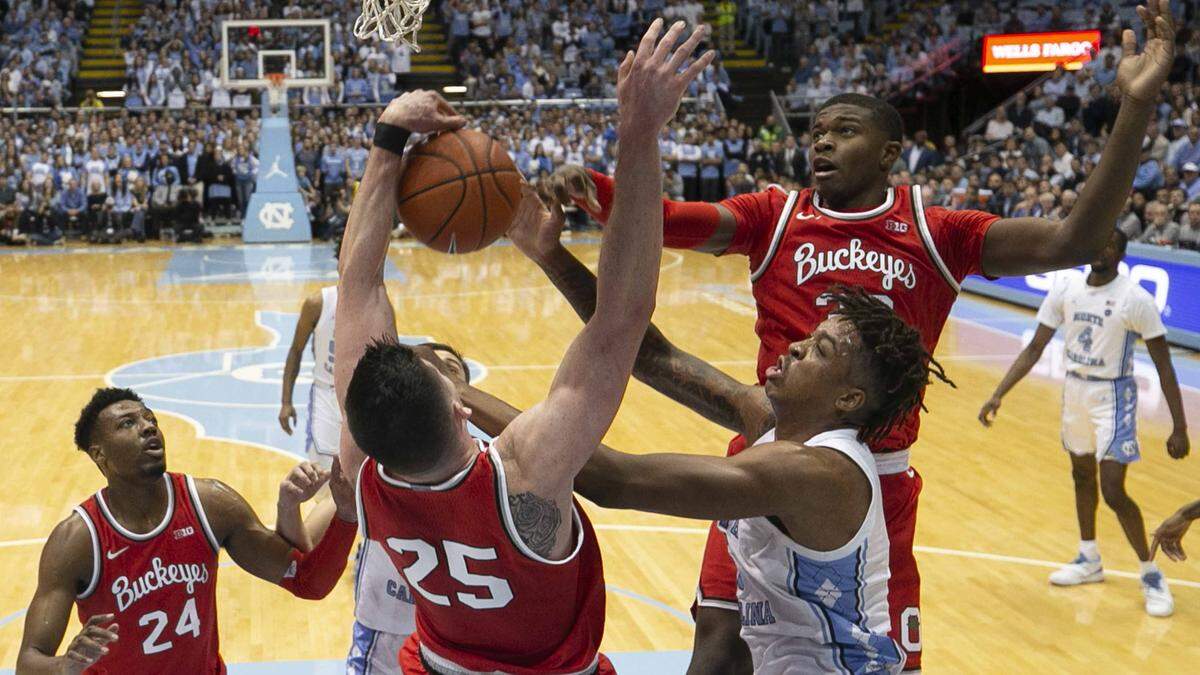
After a home loss to Louisville, Krzyzewski complained that the officials allowed the game to be played too physically, that “freedom of movement is no longer alive and well.” This echoed a complaint by ESPN’s Jay Bilas that the NCAA had given basketball officials too many directives and they had lost track of the mandate to reduce body contact and physical play that had noticeably improved the game in recent years.
There’s some credence to the argument that officials have been distracted by the NCAA’s points of emphasis on trivial issues like coaching-box violations and keeping teams seated on the bench, but the culprit is more likely a familiar one. There’s an old officiating maxim that missed shots lead to rough games, with more loose balls and rebounds and collisions. With shooting percentage down drastically this year from both 2-point and 3-point range and turnover percentage up, games are by nature going to be uglier — and more difficult to officiate.
“It’s not the referees,” Hall of Fame official and former ACC supervisor John Clougherty said on the The Whistleblowers, a News & Observer podcast. “Jay’s saying the referees’ hands are tied because they’re not calling all these fouls they’re instructed to call. Play is bad, but play is bad because players are not as good as they once were.”
The end of one-and-done
The good news, especially for the ACC, is that a mere flip of the calendar should fix the talent issues. Of the 20 McDonald’s All-Americans who have committed to colleges, eight are going to ACC schools, seven to Duke and UNC. Teams like Virginia that build through developing players should be better with this year of experience.
Across college basketball, next year’s incoming class is generally thought to have more stars in it than this one, even if there’s not a Zion in it. (Then again, at this time in 2018, Zion was the fourth-rated recruit in the Triangle.) That should take care of the talent drought.
“It should,” Ekstrand said, “and not just because of the guys coming in, but because of guys who have been forced into primary roles this year and were not really ready for it. They were thrown into the deep end of the pool and be the better for it in the long run. There were a number of players around the ACC forced into these early situations who are going to be pretty good basketball players.”
But will it stay fixed? The NBA and its union have indicated that they are likely to allow high school players to go directly to the NBA starting with the 2022 draft, ending the so-called one-and-done phenomenon in college basketball. This has mixed implications for the college game.
The players who do decide to play college basketball will in theory be more committed to their teams and less likely to leave after a single season, although some certainly still will if it is allowed. That would allow coaches who have simplified their systems for short-term players to reintroduce some complexity. But the NCAA will also lose that entire tranche of elite talent that will head straight to the pros.
The college game survived just fine without LeBron James and the late Kobe Bryant; would it be as healthy now without Zion and Trae Young? It’s an open question without an answer.
As for the lack of dominant teams, maybe an NCAA tournament without a clear favorite will add some juice to the proceedings, even if there’s every chance a pair of repeat-customer blue-bloods could end up in the title game with Duke and Kansas. That would certainly make CBS happy, given the network’s ad execs are probably having heart palpitations nightly over a potential Final Four of Baylor, Dayton, Florida State and San Diego State.
“It’s been like musical chairs,” Brey said. “It kind of gives everybody hope.”
Either way, the future is brighter with the talent coming in next fall and a year to adjust to the new 3-point distance. Last week, Williams recounted how Dean Smith thought it was good for North Carolina to have a down year once in a while so people would appreciate how good the Tar Heels were on a regular basis otherwise.
Maybe this is one of those years not just for UNC, but for the ACC and college basketball as well.
This story was originally published January 27, 2020 at 6:00 AM.