From the archives: Call it the injustice of justice
Originally published March 14, 2008
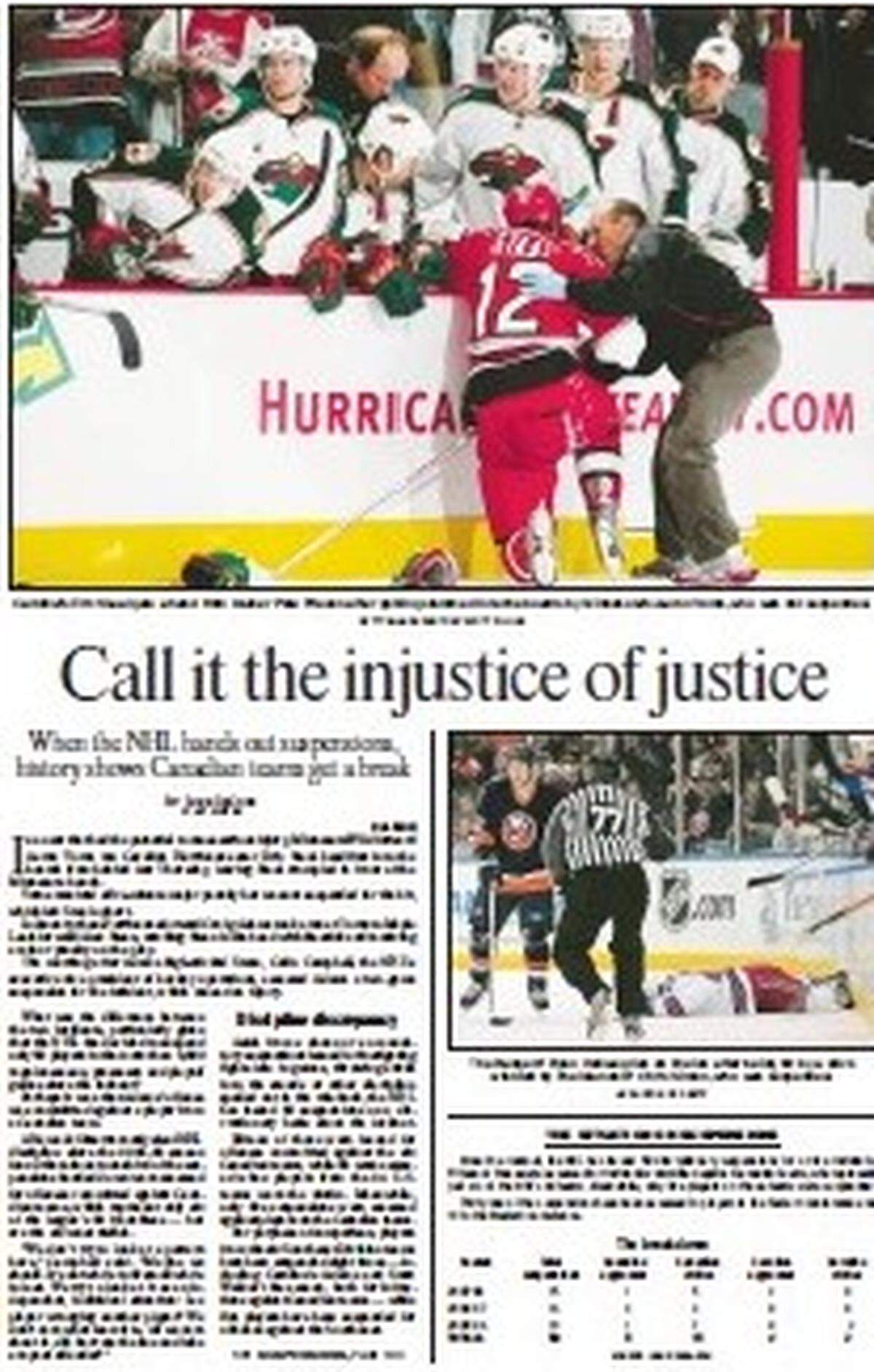
In an act that had the potential to cause serious injury, Minnesota Wild forward Aaron Voros ran Carolina Hurricanes star Eric Staal headfirst into the boards from behind last Thursday, leaving Staal crumpled in front of the Minnesota bench.
Voros received a five-minute major penalty but was not suspended for the hit, which left Staal unhurt.
In January, then-Hurricanes forward Craig Adams took a run at Toronto Maple Leafs forward Alex Steen, catching Steen in the head with his stick and receiving a minor penalty on the play.
The morning after Adams high-sticked Steen, Colin Campbell, the NHL’s executive vice president of hockey operations, assessed Adams a two-game suspension for the incident, which caused no injury.
What was the difference between the two incidents, particularly given that the NHL has decided to suspend only 50 players in the more than 3,900 regular-season, preseason and playoff games since the lockout?
Perhaps it was that Adams’ offense was committed against a player from a Canadian team.
A News & Observer analysis of NHL discipline since the 2005-06 season found that almost one-third of the suspensions handed down were assessed for offenses committed against Canadian teams, which represent only six of the league’s 30 franchises -- but are the six most visible.
“We don’t try to look at a pattern here,” Campbell said. “Maybe we should. It’s not who’s in first and who’s in last. We try to look at it as an independent, individual situation: Is a player wronging another player? We don’t care what team it is. All we care about is, did he cross the line and is he a repeat offender?”
Discipline discrepancy
Aside from a dozen or so mandatory suspensions issued for instigating fights late in games, throwing sticks into the stands or other discipline spelled out in the rulebook, the NHL has issued 50 suspensions on a discretionary basis since the lockout.
Fifteen of those were issued for offenses committed against the six Canadian teams, while 36 were assessed when players from the 24 U.S. teams were the victim. Meanwhile, only five suspensions were assessed against players on the Canadian teams.
For purposes of comparison, players from the six Southeast Division teams have been suspended eight times -- including Carolina’s Adams and Scott Walker this season, both for infractions against Canadian teams -- while five players have been suspended for offenses against the Southeast.
“Obviously, to the extent your numbers are correct, I would suggest that it is a function of random chance,” NHL deputy commissioner Bill Daly said in an e-mail. “The process is blind as to player nationality and team identity.”
Perhaps most striking is the discrepancy involving the three eastern Canadian teams -- the Maple Leafs, Montreal Canadiens and Ottawa Senators: three suspensions given to players on those three teams and 12 for fouls against them.
The N&O analysis found no such discrepancies with regard to the nationality of individual players, but more suspensions have been assessed against Eastern Conference teams than Western Conference teams, by a three-to-two margin.
After suspending 10 players in the first three months of the season, the league hadn’t issued a suspension since Jan. 23 -- until four players were suspended this week.
“I definitely feel like there’s inconsistency, a lot of inconsistency, but I don’t know that there’s a pattern of inconsistency,” said Adams, who now plays for the Chicago Blackhawks. “Sometimes the decisions you see made or the decisions that aren’t made leave you scratching your head.
“You wonder from one decision to the next what guidelines are.”
Judge and jury
The NHL’s supplementary discipline procedure rests almost entirely in the hands of one man, Campbell. While NHL commissioner Gary Bettman has input on significant incidents, Campbell determines whether players are suspended and the lengths of their bans.
A native of London, Ontario, who coached the New York Rangers for four seasons after an 11-year NHL career that saw him record 128 points and 1,292 penalty minutes, Campbell lives two hours away from Toronto on a tobacco farm in rural Tillsonburg.
Campbell, 55, known to all in the game as “Coley,” has been in this position since leaving the Rangers in summer 1998.
During his tenure, he has handled some of the most difficult situations in recent memory -- Todd Bertuzzi’s attack on Steve Moore, Marty McSorley’s attack on Donald Brashear, and Chris Simon’s two recent violent infractions.
On a typical night, Campbell will watch multiple games at home or in the league’s Toronto “war room” with several league officials who provide the long-distance decisions on disputed goals under the supervision of Mike Murphy, a former NHL coach and Campbell’s deputy.
“I was told early on in my career that they look at everything and I should just keep my mouth shut,” Hurricanes coach Peter Laviolette said.
Any controversial incident is debated by Campbell, Murphy and the NHL’s game-night hockey operations staff long before Campbell’s phone rings with a call from an irate general manager.
But in the end, the decision falls to Campbell alone.
“You take each one on its own,” Campbell said. “You look at it as right or wrong -- not about disciplining a team but disciplining a player.”
Environmental factor?
Within the Carolina dressing room, some players take it for granted that where they play affects the suspensions assessed by the league, and that the league office’s location in Toronto factors into the equation.
“Just from the vicinity of where you live plays into it, I assume,” said Walker, who said he deserved his one-game suspension for head-butting Ottawa’s Mike Fisher.
In Toronto, the Canadian media covers hockey the way the American media covers the NFL, and any incident involving a player from a Canadian team is 24-hour news. In the Southeast Division, hockey is merely one of many sports in places like the Triangle, Washington and Atlanta.
“That might have been true in the ‘80s when you had Leafs games on TV, and Montreal and the Rangers had more games on TV,” Campbell said. “We have a guy monitor every game. Whether it’s a Canadian team playing or a U.S. team or it’s a CBC [Canadian Broadcasting Company] game doesn’t matter.”
Campbell has an additional reason to be aware of what goes on in the Southeast: His son Gregory has played for the Florida Panthers since the lockout. (No suspension involving the Panthers or one of their opponents, has been issued since then.)
Still, players argue it’s not the same as playing in Canada or the other large East Coast markets.
“In bigger markets, it’s going to be a bigger issue. In smaller markets, it’s easier for things to go unnoticed,” Cole said. “That’s the way it is. I’m sure it’s that way in other sports and other businesses. That’s life.
“There’s nothing you can really do to change it. You can’t dictate the size of the market you play in. I guess you want your division or your team to be shown the same amount of respect as other teams or other markets, but that’s not always going to be the case.”
Many Hurricanes fans (and some players) are still angry over the three-game suspension handed down after Pittsburgh Penguins defenseman Brooks Orpik broke Cole’s neck with a hit from behind into the boards in March 2006, a hit not unlike the Voros hit on Staal.
Cole missed the final 22 games of the regular season and first 23 of the playoffs before returning in Game 6 of the Stanley Cup finals.
Campbell said this week that his staff didn’t think a suspension was warranted in either case, but he felt it necessary to suspend Orpik because of the severity of Cole’s injury.
In the case of the Voros hit, he said he more seriously considered discipline for Cole or Walker, both of whom were on the ice during the fight that followed despite switching places during a line change. Leaving the bench during an altercation is a mandatory 10-game suspension.
Going forward
The reins of supplementary justice in the NHL have always been held by the commissioner or his designee, but the NHL Players’ Association might like to change that. In a December interview, new NHLPA executive director Paul Kelly said the union should have a voice in the process.
“We’re going to be particularly looking at consistency across the board,” Kelly said. “We’re concerned about inconsistent results imposed on players because they’re star players or otherwise.”
Daly said no discussions about changing the system have taken place with the union or within the league. And even Adams acknowledges that as unsatisfied as he was with the process in his case, he can’t suggest an alternative.
“Maybe the way they do it is the best way and you just have to live with it,” Adams said. “In Coley’s defense, I don’t think it’s an easy job by any means. When you’re on the wrong end of it, it’s frustrating. Just a like lot of fans think they can do the general manager’s or coach’s job better, there are a lot of players who disagree.”
Staal, meanwhile, needed stitches after last Thursday’s game but not because of the Voros hit (he was hit in the eyebrow with the puck). Still, he was left wondering, what if he had been injured?
“I was fortunate I wasn’t hurt -- fortunate I didn’t end up with 20 stitches or something serious to happen,” Staal said. “Regardless, it’s still a dirty play. But they make their rulings and they see things differently, and that’s the way it goes.”