Payne Stewart’s shadow still hangs over Pinehurst, even as it builds its Open legacy
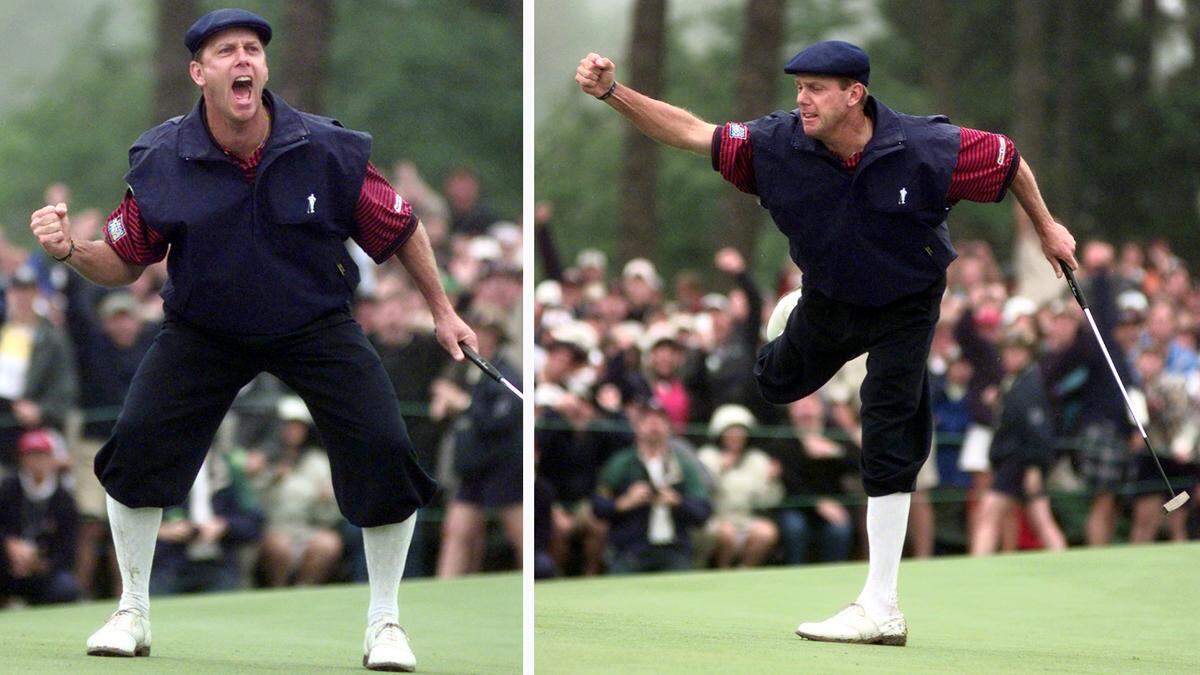
If you look closely at Payne Stewart’s scorecard from the final round of the 1999 U.S. Open, you can see how the pencil marks on the 17th and 18th holes are darker than the others, Phil Mickelson’s hand betraying his emotions as he kept Stewart’s score in the final pairing.
Kevin Robbins, the author of a new book on the final year of Stewart’s life and how it represented the final stand of a generation of finesse players as it gave way to Tiger Woods and a generation of powerful youngsters, was able to point this out on the actual scorecard Saturday in Pinehurst as it was held — in nitrile gloves — by USGA historian Hilary Cronheim.
It was on display as part of the USGA’s annual meeting at Pinehurst’s Carolina Hotel, where Robbins received the Herbert Warren Wind Award for “The Last Stand of Payne Stewart: The Year Golf Changed Forever” as the best golf book of the year, a confluence of fate that served as a reminder that, more than 20 years later, Stewart’s legacy hangs over Pinehurst to this day.
That’s in part because of the drama of Stewart’s win, in part because of his death in a plane crash four months later, in part because the next two winners — Michael Campbell and Martin Kaymer — were forgettable in comparison.
Regardless, the aura Stewart still casts — over a place with no shortage of history — is inescapable.
“I feel his presence here,” Robbins said. “I was over at the No. 2 golf course today and on the 18th green where he made that putt in 1999. I stood next to the statue, communed a little bit with him. It’s really remarkable. This is a special place, and it’s special to the story.”
But the USGA’s presence was a harbinger of the future, with the fourth U.S. Open at Pinehurst only four summers away, and an indication over the weekend that the fabled Donald Ross-designed No. 2 course will only become further entrenched in the USGA’s unofficial Open rotation beyond 2024.
“In so many ways for our country, this is the home of golf,” USGA executive director Mike Davis said. “For all of us when we come back to Pinehurst, it’s awfully special.”
As part of the meeting, the USGA unveiled its new branding campaign for the U.S. Open, focusing on the tournament as an annual event for the first time as opposed to starting over with each new year and each new site. A new tagline — “From many, one” — and ad campaign featuring actor Don Cheadle were the result of a survey of fans, volunteers, players and other stakeholders, but those weren’t the only outcomes.
One of the slightly unexpected consequences of the survey, according to the USGA, was the strong sense among players that not only where they play the U.S. Open, but where they win the U.S. Open matters. Likewise, among fans, there was an appreciation for playing the tournament on the best and most historic courses in the country.
“It’s so obvious,” said John Bodenhamer, the USGA’s director of championships, “but it just kind of sticks with all of us. … Going where they want to go is a big part of that. We’re still going through that journey.”
After a smattering of recent U.S. Opens at nontraditional courses and locations like Chambers Bay and Erin Hills, Saturday’s presentation offered a subtle hint that courses like No. 2 will get even more preference than they do now. Clearly, it is among the USGA’s preferred sites already.
“It’s not only a great test of golf, but from an operational standpoint, you can argue it’s as good as any U.S. Open site we go to,” Davis said. “There’s a lot of space between holes. Nice grandstand space. The fact that it sits on sand and drains so well, if there’s a rain event, you can get the golf course back much faster and it’s a better fan experience because you’re not walking in mud everywhere.”
Four Opens in 25 years, with the historic men’s-women’s double in 2014 thrown in, is already a Pebble Beach level of respect. Everything points to that and more going forward.
This story was originally published March 2, 2020 at 6:15 AM.