As coronavirus hit home, Bobby Lutz had a front-row seat for the beginning of the end
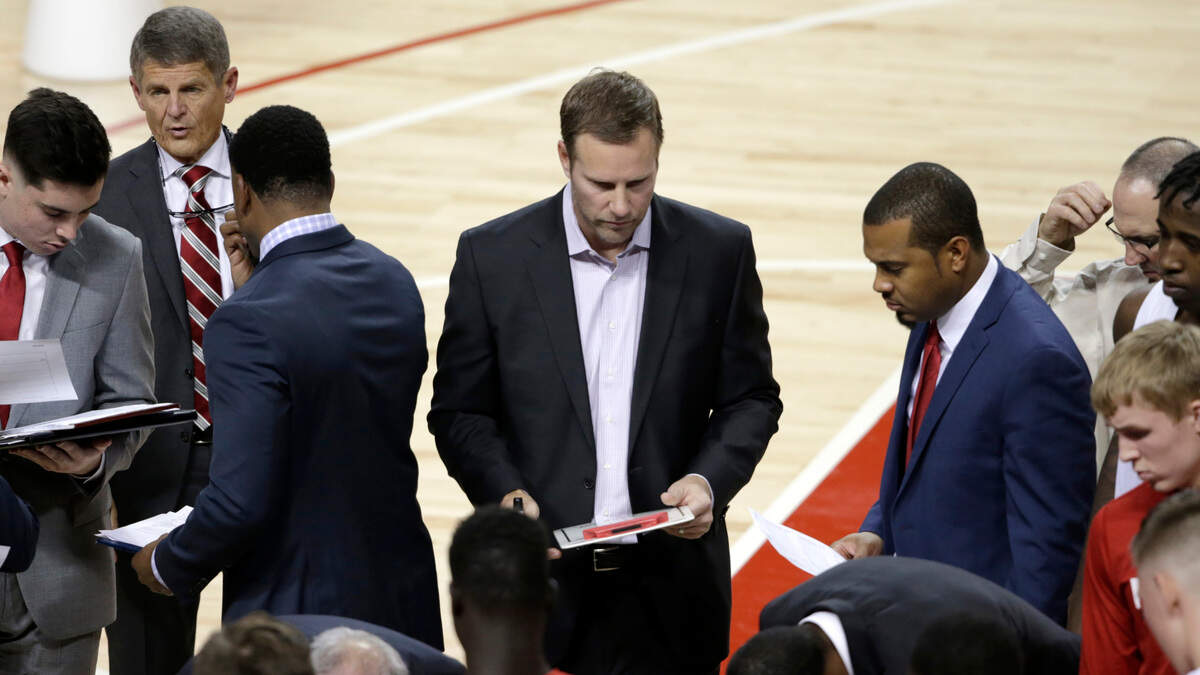
Bobby Lutz couldn’t see what America saw. He knew Fred Hoiberg, the basketball coach at Nebraska and his boss, had the flu. The common, regular old flu. The whole team knew it. But he couldn’t see the television broadcast of Hoiberg, on the bench, wiping his forehead with the back of his hand or hunched over with his elbows on his knees.
It would have been a grim scene at any time, but on that night, when the NBA had just shut down because of positive coronavirus tests, it was particularly freighted with meaning and ominous portents, as Lutz would soon find out.
“Obviously, he was not 100 percent healthy, but he was OK,” Lutz said. “We did hear at halftime about the NBA. Somebody checked their phone, so the awareness was there, but when you’re in the middle of the game, you’re not thinking about anything but that game. It was serious stuff that the Utah Jazz guys had gotten it, but we didn’t think about it that much. We just went back to business.”
Lutz — a North Carolina native, the former head coach at Charlotte, a former assistant coach at N.C. State and a special assistant to Hoiberg at Nebraska — would soon find out, with everyone else, that business as usual was over.
That night, when Nebraska lost to Indiana on the first night of the Big Ten tournament in Indianapolis, Wednesday, March 11 — only two weeks ago — was the moment the earth shifted under just about every American, sports fan or not.
In the span of a few hours, Tom Hanks and Rita Wilson announced that they had COVID-19. Rudy Gobert, who only days earlier had mocked the coronavirus, was one of two Utah Jazz players to test positive. And then there was Hoiberg on the bench, looking every bit like the star of an ominous opening scenes of a Michael Crichton disaster movie.
All of it, taken together, one after the other, made the coronavirus threat all too real, if to that point it had seemed undefined and vaporous. It was overwhelming, like seeing little vignettes of the world ending.
Lutz had a front-row seat for one of them.
He also wasn’t nearly as worried as anyone watching on television. He knew, as viewers did not, that Hoiberg had not been feeling well earlier that day and had tested positive for the common flu and, Lutz said, did not have coronavirus symptoms. Like many coaches and players before him, Hoiberg intended to fight through the flu, in a win-or-go-home game for the Huskers, and had clearance from doctors at the tournament to do so.
But as events elsewhere transpired, and Hoiberg looked worse and worse every time he appeared on camera, the Big Ten finally sent a message to the Nebraska bench at the media timeout with four minutes remaining in the game: Hoiberg needs to leave. Lutz, sitting at the end of the bench next to Nebraska officials at the scorers’ table, was the one who had to deliver the message.
“I go to Fred and say, ‘Coach, the Big Ten says you have to leave,’” Lutz said. “He said, ‘why?’ ‘I don’t know, coach. Maybe because you don’t look well. To be cautious.’ That’s why he left the court, because he’d been told to do so, even though he had been examined and cleared to coach. I want to emphasize that, because it bothers him that anyone would think he would do anything to put people at risk.”
If things weren’t already weird then, they only got weirder. Hoiberg was taken to a hospital for further testing and was gone by the time Nebraska waved goodbye to Indiana — the Big Ten squashed any handshake line — and entered its locker room, where the Huskers were told to stay. Indefinitely.
Outside the room, it was chaos, with rumors flying and friends and family texting the players and coaches locked inside. The impromptu quarantine was big news across the country, even if Lutz had been told the delay was just to clean and disinfect the team bus. Food was delivered. The players and coaches milled about, anxiously, under orders to maintain radio silence.
“Our main message was that Fred, coach Hoiberg, had been cleared, was sick, but did not have the virus,” Lutz said. “We didn’t want them worrying about that, but obviously they had to be worried. They knew this was not the normal protocol for someone who had the flu.”
After 90 minutes, the Huskers were released and took the bus back to the hotel, with a police escort from the arena all the way to the doors of the hotel elevators. Hoiberg was already there waiting for them, not feeling any better but having not learned anything new during his hospital stay. The next morning, the Huskers chartered back to Lincoln like normal — no police escort this time.
History will show the Nebraska-Indiana game was one of the last college basketball games played to its conclusion in 2020. Twelve hours later, the Big Ten tournament was canceled. Eighteen hours later, the NCAA tournament went with it.
Lutz, 61, is back in North Carolina now, at the house where he grew up near Denver, in Catawba County. His roots are here, and will stay here. It was a tough season at Nebraska, with 17 straight losses to close out the season, although Lutz knew what he was getting into with Hoiberg in his first year rebuilding the program. He could never have imagined it ending like that.
“It doesn’t make losing better or easier, but it puts things in perspective,” Lutz said. “That the most important thing, for everybody to hopefully come out of this. I have a friend who just called me who’s being tested for coronavirus and is the first person I’ve known that might have it.
“I never felt in danger. I still don’t feel like we were in danger at all. I’m glad that we weren’t. But I’m also not going to take things for granted, like coaching or going out to eat or going to church and all the things I like to do. It’s a very strange time to be alive in America.”