As North Carolina reopens, a restaurant hopes the community it built returns as well
Dan Cloos is used to an audience as he works the grill at his restaurant, his back to the line of customers along the counter waiting to order, most of whom he knows by name. No one watches now.
The orders are still coming in at Cloos’ Coney Island. The burgers and cheesesteaks continue to sizzle. The people are missing. The question Cloos can’t answer, that no one can answer, is whether they’ll come back when they’re allowed.
When it opened in 1988, just off N.C. State’s campus, Cloos’ might as well have been sovereign territory of Detroit, like an embassy overseas. All these years later, it has become a west Raleigh institution, as has Dan Cloos. His son Mark just turned 30. He grew up in the restaurant, sitting on the floor, before he could walk, in the warm breeze of the ice machine vent. Mark is still there every day, just like Dan.
As good as the food is, it’s only part of the restaurant’s appeal. Dan Cloos said business has remained steady over the past seven weeks, not far below normal, because it’s the kind of place customers want to support. Relationships built over three decades have kept Cloos’ afloat as a takeout joint during this pandemic, but takeout wasn’t what built those relationships in the first place.
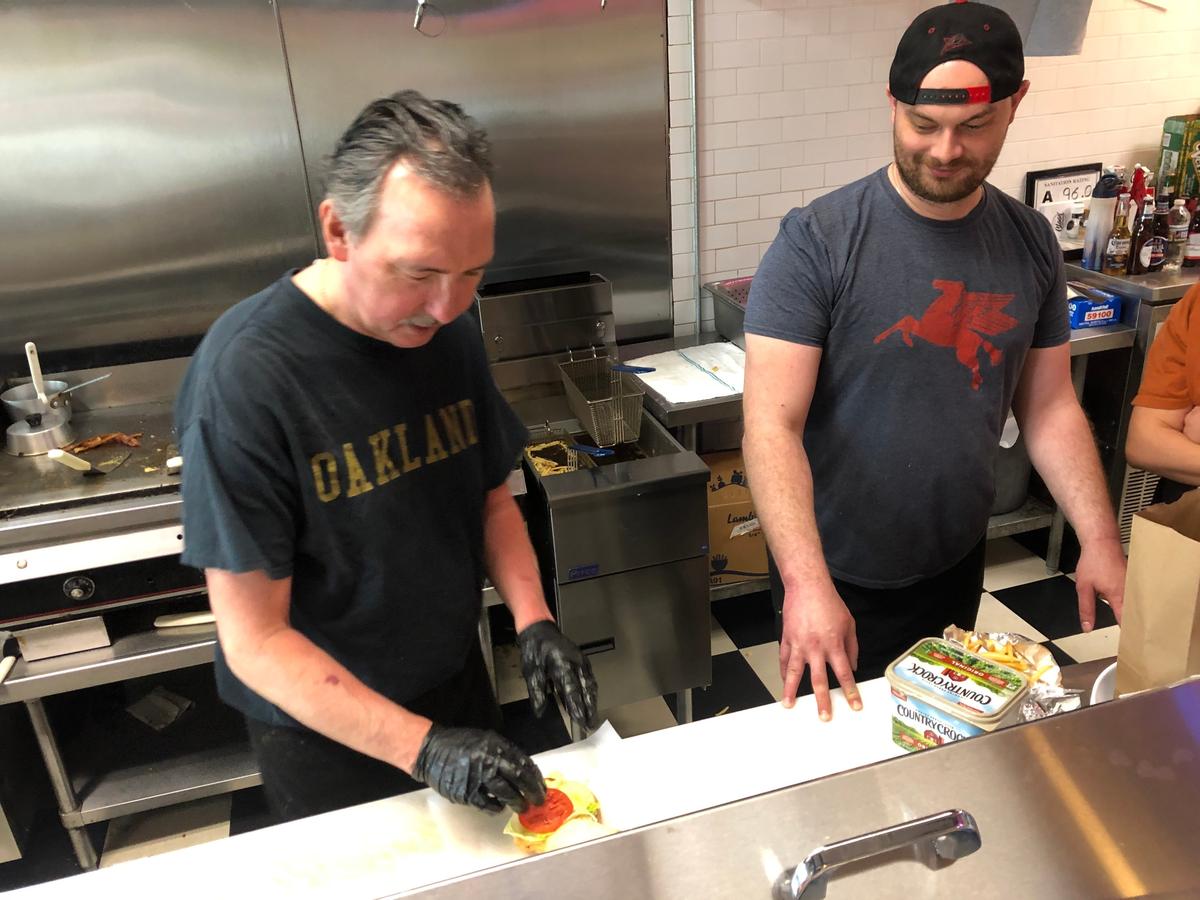
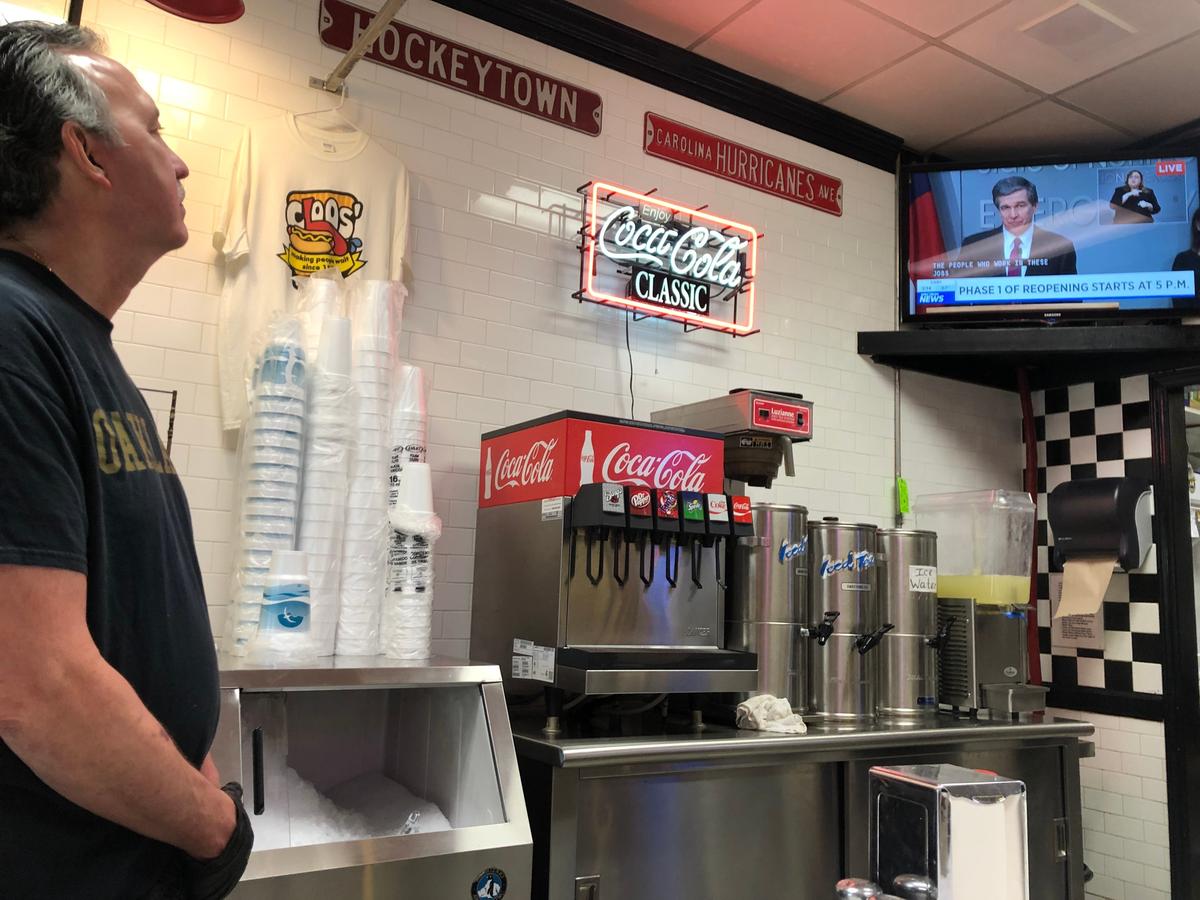
Speed has never been on the menu at Cloos’, where Dan or Mark makes every order to order, in order. (They sell T-shirts with the slogan, “Making people wait since 1988.”) In normal times, in what we used to think of as normal times, there would be people sitting shoulder to shoulder on the six stools at the counter, sharing the eight cozy four-top tables with strangers, as many people waiting for their food as eating it.
It is often an eclectic mix of coaches and students from N.C. State, construction workers in fluorescent vests, business people in suits, families on the weekends, a great many regulars, a cross-section of west Raleigh. Many of those same people wandered in Friday afternoon for takeout on the eve of North Carolina’s Phase One of reopening, picking up their usual orders and then wandering back out instead of lingering — a community disrupted.
“A lot of my customers know each other,” Cloos said. “It’s the beautiful thing about this place.”
Finding our comfort level
It’s also a fragile thing, in a situation like this. When Cloos’ and other restaurants are allowed to resume sit-down dining, at some point without restrictions on seating, how many of those regulars will actually want to cram back in, breathing the same air, sitting under an air conditioning duct, at Cloos’ or anywhere else?
Cloos thinks so, and hopes so, but he doesn’t know. No one really knows. The government can’t dictate that. That’s not a phase. There’s no chart that says, “Dinner out is an acceptable risk to me.”
We’re all going to have to find our own comfort level, balancing our health (and how we may inadvertently expose others) with our other wants and needs, making our own internal assessments of the current coronavirus danger level, as we each individually reopen phases of our life, whether that’s something as simple and mundane as eating dinner at a table in a restaurant or complicated as international travel.
Even when sports are back playing again, even when they reopen their arenas and stadiums to the public — whenever that will be — no one knows just how many people will actually choose to attend, to share the same space with 20,000 or 60,000 strangers for hours.
It’s not something that’s ever been a consideration before. That kind of communal experience was a benefit, not a threat.
“The social interaction, it will be really interesting how this will modify behavior long term,” North Carolina athletic director Bubba Cunningham said. “I’m glad we have individual seats now in Kenan (Stadium). When you’re sharing a bench and somebody’s over their 18 inches, that gets a little cozy. This is at least a little more dividing.”
Personal space will be a highly valued commodity in whatever new economy emerges from this.
Reopening is not merely a physical or statutory act. It is a mental one: the willingness to expose ourselves to others and be exposed, for those among us lucky enough to have a choice, anyway.
Protesters, in smaller crowds than the Carolina Hurricanes once drew in Greensboro, have nevertheless been able to frame a false debate between “reopening” and “staying closed.” No one wants to stay home forever, but if we flood public spaces too quickly, the last two months of sacrifice will have been wasted. That’s the real debate, between reopening sensibly and reopening recklessly, and two-thirds of Americans are worried about the latter.
Choices to make
When Cloos’ does reopen, at reduced capacity, with only four of the eight tables in use, Dan Cloos believes nothing will change. But he also knows as well as any of his customers the choices people will have to make.
Four years ago, he spent five months in the hospital after nearly dying of congestive heart failure. With the drugs and blood thinners he takes now, he’s the definition of someone at higher risk in this pandemic.
Cloos, 60, canceled an appointment with his cardiologist because he didn’t want to risk going to the hospital, but he has continued to man the grill every day, because he believes that when it’s his time, it’s his time. He hasn’t worn a mask, for his protection or anyone else’s, although he will probably have to start with diners in the restaurant.
That’s his choice. All of his customers, even as they have supported him through this pandemic, will have similar choices to make, whether they want to eat their food alone, or with each other, again. Whether it’s worth the risk.
“Herb, take care of yourself,” Cloos tells one customer as he exits.
“The best I know how. I’m tired of bouncing off the walls.”
“I can only imagine,” Cloos says. “I hear that a lot.”
This story was originally published May 8, 2020 at 5:13 PM.