John Blake’s death recalls days of scandal at UNC that now seem so long ago
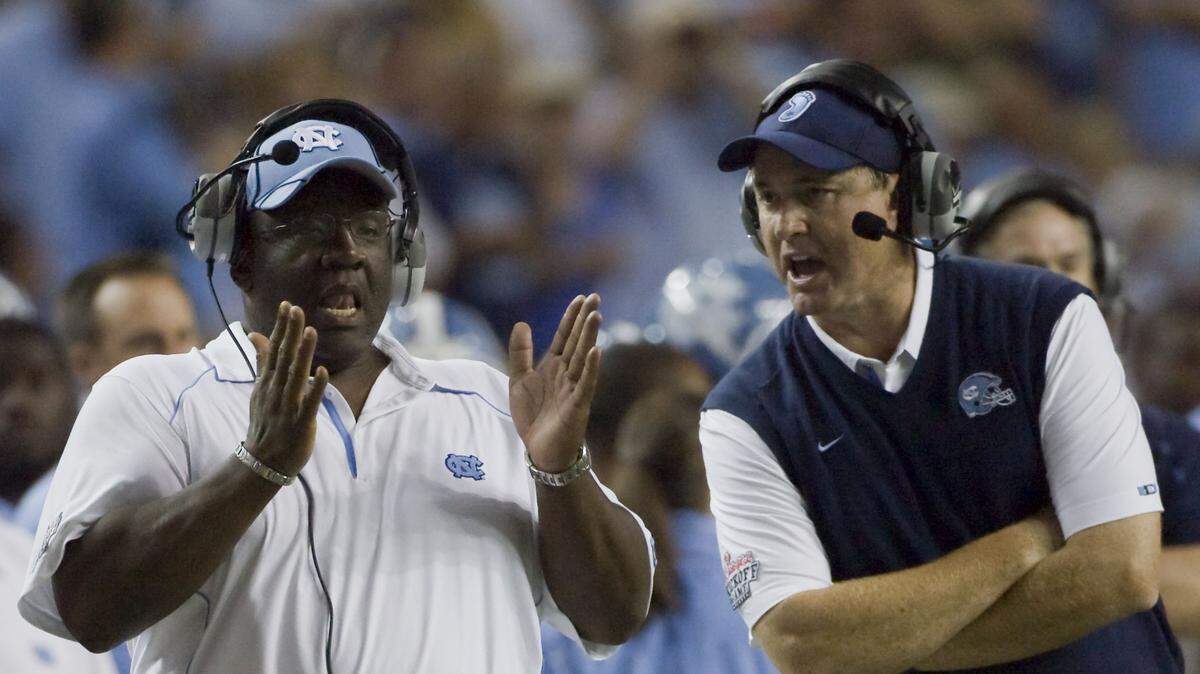
The name John Blake seems to echo from another time. It doesn’t so much identify a single person as it does an entire long-ago era of disgrace, a scandal that seemed massive at the time only to be quickly overshadowed by an even bigger one.
In other cases, when ruminating upon someone’s death, it might be an occasion to muse upon the unfairness of having one’s name serve as shorthand for ignominy. In the case of Blake, who died Thursday at age 59, it actually does justice to the tortured legacy he leaves behind, especially at North Carolina: beloved by the players he coached, sanctioned by the NCAA, blamed (scapegoated?) by an entire university.
Even more than Butch Davis, Blake exemplified and personified North Carolina’s desperate, win-at-all-costs pursuit of big-time football success almost two decades ago. It was in many ways an attempt to find a shortcut back to the glory days under Mack Brown after the program had gone awry under first Carl Torbush and then John Bunting. (A decade later, it would turn out that Brown was both the question and the answer.)
That the university even allowed Davis to hire Blake as his defensive line coach underlined just how many shortcuts UNC was willing to take at that point. Blake arrived with two Super Bowl rings, a strong reputation for recruiting and developing NFL-bound lineman and an even stronger reputation for bending the rules when it came time to seal a commitment.
But Davis pushed hard for Blake, who he had coached in high school. Some schools — and previously UNC likely would have counted itself among them — wouldn’t let someone like Blake on campus. It was a decision UNC would come to regret. Several of the players Blake recruited to UNC did indeed go on to the NFL, most notably Marvin Austin, but not before dragging the university through the NCAA mud first.
Would the rap lyrics Austin tweeted have sparked the massive investigation they did if Blake weren’t already there to attract the NCAA’s attention? Either way, it led to the discovery that the program was awash in agents and runners, even in the weight room. Meanwhile, Blake was in cahoots with agent Gary Wichard, running what appeared to be a pump-and-dump scheme with draft prospects, among other transgressions.
The NCAA unearthed evidence of Blake’s deep connections to Wichard’s agency, Pro Tect Management, and the Blake-Wichard clients always seemed to get favorable treatment from ESPN analyst Mel Kiper Jr., who swore Blake and Wichard were merely friends.
Every bit of it was ghastly for North Carolina, a school that had always prided itself on its squeaky-clean image. From the frame-by-frame Zaprudering of the players getting off the bus for the 2010 opener against LSU in Atlanta to see who was and wasn’t eligible — 13 players were ineligible and Blake resigned the next day — to the receipts and airline tickets that documented the illegal benefits players got from agents, the Davis-Blake regime brought only embarrassment to Chapel Hill, never an ACC title or 10-win season.
Whatever Blake did, though, was tacitly sanctioned by Davis and the university, from the chancellor on down. Because of his reputation, he became as convenient a place to pin the blame as anyone, even if he had only been doing exactly what he had been hired to do. In the end, Davis tried to shift responsibility to his old friend, trying to stave off his own inevitable firing for a few more months.
“I’m sorry that it has affected the football program,” Davis said in 2010, a month after Blake left the team. “But I’m going to tell you what I’m more sorry about, I’m sorry that I trusted John Blake.”
When the school settled with the NCAA in 2012, the football scandal had already unearthed the beginnings of a much bigger scandal that would take years to unravel. By the time the NCAA decided in 2017 it couldn’t prosecute UNC for decades of academic fraud, Blake was long gone and all but forgotten. The NCAA hit him with a three-year show cause penalty, essentially banning him from college football, and other than one year on the Buffalo Bills’ staff, that was the end of Blake’s coaching career.
There’s no doubt Blake was good at what he did. He had a short and unsuccessful stint as head coach at Oklahoma, his alma mater, but many of the players he recruited won a national title after he left. The man could coach defensive linemen. And he could recruit them, methods unknown. North Carolina certainly got that from him. And a lot more.
This story was originally published July 23, 2020 at 3:32 PM with the headline "John Blake’s death recalls days of scandal at UNC that now seem so long ago."