Another blowout loss sends Duke and David Cutcliffe into an offseason of uncertainty
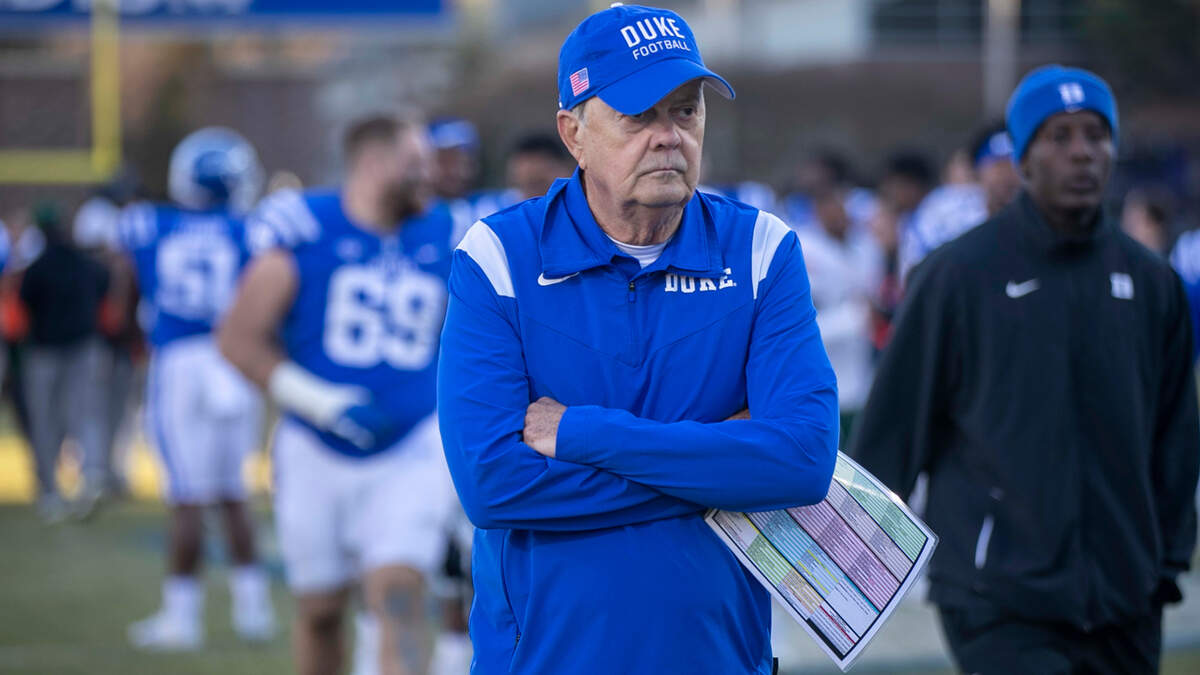
On the long walk in the lengthening shadows after the postgame handshake, David Cutcliffe stopped at the 30-yard line and turned to look at midfield. He stood there for a moment. Duke and Miami players moved past him like flowing water around a rock.
The game had long ago been decided, the season long ago lost, and now Cutcliffe looked back and over all of it, for what may have been the final time.
That was not, he said later, what was on his mind. He was thinking not about his future but about the players whose season ended with another loss, who haven’t won an ACC game in more than 13 months.
“What am I going to say to them?” Cutcliffe said. “Game after game after game, that might be a little harder than what you might think. That really was the only thing that was on my mind, those seniors and those returning players, and how hard they’ve worked and how disappointed they would be.”
In the end, it’s hard to separate the players’ disappointment from Cutcliffe’s future from Duke’s record. It all goes together. It’s all one thing.
Saturday’s 47-10 loss to Miami was a dismal end to a dismal season, yet another blowout loss as Duke went winless in the ACC for the first time since before Cutcliffe arrived on campus 14 years ago. The Blue Devils lost the final six games of this season by 25 points or more: 48, 38, 25, 31, 40 and 37.
There is absolutely an argument to be made that keeping Cutcliffe is still the best path forward for Duke and new athletic director Nina King, but it would be almost unprecedented. Even at Duke.
“That’s not where my mind is and I’m really not going to go into any thoughts or details in that regard,” Cutcliffe said. “I’ve got a job to do that’s current and right now, and that’s where my focus is.”
On the bright side Saturday: Jaylen Stinson had a 94-yard kickoff return for Duke’s only touchdown and Mataeo Durant had 68 yards to set Duke’s all-time single-season rushing record, a mark that had stood for almost 50 years, and did it the hard way, by grinding out yards against defenses increasingly stacked against him with no respect for Duke’s passing game.
And … that was about it.
Duke led 10-3 less than seven minutes into the game. Miami scored the next 37 points.
“Every week we came in locked in, ready to learn, ready to get better, ready to play,” Durant said. “It didn’t result in wins on a Saturday. But as a team we came in ready to go.”
The last 0-8 ACC season got Ted Roof fired and Cutcliffe was brought in not to rebuild but build Duke football from scratch. Which he did, only for everything to come full circle.
There has been strong “gradually, then suddenly” energy in Duke’s decline. After going 8-5 with a bowl win over Temple to end the 2018 season, Duke’s sixth bowl game in seven years, the Blue Devils started 5-2 the next fall with a win at Virginia Tech. One of the two losses was to Alabama.
Since then, Duke is 6-23.
Duke put a ton of money into football when Cutcliffe arrived, and the state of Wallace Wade now is testament to that. It actually looks like a real stadium now, and not some college football version of North Wilkesboro, covered in dust.
But since then, Duke has built new stadiums and practice fields for almost every other sport on campus while football has fallen behind not only Wake Forest but Appalachian State and East Carolina as well, its locker room and player amenities in desperate need of modernization.
Meanwhile, brain drain on the coaching staff has caught up with Duke. Since the division title in 2013, Duke has lost Kurt Roper, Scottie Montgomery, Jim Knowles and Derek Jones to better jobs and Jim Collins and John Latina to retirement. Some of them, like Montgomery taking the ECU job, as ill-fated as that was, were no-brainers. But Cutcliffe lost too many established, veteran assistants — Knowles is a Broyles Award finalist as the defensive coordinator at Oklahoma State — without comparable replacements.
That has hurt not only on campus but in recruiting. Duke has sent dozens of players on to the NFL under Cutcliffe but this team is bitterly and obviously outmatched at almost every position. All of the struggles — especially the propensity to give up explosive plays without generating any — track back to that. The recruiting pipeline that evaluated, landed and developed players who fit the school and the program to fuel Duke’s rise has apparently run dry.
All of that has to be addressed and corrected, no matter who’s coaching Duke next season.
So: Would Duke be better off taking the money it would have to put behind a new coach and giving it to Cutcliffe to see if he can leave things on a better footing for the next guy before Cutcliffe is ready to leave on his own terms in a few years?
As noncompetitive as Duke has been the past two seasons, it’s still a fair question to ask given the inherent gamble in changing coaches at a program like Duke.
One way or another, Saturday was the end of an era. Whether it’s someone new hitting the reset button or Cutcliffe given the chance to do it himself, that button has to be reset.
This story was originally published November 27, 2021 at 5:26 PM.