The ACC’s television deal is an anchor. How can the league improve it?
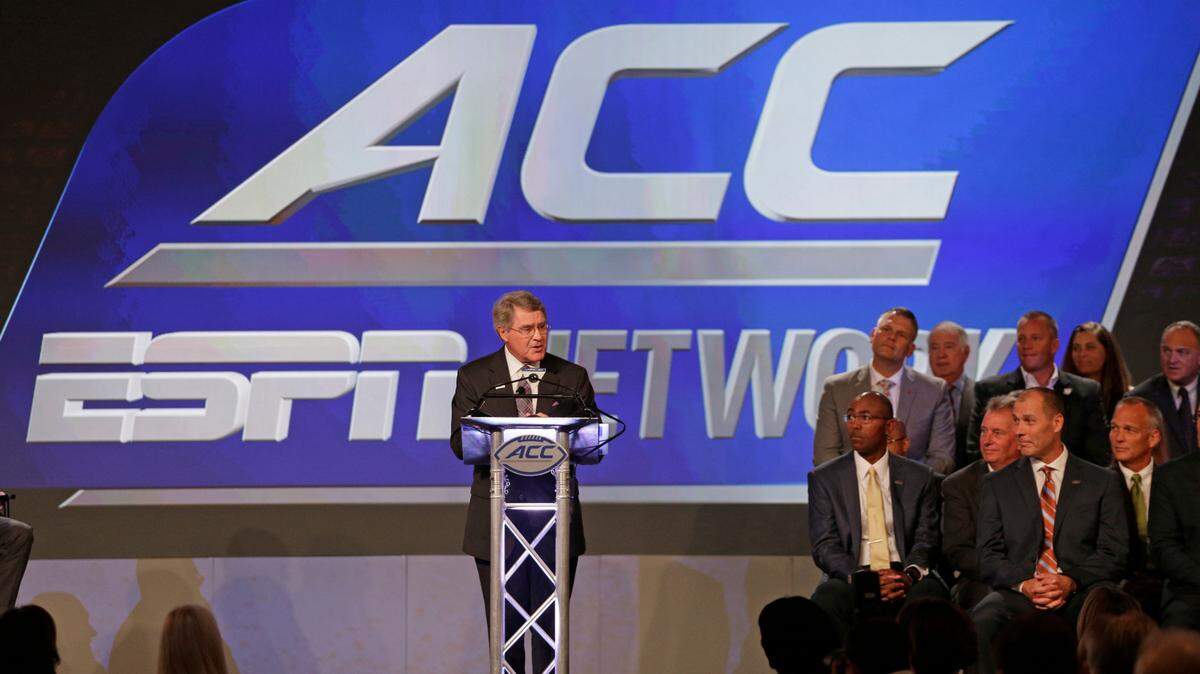
When ESPN closed a deal with Comcast in December to carry the ACC Network, it didn’t just close the last big hole in the ACC footprint. It delivered money directly to the pockets of ACC schools.
As a 50-50 partner with Disney in the ACC Network, the Comcast deal could be worth an additional $6 million per year per school or more, once the league and network settle their annual accounts in September. Adding value to the network remains one of the very few opportunities the ACC has to increase its television revenue, thanks to a deal with ESPN that runs through 2036 and has now left the ACC lagging behind the Big Ten and SEC.
Closing that “revenue gap” has been a top priority for new ACC commissioner Jim Phillips, but the length of the deal and the lack of common-sense expansion candidates are major hurdles, which has left the ACC looking for any angle it can to add value to the contract.
It should be a two-way street: Phillips said there’s a willingness in Bristol to meet the ACC halfway, and as much as ESPN has put its chips on the SEC, it’s also an equal financial partner in the ACC Network — invested not only in its success but the long-term health of the league.
“We are in constant communication with them,” Phillips told The News & Observer, “and we are both motivated to find a solution.”
The long-term deal does help to ensure the league stays together, thanks to the grant-of-rights agreement that binds teams to the ACC through its expiration — although even that may be up for grabs, especially as the end approaches. Even Phillips has said, with regard to the strength of the grant of rights, “your guess is as good as mine.”
Despite its stabilizing force, the length of the deal has become an anchor on the league’s ambitions. While the Big Ten, Big 12 and Pac-12 are headed back on the market in the next few years at a time when the demand for live sports programming has never been stronger, the ACC may have to sit out this cycle … and the next one … and the next one … as the revenue gap with the Power 2 grows bigger.
The ACC’s deal made sense at the time — and the ACC Network wouldn’t have happened without that long-term agreement — to capitalize on the strength of the conference at a moment of massive change in the television industry, when experts expected rights fees to plateau as consumers dropped cable and satellite packages in a wave of so-called cord-cutting.
But while that happened with non-sports content through the increased availability of high-speed internet and consumer adoption of streaming services like Netflix, Hulu, Peacock and Discovery Plus, live sports emerged as one of the very few properties that still drew people to high-priced pay TV providers. About eight hours after the ACC signed that deal, it went from overvalued to undervalued.
“The idea was you lock in huge revenue streams because a dollar today in basic finance is always worth more than a dollar tomorrow, so you lock in your distribution with these big media companies and you take the economics,” sports media consultant Patrick Crakes told the ACC Now podcast. “What happened was, as happens in all market economies, some disruption happened.”
Meanwhile, at a time when college football accounts for 80 percent of the economics in college sports and 100 percent of conference realignment, the ACC’s bargaining position has been diluted by the poor performance of some of its would-be or one-time football powerhouses.
“At the moment the ACC is very fortunate, I think,” Crakes said. “They kind of don’t count their blessings. There’s been underperformance among some of these traditional top brands on the football side of the ACC. Two years of Florida State and Miami being top-15 teams along with Clemson fixes that problem by itself.”
So, whether that happens or not, where can the ACC go from here?
The easiest way to reopen and grow the ACC’s deal with ESPN would be to add Notre Dame as a full football member, something that seems increasingly unlikely as time passes. The ACC had its chance to strong-arm the Irish during the 2020 COVID season and whiffed, letting the Irish have the milk for free. Instead, Notre Dame is still a free agent as its football deal with NBC comes up for renewal in 2025.

With a seat at the College Football Playoff table, whatever expansion eventually happens will suit the Irish’s desire to stay independent. If Notre Dame does jump anywhere, it would certainly make sense on the surface to go for the bigger money in the Big Ten in a few years. But that doesn’t mean the ACC shouldn’t try, even if it means abandoning the league’s traditional equal distribution of revenue to sweeten the deal for the Irish.
Adding other schools doesn’t make a ton of sense either, since a Cincinnati or West Virginia wouldn’t add enough marginal value to make more money on a per-school basis. The ACC could potentially expand outside its footprint by adding some combination of Oregon, Washington, California and Stanford, but that’s a dangerous Rubicon for the ACC to cross. Just because the Big Ten did it doesn’t mean it was the right thing to do.
“I’m not trying to be coy about it,” Phillips said. “All options are on the table. They have to be for the ACC. That’s where we’re at in 2022. I don’t think you run from it. You run to it and you start getting busy. Here are a bunch of options, and here are what the value would be. This is where it ends up, you’re going to have to do this in order to get that. You start playing those options out.”
Expansion isn’t the ACC’s only option. There remains the possibility of some altered or expanded relationship with ESPN that works as a sort of addition or addendum to the existing rights deal.
That may take the form of a programming partnership with the Pac-12, as has been much discussed since USC and UCLA announced their move to the Big Ten. The Pac-12 Network has suffered since launch from carriage issues — it’s still not available nationally on DirecTV, a huge miss — and doesn’t have a network partner the way the ACC and SEC (ESPN) and Big Ten (Fox) do.
The ACC Network has plenty of late-night inventory among the spurtle commercials; there may be an opportunity there, albeit at the risk of diluting its own brand. (It would be ironic if, after all those years chasing its own network, the ACC ended up a 50-50 partner in what was essentially a rebooted ESPN2.)
At the moment, as Phillips indicated, the ACC is waiting to hear back from ESPN to get a sense of what any of these various options might be worth, and the ACC isn’t the only one. The Pac-12 and Big 12 are waiting for a response as well. What ESPN’s money people forecast could further reshape the conference landscape.
There might be a pause after the Big Ten’s West Coast swoop and the SEC’s addition of Oklahoma and Texas last summer, but in three or four years those conferences will be able to go back to ESPN and Fox for more money from more expansion. If it doesn’t happen now, it will soon.
“We’re going to end up with like 3.5 conferences in the end,” Crakes said. “We know who two of them are. The question is, what will happen with everything else?”
Never miss a Luke DeCock column. Sign up at tinyurl.com/lukeslatest to have them delivered directly to your email inbox as soon as they post.
This story was originally published July 30, 2022 at 6:10 AM.