NCAA rev-share era finances already impacting rosters, if not coaching styles
AI-generated summary reviewed by our newsroom.
- Revenue-sharing rules now shape college rosters alongside eligibility limits.
- Coaching staff balance NIL demands with athlete development and court duties.
- Roster turnover increasingly reflects NIL budgets and cap-driven trade-offs.
We’re almost two weeks into the new era of college sports when schools can pay athletes directly — sorry, share revenue with them — which suggests that coaches (and their new general managers) are going to have to learn new ways to manage a roster without the usual quiver of threats and unkept promises.
Then again, for Will Wade, it looks pretty much the same.
“I was at the forefront of the other NIL movement,” Wade joked Wednesday, yet again alluding to the under-the-table payments that got him fired at LSU and are now standard over-the-table operating procedure in college athletics, at his new job at N.C. State and everywhere else.
All joking aside, one of the most specious sky-is-falling warnings against NIL before it became a thing was that it would pit teammate against teammate financially, tearing apart locker-room chemistry. This was, of course, nonsense. Not only did one have to look at pro sports to see that wasn’t the case, but in practice players have been thrilled to see their teammates cash in, as Cooper Flagg’s Duke teammates were for him last year. His grandmother, too.
The same has been true of coaches managing rosters. Some of the older-schoolers — Bill Self, Tom Izzo, Kelvin Sampson — made a seamless transition to the new era while others threw up their hands and walked away, but the principles haven’t changed.
“It’s all the same,” Wade said this week. “Damn, they were getting paid before! It’s all the same. There’s no difference with any of it. I mean, look, I guess what you’re asking is this: If you try to coddle them and be nice to them and give them everything they want, they’re still transferring. You might as well coach them how you want to coach them and play them how you want to play them, and at the end of the year, we’ll figure it out.”
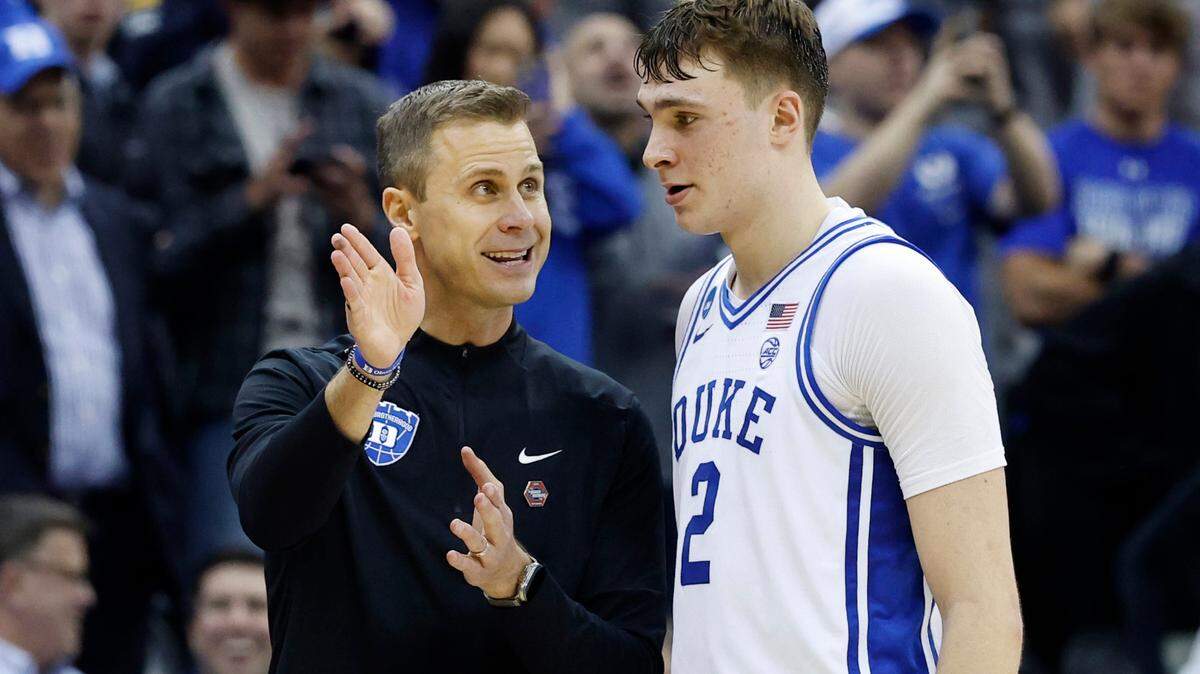
If there is a new dynamic in this new world, it’s helping players balance their new off-court commitments with their on-court duties. That was one of the things Jon Scheyer learned last season with Flagg, who entered college with the endorsement portfolio of an NBA star — New Balance, AT&T, Gatorade — before even stepping foot on campus.
There may not be another Flagg anytime soon, but brokering NIL deals remains a considerable element of Duke’s basketball recruiting process, as it was for this year’s star freshmen, the Boozer twins Cameron and Cayden. That’s something Scheyer, as a coach, has learned to help players manage.
“So much now is thrown at anybody we’re recruiting right now,” Scheyer said. “They’ve had opportunities for money. They’ve had opportunities for brand deals, promotions, you name it. I thought that group did an amazing job, and Cooper was the prime example, of keeping the main thing the main thing. And knowing if you do it the right way, if you knock it out of the park at Duke, not only is the financial aspect going to be there for you, but for your life you’re going to be in an amazing position. I thought Cooper did an amazing job of just being present, being the best player he could be in the moment.”
Alongside that external pressure, there’s internal pressure as well, the business of managing a roster under both the revenue-sharing cap — set sport-by-sport by each school under the $20.5 million total — and whatever NIL resources a school can bring to bear. At N.C. State, Wade said the Wolfpack front-loaded all of its NIL deals ahead of July 1 so they wouldn’t have to pass through the new NCAA clearinghouse to determine “fair-market value,” a phrasing seemingly custom-made to tempt a new tidal wave of antitrust challenges.
Even then Wade hinted the Wolfpack overextended itself in the race to rebuild the roster after he was hired, which led to center Paul Mbiya decommitting and going to Kansas instead. After Mbiya committed, the Wolfpack landed North Carolina veteran Ven-Allen Lubin and Texas Tech star Darrion Williams, apparently depleting the pool of money available.
“It’s not Paul’s fault,” Wade said. “I want to be very clear about that. It’s not his fault, it’s our fault. I’m saying the kid wanted to come. We couldn’t facilitate it happening.”
In the old days, all N.C. State would have needed was an open scholarship. (And maybe a “strong-ass offer,” as much as everyone pretended that wasn’t happening.) Now, there’s a financial component that has to fit as well.
Coach ‘em up, sure, just like before — but make sure to pay up.
Never miss a Luke DeCock column. Sign up at www.newsobserver.com/newsletters to have them delivered directly to your email inbox as soon as they post.
Luke DeCock’s Latest: Never miss a column on the Canes, ACC or other Triangle sports
This story was originally published July 10, 2025 at 10:46 AM.