After years of planning, Lenovo Center construction finally kicking up dust
AI-generated summary reviewed by our newsroom.
- Lenovo Center's $100M first-phase renovation targets completion by hockey season.
- Upgrades include bunker suites, a view bar, and phased concourse reconfigurations.
- Future exterior plans add parking decks and mixed-use development near arena.
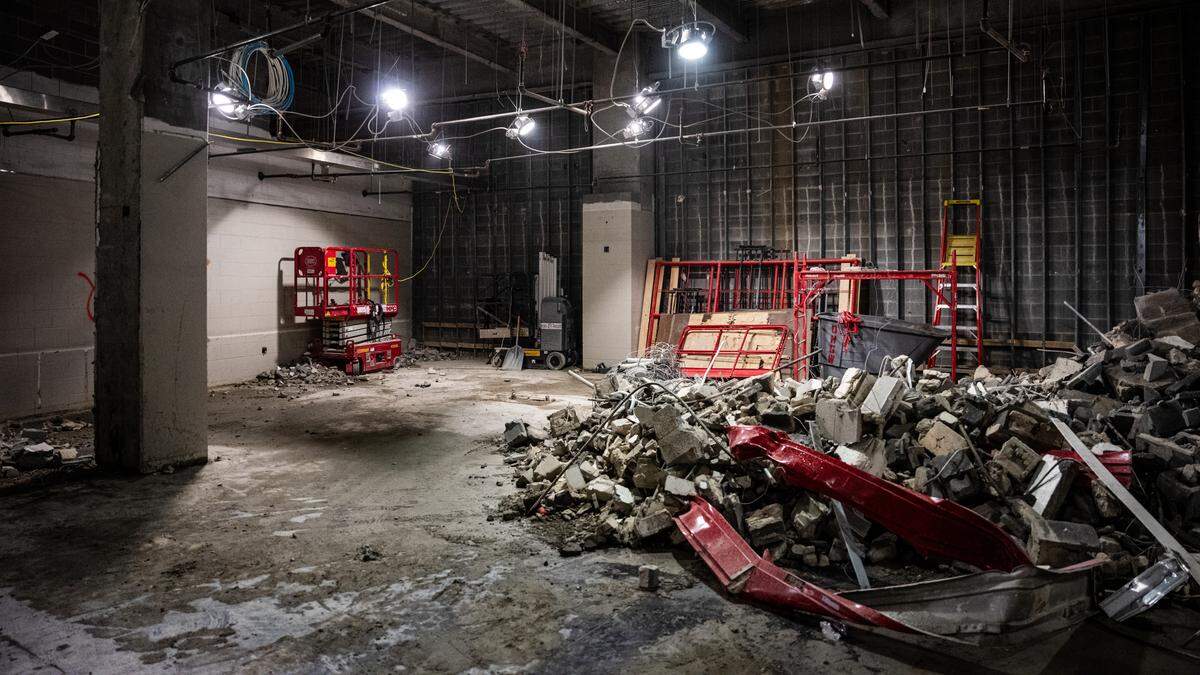
After years of discussion, months of preparation and weeks of work behind the scenes and under the building, construction on the $100 million first phase of Lenovo Center is finally in full swing.
The ice is gone, replaced by the beeping of construction equipment and a cloud of dust that hangs in the air above the scoreboard. Under the stands, space has been cleared for six new “bunker suites” behind the south goal as well as a new multi-purpose space. And in the upper corner of the arena, three sections of seats have been removed as demolition and construction continues on the new bar that will overlook the arena bowl.
And now, the race is on to have all of that done in time for hockey season, which is less than two short months away, not to mention on a tight budget given rising construction costs. Meanwhile, planning continues for the next two summers of construction, another $200 million of work on the rest of the arena.
“Our intention is to have this ready as fast as they can,” Philip Isley, chairman of the Centennial Authority, which oversees the arena, said at a media briefing Wednesday. “We’re moving forward with a lot of significant construction right now and we expect that fans will be able to enjoy these (improvements) for the next season.”
Some changes have been made from what had been announced in January. Not all of the seats in the three sections that will become the “view bar” have been removed, as originally planned; the uppermost seats adjoining the back wall of the arena will remain. And improvements to the 300 level — removing excess staircases to add more bathrooms, concessions and other fan amenities — will continue in phases beyond the summer.
“That will take throughout the entire season to get done,” Carolina Hurricanes CEO Brian Fork said. “We’ll do it quad by quad by quad. There will be some construction walls in temporary areas that fans can walk through as we move through, just as with the concerts the last three weeks.”
Fork said four of the six bunker suites sold before they were even marketed, and the team envisions the upper-level view bar being open to any ticketed fan, and possibly as standing-room space during the NHL playoffs — a gathering space for fans who don’t want to be moored to a single seat but still want to be able to see the game.
“That seems to be the new general trend with respect to these new builds we see all over the nation,” Isley said. “So we think this is actually getting us to a place that’s certainly going to be unique in North Carolina, but it’s also a very tried and true amenity.”
Changes to the seating bowl, main concourse and club level — as well as an expanded loading-dock area to allow for increasingly complicated concert load-ins — will happen over the next two summers, although exactly what and when has yet to be determined by the Centennial Authority. But for the first time, there’s real work under way to an arena that has always been kept mechanically sound but was definitely starting to show its 25 years of age.
Outside, the development of the land outside the arena is still scheduled to begin at the end of N.C. State’s football season. Currently, that includes the conversion of two parking lots to the southeast of the arena into parking decks to allow for further development of lots adjacent to the building into offices, restaurants, housing and everything else that goes with the billion-dollar mixed-use development Hurricanes owner Tom Dundon is overseeing.
The development agreement protects areas of surface parking near the arena for football tailgating, and the parking lots to the south of the arena surrounding Carter-Finley Stadium remain under the control of N.C. State, but athletic director Boo Corrigan said he continues to hear from fans who are concerned about football parking.
“We have the best and worst problem in college sports,” Corrigan said. “We have unbelievable parking, and anything that changes is going to change that. I think that’s the single biggest issue, that people are worried about the parking, and where they are and where they’ve been. You know, we went through the same thing when the (football indoor practice facility) was built, right? It changed, right?
“So the one constant is change, is what it is. I think they’re excited about the opportunities to come out early, to stay after a game, to be a part of that. But until we actually see what that is and how it does change, I think that’s the biggest fear — change.”
That’s no doubt going to continue as work on the development proceeds over the next decade, but at least inside the arena, there’s tangible progress being made on a building that desperately needed a refresh, and is finally getting one.
Never miss a Luke DeCock column. Sign up at www.newsobserver.com/newsletters to have them delivered directly to your email inbox as soon as they post.
This story was originally published July 30, 2025 at 5:05 PM.