
Former N&O reporter hosts TV show exploring historic artifacts
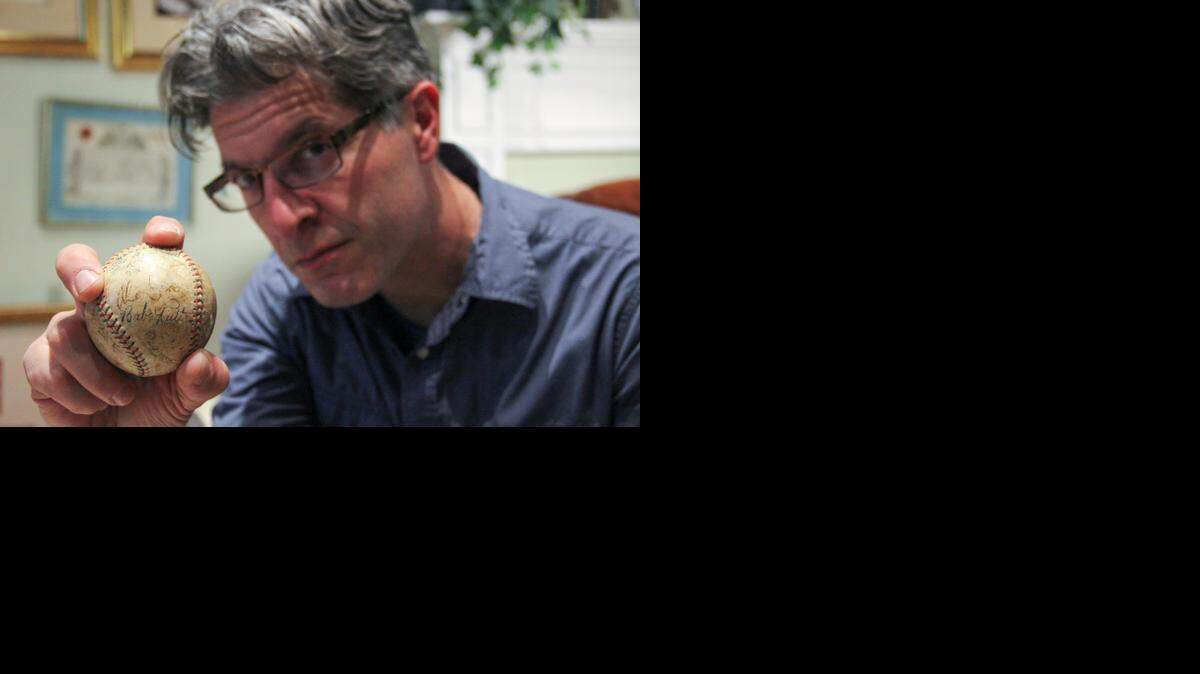
Geoff Edgers has a stronger sense of adventure than one might normally attribute to an arts writer. Edgers, the national arts reporter for The Washington Post, debuts his second television series at 10 p.m. Tuesday on the American Heroes Channel. “Secrets of the Arsenal” has Edgers traveling the nation telling stories behind some of history’s forgotten yet fascinating artifacts.
His first episode has him target-shooting with a longarm rifle like the one Sheriff Harry Morse used to kill outlaw Juan Soto in 1871 (the story of the Morse-Soto shootout is featured in the episode). In his previous series, “Edge of America,” which aired last year on the Travel Channel, Edgers roamed coast to coast bike-jousting, climbing a 125-foot ice wall and eating the still-beating heart of a rattlesnake.
Edgers wrote about arts for The News & Observer from 1996 to 2002, and for the Boston Globe from 2002 until just a few months ago, when he took the arts job at the Post. He also made a documentary about his quest to reunite The Kinks rock band, called “Do It Again,” which played at the Full Frame Documentary Film Festival in Durham in 2010.
We caught up with Edgers, who lives with his wife and two children outside Boston, to talk about the second chapter in his television career.
Q: On “Edge of America” you had a lot of adventures that put you in physical danger a few times. Will “Secrets” be a little easier on your insurance deductible?
A: There is something special about saying you castrated a bull in your first episode, as I did on my Travel Channel series.
But what I loved about “Secrets” is that I got to do what I love to do anyway – learn about amazing stories and get my grubby paws on the real things connected with those stories. I mean, I handled the first medal of honor given out and Annie Oakley’s gun. They let me go into the cockpit of the B-29 bomber that dropped the atomic bomb on Nagasaki. And after leaving that cockpit, a man was standing by to check whether I’d picked up any radiation by testing my fingers with a Geiger counter.
Q: Some of the artifacts you feature are well known, but some are fairly obscure. How does the show find them?
A: Our Red Rock production team is very talented ... That’s the key to the show, really, to find fascinating objects that allow us to tell even the best known stories. The Revolutionary War is a great example. When you spend time with the letter George Washington wrote to his spies – and you get a hands-on lesson on how to mix the chemicals that make up the invisible ink – you develop a new appreciation for that moment in history. Same goes for the Mauser seized from a German U-Boat. The object itself is unexceptional. What’s incredible is the story behind it, of an American serviceman seizing the gun under great duress.
Q: Do you have a favorite story or experience from this season you can tease?
A: I was able to buy a practice bomb from World War II from one of our featured experts. He had it in a corner. It looked like a real bomb and was dated 1943. And the collector said it would be $50. I wrote him a check and loaded the thing into the passenger seat of my Mustang. For some strange reason, my wife didn’t say anything, even when my son and niece began carting it around the neighborhood in a wagon at one of our gatherings.
I think there are several favorite stories. But for me, the most fascinating piece is meeting real soldiers who did things I can’t even imagine doing myself. Robert Graham, the leader of a special ops unit in Vietnam, basically found himself under attack in a bomb crater in Cambodia, his arm gushing blood, and jammed his finger into the wound and blasted his way out. He got out, got repaired and then headed back into battle.
Going to these military museums was eye opening. The primary source materials at these places are stunning. The West Point Museum, in New York, isn’t glitzy or crowded, but they have Napolean’s sword and Hitler’s gold pistol. The Museum of the United States Air Force in Dayton, Ohio, is one of the best museums I’ve ever seen.
I also really enjoyed the first-hand lessons I experienced. I got to learn how to use signal flags with a group of Civil War re-enactors. You get a different feel for that war when you’re standing on a rolling hillside, in the middle of the country, and trying to communicate vital signals with another unit hundreds of feet away. I’ll also say that we went to a local farmstand after and had some fantastic ice cream. There is nothing weirder than enjoying a double-scoop with a bunch of people wearing Civil War uniforms.
Q: I like that each story has a dramatic re-enactment. Were you ever tempted to ask for an acting role?
A: I sort of left those to our series producer, Rob (Kerr), and our episode directors. We did have some fantastic cameos. Doug Nelson, one of those directors, did an incredible job stepping in as Captain Fluckey, a submarine commander during World War II. Another director’s wife stepped in and played Bonnie in a Bonnie and Clyde re-creation.
This story was originally published December 15, 2014 at 2:13 PM with the headline "Former N&O reporter hosts TV show exploring historic artifacts."