
Chrysanthemum devotees work to protect cultivars
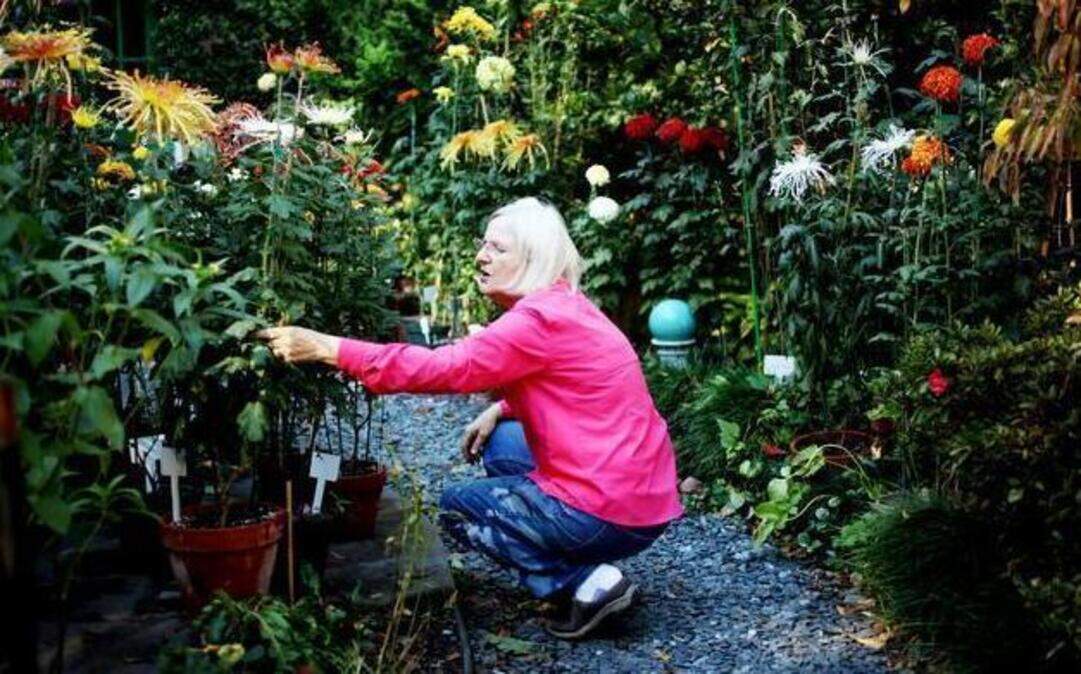
The chrysanthemums in Joan Matthews’ Raleigh garden bear little resemblance to the supermarket variety that pop up on America’s porches every fall. Instead, imagine colorful flowers a foot across, some with spidery petals reminiscent of fireworks exploding in the sky, others fluffy pompoms as big as a baby’s head.
These are the unusual varieties that she and other enthusiasts grow for more than their beauty alone.
“The state of these fancy chrysanthemums is very precarious,” said Matthews, who discovered too late that a rare plant she once cherished no longer exists. “If we don’t have more people involved in growing them, we may lose some of these blooms in our garden. I don’t want some of these cultivars that are so beautiful to be lost forever.”
The cultivars – mums produced by selective breeding – aren’t widely available. The U.S. supplier, King’s Mums, lost thousands of plants last year and a new owner is working to keep the company afloat. So survival of the rarest varieties hinges on gardeners such as Matthews and her prize-winning mentor, Ray McVay of Apex, who snip and root and share cuttings with others who will, in turn, do the same.
To promote that sharing, Matthews and others have revived the Central Carolina Chrysanthemum Society, which disbanded in 2007. It meets monthly at JC Raulston Arboretum in Raleigh and welcomes new members. Its second meeting is Monday.
At a time when involvement in civic clubs has fallen off and membership in the National Chrysanthemum Society has dwindled to about 425, the local club’s first meeting drew 27 people, a hopeful sign. Spring is prime time for getting new plants started.
Getting ready
Before the calendar turned from frigid February to milder March, Matthews was preparing.
Carefully labeled specimens sprouted in her dining room, on a sunny, enclosed porch and in a cold frame on the patio. In an experiment, some of her container-grown mums spent the winter on their sides, under a frost blanket. Her Five Points garden boasts all 13 cultivar types and more than 130 varieties of those 13. Spider mums, with their delicate “tentacles,” are her favorites.
Matthews was “enthralled” when she saw one “as big as a dinner plate” that McVay displayed at a show several years ago. Since then, she has plugged into a community of enthusiasts as far away as India who trade tips and swap photos of prized specimens. The Central Carolina Chrysanthemum Society aims to build on that, with month-by-month strategies for producing eye-popping mums.
Though Matthews, a retired Wake County ESL teacher, devotes a couple hours a day to her collection, she said mums aren’t fussy. And, she added, you don’t need a greenhouse to have a spectacular display.
“When it’s 60 at night, you can break pieces off and they will root like crazy,” she said, thumbing through records detailing when each of her mums was potted, pruned, staked and shared. The results speak for themselves: Matthews became a national prizewinner the only time she entered her mums in competition, and her garden is slated to grace the cover of Country Gardens magazine’s fall 2015 issue.
‘Let people see them growing’
The magazine cover is just one way of calling attention to mums.
North Carolina enthusiasts will show chrysanthemums at the 2015 N.C. State Fair, and though she doesn’t like cutting flowers because she prefers to enjoy them in the landscape, Matthews shares arrangements with other garden clubs to cultivate their interest.
“The key thing is to let people see them growing – that’s the biggest influence,” she said.
And that’s why, when King’s stopped shipping last year, Matthews put out a call for cuttings to share with the William Louis Culberson Asiatic Arboretum at Sarah P. Duke Gardens in Durham. Growers all over the country responded.
And visitors liked what they saw, said horticulturist Michelle Rawlins, who displayed 62 strategically placed mums last fall.
“They were a big hit,” she said. Rawlins is propagating more to add to the 12 cultivars she plans to keep from last year and plans to add a few new cultivars from King’s.
“I’m pretty sure I can’t handle more than 30 different cultivars, so I’m going to stop there,” she said. “It is a bit addicting, I’ll admit.”
Rawlins, McVay and Matthews hope the Central Carolina Chrysanthemum Society will get others hooked, too.
Miller: 919-829-8901
Growing mums
Mums can be grown in the ground, in containers and even as bonsai. To grow standout chrysanthemums that will bloom September through first frost:
▪ Plant the largest flowered types as soon as weather and soil conditions permit. Small-flowered types can be planted as late as July.
▪ Provide good drainage. Amend soil with manure, compost, leaf mold or peat moss; a raised bed is ideal. Apex grower Ray McVay says: “Chrysanthemums like ... a soil pH of 6.5-7.0.”
▪ Give plants four to six hours a day of full sun.
▪ Watch the water. Mums don’t like wet feet. “The worst thing for mums is for their roots to get waterlogged,” said Joan Matthews of Raleigh. “That’s why they’re so good for us, because we have such dry periods.”
▪ Choose clay containers, which are porous and let plants breathe.
▪ Regular use of a high nitrogen and potassium fertilizer will increase flower size and numbers.
▪ For the largest flowers, remove all buds except for the larger central bud, a type of pruning known as disbudding that directs the plant’s energy to flower production. Use stakes for support.
▪ Watch for aphids and other unwanted pests, and spot treat individual plants to prevent infestation from spreading.
▪ Protect mums during winter in a cold frame, on a porch or in the garage. Or lay them sideways on the ground, covered with a frost cloth.
Sources: Joan Matthews, Ray McVay and King’s Mums, LLC.
Join the society
The Central Carolina Chrysanthemum Society meets at noon on the third Monday of the month, from February to September, at JC Raulston Arboretum, 4415 Beryl Road, Raleigh.
First meeting is free; annual dues after that are $35, which includes membership in the local and national societies, two plants, a handbook and the quarterly journal, “Chrysanthemum.”
For information, send email to ccmumsociety@gmail.com.
Learn more
National Chrysanthemum Society mums.org
King’s Mums, LLC kingsmums.com
▪ See cultivar mums in bloom this fall at the William Louis Culberson Asiatic Arboretum at Sarah P. Duke Gardens in Durham and in the Family Garden area of the N.C. Botanical Garden in Chapel Hill.
This story was originally published March 20, 2015 at 10:00 AM with the headline "Chrysanthemum devotees work to protect cultivars."