
Unicyclist's cross-country trek yields tales from one tired traveler
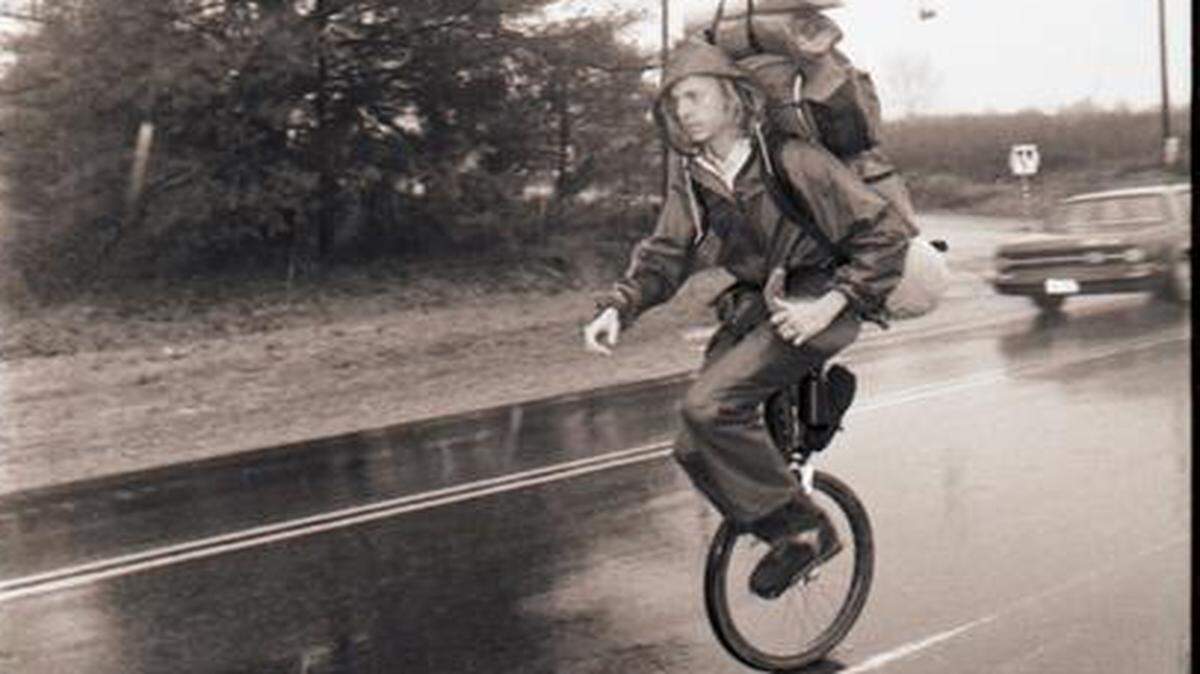
A unicycle slows a body down.
And that is the main point that Mark Schimmoeller makes in his book, “Slowspoke: A Unicyclist’s Guide to America.”
As Schimmoeller rode cross-country in 1992 on a unicycle, he experienced the beauty of the countryside, and though he chose whether to continue on his sometimes-painful trip, he could not know what might happen as he rode along highways, battling with traffic and fatigue. He gave himself up to chance.
Schimmoeller took to riding a unicycle as a teen. Even then, he did not like being hurried.
For a while, he was a graduate student in the master’s in fine arts writing program at Warren Wilson College in Swannanoa, N.C., just east of Asheville. When a writing internship fell apart, he created another narrative opportunity: the unicycle trip.
The unicycle’s pace would mean an unrushed experience. But the realities of his journey quickly overwhelmed him: Traffic zoomed by, unnerving him. The physical demands were far beyond what he anticipated. And he didn’t like the stares and attention from passersby.
When his sister dropped him off in North Carolina to begin this adventure, he experienced his hardest day of the entire six-month journey.
Schimmoeller decided to hike instead, and strapped his unicycle to his back. That didn’t work either. He would return to his unicycle and hope for long, flat roads with no cars.
As he rode, his strength and patience grew. He would feel alternately vulnerable and mighty. There was always a negotiation between him and gravity.
A good place to camp and a good meal created pinnacle moments.
He treated himself to one hotel night in every state. He managed his expectations by sometimes shielding his eyes from mile markers. The state line was always farther than he thought.
The unicycle is not an easy vehicle to master. It requires perseverance. I rode one for years and found it a physical and mental challenge. It is demanding of concentration, balance and core strength. But it also is just plain fun. To take it cross-country is, well, not on my bucket list, but what did inspire me was his encouragement for all of us to find time to pause and look around.
That is what makes his book worth reading.
Readers will experience his enthusiasm for preserving nature (he and his wife live simply in their 600-square-foot Franklin County, Ky., home on solar energy and firewood) his belief in finding your own pace and his exuberance in this accomplishment.
In “Slowspoke” he writes well and persuasively about the beauty of slowness:
“You don’t have to be a unicyclist to experience this,” he says on his blog.
“You can experience this listening to a piece of music, or being in the woods, or making something well. The important thing is to discover whatever that activity is that slows time for you.”
Ann Caulkins, publisher of The Charlotte Observer, learned to ride a unicycle at age 8.
Schimmoeller on the road
What he rode on his journey: “I started out riding a 24-inch-wheel Schwinn unicycle and made it halfway across the country. In Kansas City, I met a mechanic who told me where I would’ve been at that moment if I had a unicycle with 26-inch wheel: I would’ve been closer to the Oklahoma panhandle. He offered to build it for me, and did so from scratch. The towns were getting farther apart, so the one he made had holes under the seat, to hold water bottles. That’s the unicycle I have now.”
When he rode: “Between March and November, 1992. I took the summer off and made the trip in two parts.”
Where he went: “I left from Francisco, a place (in Stokes County) that was five miles from Hanging Rock State Park. The trip ended at the Navajo Nation, in Arizona, at Lukachukai.”
Worst stretch: “That first five miles. It occurred to me that this indeed was going to be a physical feat, and I hadn’t prepared for that. I felt physically exhausted.”
Best stretch: “After I got stronger – that was a euphoric moment. I could own my own movements, without cars passing me and not feeling motionless and foolish. In North Carolina, outside Dobson was good for me. Kids passed me in a school bus and cheered me on. That made me feel good.”
Are flat roads easier? “Not necessarily. Kansas was pretty bad. I found out that most cross country bicyclists go the other way, west to east. I was riding against the wind.”
Which is harder, uphill or down? “Probably uphill, on steeper slopes. I would take them as walking breaks, which I needed anyhow.”
Spills and falls: “I had a potentially pretty bad one in Kansas, when my wheel hit a rock and spit out from under me. It caused me to fall on my back, but my backpack cushioned me.”
This story was originally published March 27, 2015 at 2:19 PM with the headline "Unicyclist's cross-country trek yields tales from one tired traveler."