
NC pension fund remains committed to its hedge fund investments
A simmering debate about whether state pension funds should invest in hedge funds has been thrust into the spotlight now that the nation’s largest public pension fund has unveiled plans to divest a $4 billion hedge fund portfolio.
The recent move by the California Public Employees’ Retirement System, or CalPERS, a bellwether pension fund with $300 billion in assets, has raised questions about whether other state pension funds will follow its lead.
Some hedge fund critics – who complain hedge funds charge excessive fees, are shrouded in secrecy and have been under-performing – anticipate a wave of state pension funds could follow in CalPERS’ footsteps. But others predict most state pension funds will continue to plow money into hedge funds.
“There are many pensions out there that still believe that hedge funds do provide value,” said Mitch Ackles, president of the Hedge Fund Association, an industry trade group. Hedge funds tout themselves as enabling pension funds to diversify their investment portfolio and thereby reduce risk.
Kevin SigRist, chief investment officer of North Carolina’s $90 billion fund, said that the state is by and large pleased with the performance of its hedge fund investments and plans to stay the course.
North Carolina’s hedge fund investments generated an 11.48 percent return for the fiscal year that ended June 30, as well as a three-year return of 6.86 percent and a five-year return of 7.59 percent. That 11.48 percent return bests the 7.1 percent return that CalPERS reported from its hedge fund portfolio and compares to the state’s 15.88 percent overall return for its latest fiscal year.
“We would expect to continue to evaluate (hedge funds) and use them where appropriate and where we think there are benefits to the trust fund,” SigRist said.
Likewise, the chief investment of the California State Teachers’ Retirement System, the nation’s second-largest public pension fund, recently said in an interview on Bloomberg Radio that it planned to continue to invest in hedge funds despite CalPERS’ decision.
But CalPERS’ move has galvanized hedge fund critics.
The State Employees Association of North Carolina wasted little time in urging state Treasurer Janet Cowell to withdraw North Carolina’s hedge fund investments. Cowell is in charge of investments by the pension fund, which provides benefits to more than 900,000 state employees, teachers, police officers and firefighters.
“We absolutely disapprove of continuing to pay high fees for high risk that’s never been shown to be a good bet in terms of return,” said SEANC spokeswoman Ardis Watkins. State employees contribute 6 percent of their paychecks to the pension fund.
Earlier this year, a report commissioned by SEANC lambasted Cowell for investing state pension fund dollars in hedge funds. The report complained the pension fund doesn’t disclose “massive” fees paid to hedge funds because it hires “funds of funds” that in turn hire hedge funds that invest the state’s money. Those underlying fees aren’t spelled out.
“We don’t know how much we have paid for the privilege of not making enough money,” Watkins said.
The treasurer’s office countered that its fee disclosure policies are in line with industry norms and that there are no “hidden fees” because its returns on all investments are calculated after deducting investment fees and expenses. SigRist said the pension fund also is working to reduce the use of funds of funds “because of the underlying fees.”
A different animal
When pension funds and other institutional investors talk about investing in asset classes, they mean categories such as stocks, bonds, real estate and commodities. But hedge funds are a different animal.
Instead, different hedge funds have different investment strategies that cut across typical asset classes. They also embrace the atypical, such as works of art.
“Hedge fund strategies are all over the map, anything you can possibly imagine,” said Gregory Brown, finance professor at UNC-Chapel Hill.
CalPERS declared this month that it would exit a $4 billion investment in hedge funds over the next year.
“Hedge funds are certainly a viable strategy for some, but at the end of the day, when judged against their complexity, cost and the lack of ability to scale at CalPERS’ size, the ($4 billion investment in hedge funds) is no longer warranted,” Ted Eliopoulos, the fund’s interim chief investment officer, said in a statement.
SigRist said that the fact that hedge fund investments cut across asset classes is at the heart of why North Carolina doesn’t disclose how much of its pension fund is allocated to hedge funds – a practice that has drawn SEANC’s ire. Although the pension fund has stipulated the allocation to hedge fund strategies, he added, that’s only a piece of the pie because it’s based on an antiquated concept of what a hedge fund is.
But, at The News & Observer’s request, the Treasurer’s office broke out its total hedge fund investments: 4.32 percent of total assets as of June 30, or about $3.9 billion. The state paid $91.5 million in fees to those hedge funds, but that doesn’t include fees paid by the funds of funds it hires.
Although the percentage of assets North Carolina has devoted to hedge funds is much larger than the average pension fund, SigRist said that’s inconclusive because there is no widely accepted definition of what constitutes a hedge fund investment. So different states could use different criteria, and outsiders could disagree with the criteria North Carolina applied to arrive at its hedge fund number.
To further complicate things, some funds use a combination of traditional and hedge-fund-like investment strategies.
In that same vein, CalPERS’ announcement and the media reports that it spawned have glossed over what is in effect some fine print in its decision.
Although CalPERS appeared to be saying it was ending all hedge fund investments, spokesman Joe DeAnda confirmed that it actually is eliminating a specific hedge fund investment program, which it calls its Absolute Return Strategies program. ARS programs typically involve diversified investments aimed at lowering risk while still generating good returns.
“The decision only impacts our ARS program,” DeAnda said in an email. “ ‘Hedge’ strategies in other asset classes are not affected.”
North Carolina also has an ARS program that has been “on a wind-down since 2009,” SigRist said.
Justifying hefty fees
Although CalPERS took pains to say its decision wasn’t based on the performance of its hedge fund investments, that pronouncement has been met with skepticism.
“I think their decision is based on the simple fact that the returns just aren’t there,” said Richard Warr, a finance professor at N.C. State University. “The returns just have not been there to justify the massive fees.” CalPERS paid $135 million in fees last year for its $4 billion in hedge fund investments.
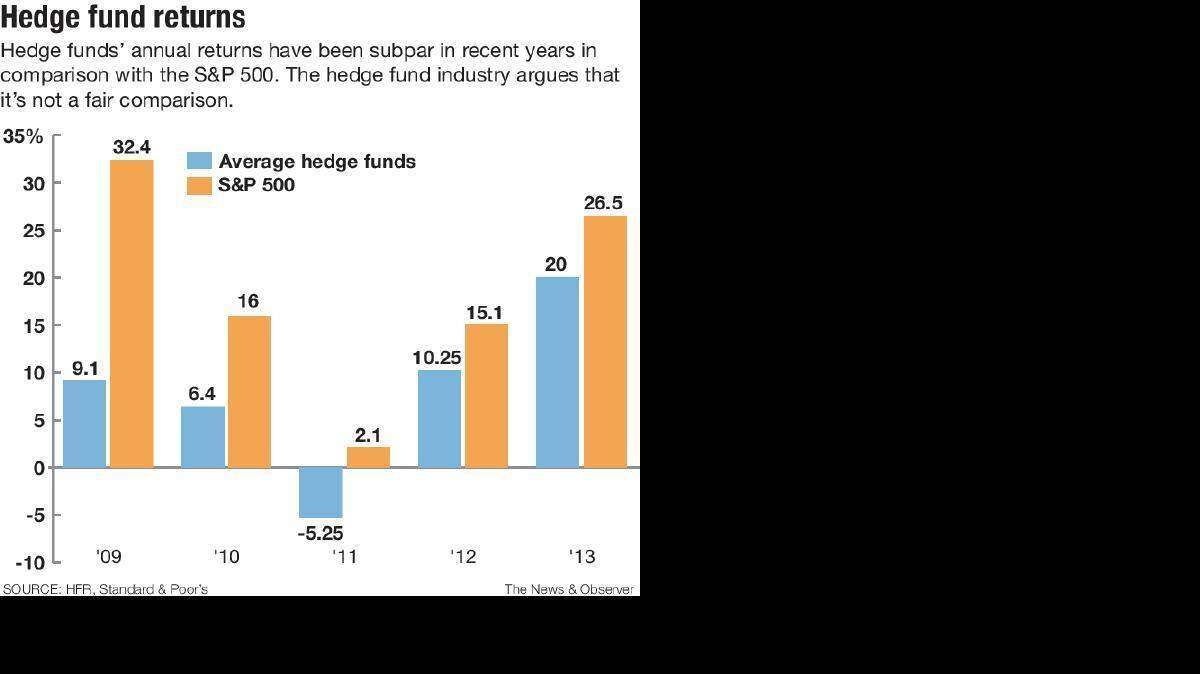
In comparison to the S&P 500, a standard benchmark for investment performance, hedge funds have under-performed in each of the past five years. According to hedge fund research firm HFR, last year the average hedge fund generated 9.1 percent in returns, versus 32.4 percent for the S&P 500.
As for the high fees Warr mentioned, pension funds often have a “2 and 20” fee structure. That is, they charge a 2 percent management fee for the assets they manage and reap 20 percent of the profits.
By comparison, Warr said, large pension funds can pay a tiny fraction of a percent to money managers that invest in stocks – and get to keep 100 percent of the profits.
And although hedge fund advocates say large pension funds such as North Carolina’s typically can negotiate lower fees from hedge fund managers, Warr argued that even if you negotiate a 50 percent discount the fees would still be “outrageously high.”
Donald Steinbrugge, managing partner of Agecroft Partners, a Richmond, Va., consulting and marketing firm that works with hedge funds, said comparing hedge funds to the S&P 500 is misguided.
“What most pension funds are doing is taking money out of fixed income (that is, bonds) and putting it in hedge funds to enhance their returns,” Steinbrugge said.
That’s because, with bond returns at all-time lows, hedge funds have been out-performing bonds in recent years.
Last year three-month Treasury bills generated a 0.07 percent return while 10-year Treasury bonds posted a negative return, eroding 9.1 percent, according to Federal Reserve data. North Carolina pension fund’s bond investments declined 3.49 percent last year.
Steinbrugge predicts most public pension funds will continue to up their investments in hedge funds in spite of CalPERS’ move.
Fall out debated
SEANC and Edward “Ted” Siedle, a former Securities and Exchange Commission attorney and author of the highly critical SEANC report on the state pension fund, warn that what they describe as a “run-on-the-bank situation” could emerge if a bunch of public pension funds decide to withdraw their hedge fund investments.
“The problem is, if everybody goes to the door, you are going to find the door is locked,” Siedle said.
Hedge funds typically have “gate provisions” in their contracts. That allows them to limit withdrawals by their investors if necessary to prevent a run on the fund that would force it to liquidate its assets at fire-sale prices. When a gate is imposed, investors are often limited to withdrawing their money in stages.
If hedge funds are forced to sell their assets to pay back investors at an inopportune time, Siedle said, it could be a losing proposition that could cost the North Carolina pension fund money. And, he added, some hedge funds could end up running out of money, making it imperative for the state pension fund to exit its hedge fund investments sooner rather than later.
But others argue that they don’t foresee public pension funds exiting hedge funds en masse and, at any rate, the amount of money public pension funds have invested in hedge funds isn’t enough to force the panic scenario that SEANC paints.
That includes Warr, an avowed hedge fund critic.
“I really like the folks at SEANC ... but I think that’s kind of a little hyperbole, frankly,” Warr said. “I don’t think there is going to be a run on the so-called hedge fund bank.
“There’s no reason to bail out today,” Warr continued. “There is no information about hedge funds we didn’t know two weeks ago, except that someone has said publicly they don’t like them.”