
18 months after hurricane, NC families still trying to rebuild
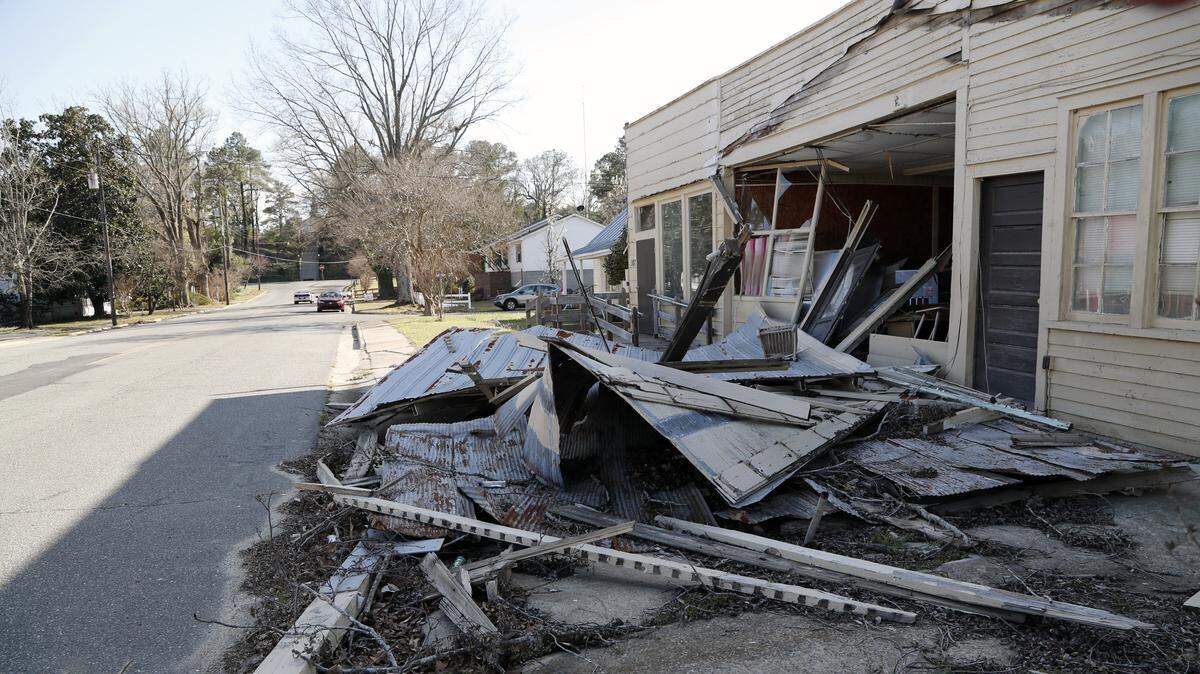
Nearly 18 months after Hurricane Matthew, recovery in the small Wayne County town of Seven Springs has been uneven. Several local businesses are back open and some residents have returned. But across the street from the bustling Mae's Restaurant, another storefront looks like the Neuse River floodwaters just receded yesterday — the front wall is bashed in and office furniture and other debris fills the space.
Those who haven't come home are still waiting on FEMA. N.C. Emergency Management has applied for $100 million in FEMA money to buy out, rebuild and elevate 800 properties in the counties damaged by Matthew, but much of the money isn't expected to flow until later this year.
"If you're the person who has been displaced for over a year and a half, and you're waiting for money to come in, nothing's coming quick enough," said Seven Springs Town Commissioner Ronda Hughes. "Considering what FEMA and the government have had on their hands with other hurricanes in Florida and Texas and Puerto Rico, I think they're doing the best that they can."
N.C. Emergency Management spokeswoman Julia Jarema says the FEMA Hazard Mitigation Grant Program applications were submitted last October, as the federal government sets the deadline one year after a natural disaster.
"While we recognize that such timelines are rarely viewed by survivors as fast enough, the NCEM Hazard Mitigation Section screened 3,000 survivor applications and submitted 800 households under 70 grants for $100M+ worth of funding," she said.
Hughes has been able to repair her home and return, and her shop, Neuse River Trading, reopened in February. Others haven't been so lucky. According to Emergency Management, 66 households across Eastern North Carolina remain in FEMA's Direct Housing Program, which provides temporary mobile homes for displaced residents unable to find other housing. That number is down from 161 households at the program's peak.
"We anticipate that the majority of the families will be out by mid-April, but 13 families will likely need additional help," Jarema said in an email and added that FEMA had extended the program until July 10.
She said the reasons families aren't yet in permanent housing vary widely. Many are relying on volunteers to help complete the work and there aren't enough volunteers to go around, while others are trying to do the repairs themselves.
"In other cases, families underestimated the cost of repairs and are now seeking volunteers/non-profit agency help to complete the work," Jarema wrote in her email. "In some cases, fraudulent contractors took/misspent funds so families are looking for other options to finish the work."
The majority of those remaining in the program are in Edgecombe County, where there's a limited amount of affordable housing available.
Other government agencies have moved faster. So far, the U.S. Small Business Administration has approved 2,240 home loan applications totaling $70.24 million in North Carolina and 427 business loan applications totaling $31.25 million. Many of the state disaster relief programs funded in 2016 and 2017 legislation have issued their grant money, but some are still in the works or have funds left over. The state has $20 million set aside for a State Acquisition and Relocation Fund, which will fund buyouts of storm-damaged property that aren't covered by FEMA. That program will be under way in the second and third quarters of this year, according to N.C. Emergency Management.
Further state funding could come later this year. Rep. John Bell, a Republican from Wayne County, is leading an interim House committee on disaster relief needs. "I think we have to look at where the initial amounts of funding didn't hit," he said, adding that legislators will also look at long-term efforts that could help minimize flood damage in future storms. Bell's committee recently discussed problems with beaver dams that can cause streams and rivers to back up in unexpected ways.
"You're never going to be able to prevent a flood, but you can sure try to look at ways to help deter the impact it would have," he said.
There's not much state leaders can do to speed up the process for storm victims still waiting on FEMA, Bell said. "It is a painful, long process full of red tape," he said, adding that "I wish there was a way to get it done faster, and we really try to put the pressure on" by working with Sen. Thom Tillis, U.S. Rep. David Rouzer and other members of the state's congressional delegation.
Because of the uncertainty around FEMA money, it's still unclear how many Seven Springs residents plan to return. "We've got a lot of residents that have chosen the buyout program, and that's a big strain on the town," Bell said. "You're losing residents and you're losing tax base." Hughes estimates that half of the town's pre-storm population of 111 people haven't yet returned. "It's probably going to be another year or so before we know the outcome of who's going to be staying," she said.
The loss of property tax revenue has prompted some to question whether Seven Springs can sustain a municipal government or should cease to be a town. Planning experts from UNC-Chapel Hill and N.C. State have been helping town leaders come up with ideas for the future — some centered around riverfront tourism — and Hughes said she's optimistic for the town's future.
"I believe in my heart we will be able to survive, but it might be a different kind of survival," she said. "We're tough and we're going to dig in and try our best to make this work."
This story was originally published April 4, 2018 at 2:58 PM with the headline "18 months after hurricane, NC families still trying to rebuild."