
Duke fits first patient in state history with 'bionic eye'
Half of his 66-year life ago, Larry Hester’s eyesight began closing in.
His peripheral vision narrowed, night vision faded, and the sharpness of what he could see blurred until he had to quit driving and reading.
He had a degenerative disease called retinosa pigmentosa, or RP, which destroys the delicate cells in the retina that collect light for the brain to translate into vision. His doctor said then that there was nothing that could be done, that he would lose his sight entirely.
“That was tough,” said Hester, a retired tire dealer who lives in North Raleigh. “But that’s the way it happened, and there’s still no cure for it.”
But now, finally, there is something better than darkness.
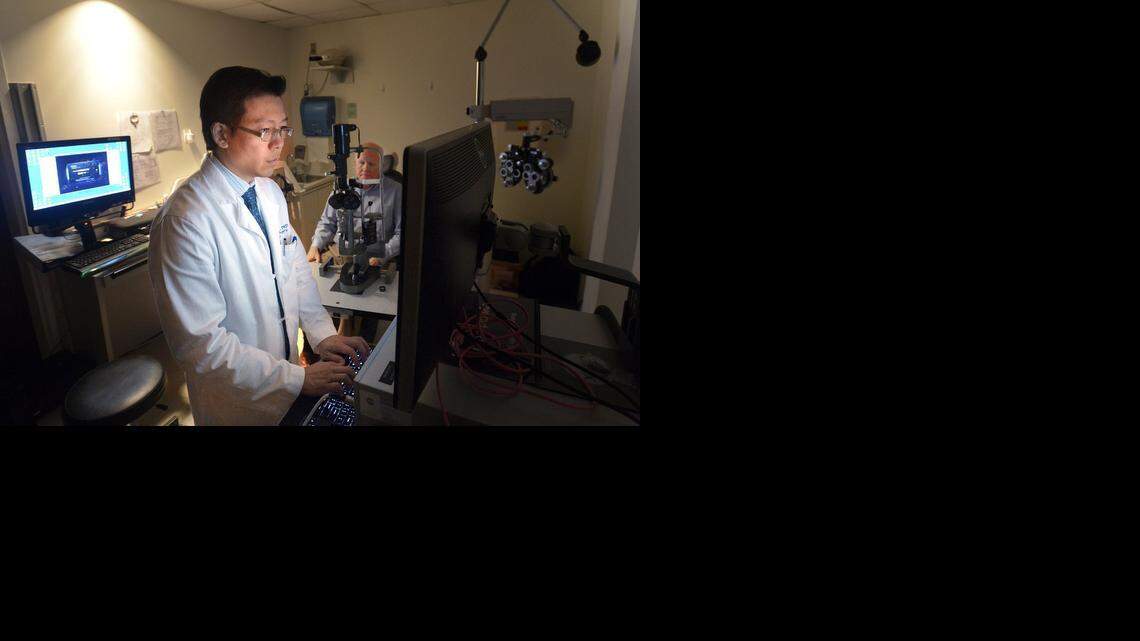
On Wednesday, Duke University eye surgeon Paul Hahn cut a slit in Hester’s left eyeball and slipped in a tiny panel of electrodes, the internal part of the first robotic eye ever implanted in North Carolina.
The $145,000 device, called the Argus II, was approved by the FDA early in 2013. Surgeons have implanted them in just six other people in the United States and a few dozen elsewhere in the world.
Technically, it’s a “retinal prosthesis system,” but it’s often called a bionic eye.
It works like this: A tiny video camera mounted in a set of dark eyeglasses picks up images, then sends them down a wire to a small computer that can be worn on a belt. The computer processes the images into electronic signals that are then sent back up the wire and transmitted wirelessly into the implant. The implant emits minute pulses of electricity that are transmitted via the optic nerve to the brain, which perceives them as a kind of rudimentary form of vision.
Hester, a gentle and endlessly upbeat grandfather, said he understands that the device will give him only about 60 pixels of imagery to work with, compared to a few million for a typical cellphone camera, and that inevitably better versions will come along, with more pixels, smarter software and no wires.
But he felt lucky to become a pioneer for a new technology that seems little short of a miracle, and signed an agreement to let the company that built the device, Second Sight, study him for up to five years after the operation.
“Sometimes I just get speechless thinking about it,” he said shortly before the operation. “It’s really a medical breakthrough, and I’m just very happy it has happened in my lifetime.”
Hahn finished the surgery midday, and Hester went home not long afterward. He’ll be back for a checkup Thursday, then again in a week. Finally, in about two weeks, will come the big day: A technician will switch on the device.
It will take a few sessions, Hahn said, to program the system, and then an occupational therapist will train Hester in how to make use of the images, which are often described as flashes of light, in his daily life.
“It will be kind of like learning a new language, or re-learning how to see,” said Hahn, an assistant professor of ophthalmology at Duke’s medical school and a surgeon at Duke University Eye Center.
“What I tell people upfront is that they are not going to be able to see faces, they’re not going to be able to read a newspaper, they’re not going to be able to drive,” Hahn said. “And I think those are the things people would most want to be able to do. Instead, what they see are flashes of light that they can correspond to perception, based on what’s going on around them.”
A stepping stone
Duke hopes to fit perhaps four or five patients with the device over the next year or so, then perhaps twice as many a year later. It’s hard to predict the demand, but more patients than expected have been inquiring, perhaps because of the nature of the disease, which has left many patients without hope and no real reason to keep in touch with their ophthalmologists.
RP is relatively rare, with about one in 4,000 Americans suffering from the disease. The Argus II is particularly suitable for treating RP for a number of reasons. Among them is that it leaves key parts of the eye, including the optic nerve, intact.
The hope, said Hahn, is not only that the device will be improved over time, but also that once doctors and the company gain more experience with it, the technology can be used on more common eye diseases, such as macular degeneration and diabetic retinopathy.
“One of the limits of this device is the level of vision you can recover, but it’s a stepping stone toward further iterations of this device, or other devices, that could provide better levels of vision,” he said. “And just as importantly, it’s a stepping stone toward use of this type of technology in other diseases.”
Gaining that base of experience requires pioneers like Hester, who said he first heard of the device when his wife read him a story early last year about it getting FDA approval.
He then called the company, which eventually linked him with the eye center at Duke.
It took nearly a year to jump various hurdles, including getting the financing, which is mostly from Medicare, he said, but then, a couple of months ago, Duke called.
Now, he’s just waiting for his incisions to heal, and for his new left eye to be switched on.
“I don’t have great expectations, but some little something is better than nothing at all,” he said.
His dream, Hester said, is being able to see his wife Jerry’s own blue eyes again.
His bionic eye won’t do that. But it could bring true his smaller dreams, things that have been impossible for years.
“It would be nice to be able to get out and see a tree,” he said. “It will be nice to walk down the sidewalk and know where the curb is.”
He paused for a minute, to collect his emotions, as he thought about his four granddaughters, ages 7 through 16. He has never seen them.
“It will be nice to sit with a granddaughter and sit there watching fireworks with her and actually see the light from the fireworks,” he said. “And maybe, even if it’s just a little, see her.”
This story was originally published September 10, 2014 at 7:47 PM with the headline "Duke fits first patient in state history with 'bionic eye'."