
New hearing ordered on Howard murder convictions
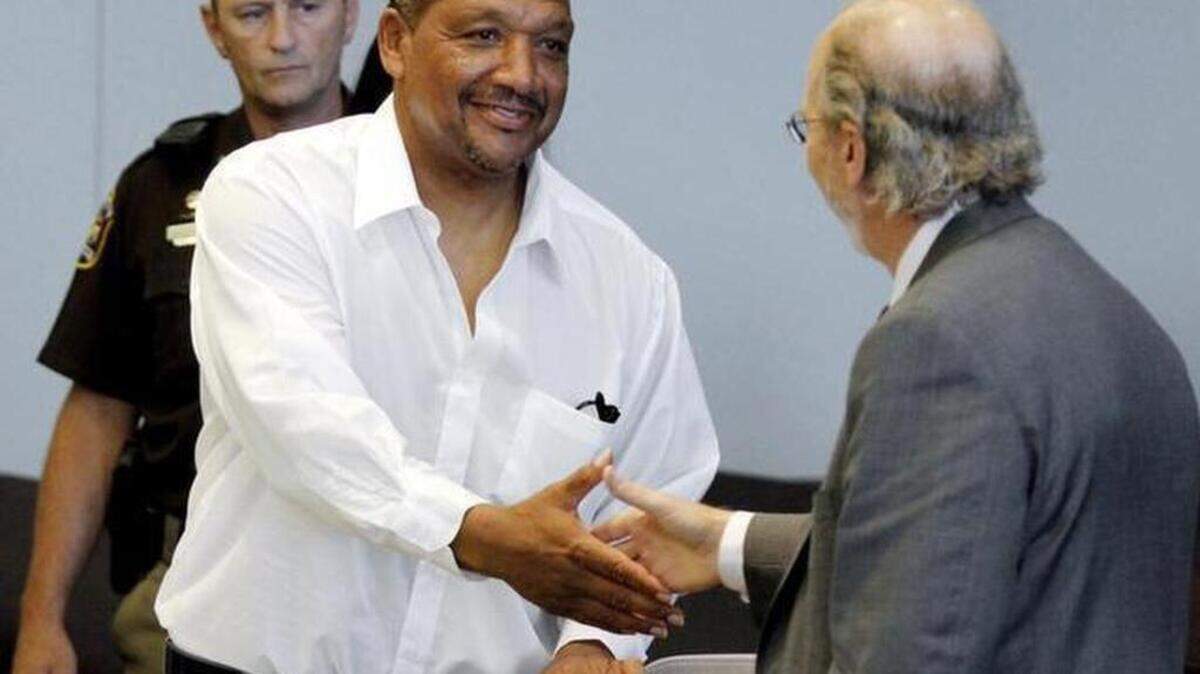
Darryl Anthony Howard, a 54-year-old man whose convictions for two homicides he maintains he did not commit were overturned two years ago, again will have to make the arguments that won him his release.
The N.C. Court of Appeals on Tuesday issued a ruling that calls for an evidentiary hearing in the Durham County Superior Court case.
State prosecutors argued that Superior Court Judge Orlando Hudson should not have vacated the verdict in May 2014 without holding a hearing on Howard’s claims in his request for relief.
The three-judge panel – Ann Marie Calabria, Donna Stroud and John Tyson – agreed with prosecutors in a unanimous decision, saying Hudson had not followed a process that would have given more confidence in a ruling that addressed some conflicting assertions from the defense team and prosecutors.
Howard, the appeals court panel ruled, “has supported the allegations contained” in his 2014 request for relief from his prison sentence “with sufficient and potentially compelling evidence. However, under no circumstances did the information offered in support and opposition… present only undisputed facts and pure questions of law. Given the nature of defendant’s post-conviction claims and the unusual collection of evidence offered in support of them, the trial court erred in failing to conduct an evidentiary hearing and make findings on the conflicting assertions…”
Howard was convicted in 1995 of two counts of second-degree murder for the homicides of Doris Washington, 29, and her 13-year-old daughter, Nishonda, at a Durham public housing complex. The killings occurred in 1991 in what investigators described as drug-related crimes.
Howard, who was 32 when he was convicted, knew the victims and was no stranger to Durham police then. He also was a regular visitor to the public housing complex.
Nevertheless, since firefighters discovered the naked bodies inside an apartment choked with smoke, Howard has maintained that he had nothing to do with the violent deaths.
Charlotte attorney Jim Cooney worked on Howard’s case in collaboration with the Innocence Project, a national organization dedicated to exonerating the wrongfully convicted through DNA testing. They argued that new DNA evidence and statements collected by post-conviction investigators implicated another man in the crime.
Cooney also argued that a police document uncovered by Innocence Project researchers raised questions about the actions of Durham prosecutors, who pushed ahead with the case against Howard knowing that DNA pointed to other culprits.
Sperm was found on the teen and collected in an investigative rape kit. An autopsy showed that her mother had been sexually assaulted, according to court documents. Howard was charged in the homicides, but DNA tests excluded him as a match to the sexual assault evidence.
At trial, Durham police detective D.L. Dowdy testified that he never suspected that the murders involved sexual assaults and that he never investigated them as such.
Mike Nifong, the former Durham District Attorney disbarred for his misconduct in the Duke lacrosse case, was an assistant district attorney and the prosecutor at trial. During his closing arguments, Nifong repeated the investigator’s claim to the jury and suggested that the sperm on the teen was the result of consensual sex before the murder.
Those claims by Nifong and Dowdy were contradicted by a police memo that was in law enforcement files but not turned over to trial attorneys representing Howard.
The memo outlined a confidential tip that police received a few days after the bodies were found. The tipster said a drug gang had murdered Doris Washington over an $8,000 drug debt. The tipster also said the killers raped the mother before killing her and that the daughter, an eighth-grader, was raped and killed after unwittingly walking in on the scene.
The recent, more sophisticated DNA tests showed that sperm from the rape kit compiled in the Doris Washington homicide matched that of a convicted felon, Jermeck Jones, whose criminal history includes 35 convictions, including several assaults against women.
The defense team argued that there was not a shred of DNA that links Howard to the victims.
They also argued that DNA evidence and autopsy reports showed that Washington was sexually assaulted shortly before she was strangled and beaten to death.
Prosecutors argued that the jury heard in 1995 that DNA evidence didn’t match Howard but convicted him anyway because of witness testimony.
Lawyers for Howard issued a statement in response to the Tuesday ruling.
“In reversing the trial court’s decision on procedural grounds, the North Carolina Court of Appeals readily acknowledged that we have presented a compelling claim that Mr. Howard was wrongly convicted,” Innocence Project Co-Director Barry Scheck, staff attorney Seema Saifee and Cooney said in the joint statement. “We look forward to the opportunity to present all of the undeniable evidence of Mr. Howard’s innocence at an evidentiary hearing and are confident he will ultimately be freed.”
Anne Blythe: 919-836-4948, @AnneBlythe1
This story was originally published April 19, 2016 at 9:41 AM with the headline "New hearing ordered on Howard murder convictions."