
Wake landowners wait on Map Act’s fate in court
More than 200 landowners in Wake and six other counties will be watching this winter as the N.C. Supreme Court considers a Forsyth County challenge to the Map Act, used by the state to freeze development indefinitely on swaths of land it hopes to buy one day for new highways.
The N.C. Court of Appeals ruled in February that when the state Department of Transportation created a “protected corridor” in the 1990s for the planned Winston-Salem Northern Beltway it was the same as taking private property – without paying for it.
DOT invokes the Map Act to prevent landowners from improving old buildings or putting up new ones. The department’s lawyers liken the law to “zoning ordinances.”
In a brief filed in October with the Supreme Court, DOT says it uses the Map Act to regulate local land use for the public benefit.
“Corridor protection is a planning tool that allows a highway’s proposed location to fit into the long-range plans a community has for its future development,” says the DOT brief, filed over Attorney General Roy Cooper’s name and drafted by Dahr J. Tanoury, a special deputy attorney general.
The DOT brief argues that curbing development now means that fewer businesses and families will have to be relocated later if the land is eventually needed for a highway project – adding that this “has the added benefit of reducing future right-of-way acquisition costs.”
But nine Forsyth landowners suing DOT, led by Everette and Martha Kirby, counter that reducing DOT land costs is the Map Act’s true purpose. In their Supreme Court brief, filed in November, attorney Matthew Bryant of Winston-Salem cites testimony by DOT officials and brochures that landowners received from DOT.
“It is highly unlikely that property owners will be allowed to do things that will increase the cost of building the road (by dramatically increasing the cost of buying the property),” says a DOT publication called “Protected Corridor: What That Really Means to You,” quoted in the Kirbys’ brief.
Members of the General Assembly had this in mind in 1987 when they enacted the Map Act, in legislation with a long title that began: “An Act To Control The Cost of Acquiring Rights-Of-Way For the State’s Highway System.”
The legislature is divided on this issue today. In April, the House voted 113-0 to repeal the Map Act. The measure never made it to the floor of the Senate, where some legislators expressed concern that it would increase the cost of highway projects for taxpayers.
DOT officials say the state Court of Appeals ruling, unless it is overturned, could force the state to pay as much as $600 million in damages to landowners affected by protected-corridor restrictions in eight counties. The Supreme Court will hear arguments in February, and a ruling is expected later in 2016.
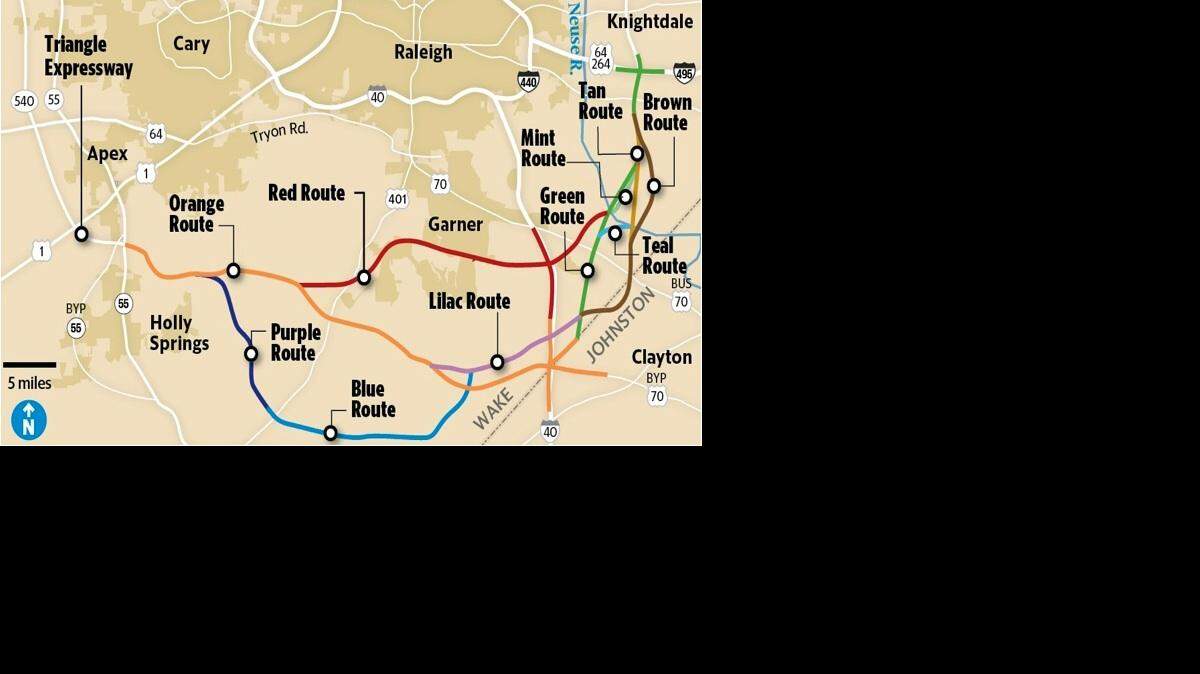
In southern Wake County, the Forsyth case will affect dozens of landowners on what is known as the Orange Route, marked by DOT in the 1990s as its preferred path for the 540 Outer Loop from Holly Springs to Garner.
Orange Route landowners say they can’t make money on their real estate investments, and they can’t improve or sell their homes. A Wake judge has put 22 local Map Act lawsuits on hold until the Supreme Court issues its ruling.
If the state wants to curtail development in future roadways to save money, it has the power to achieve that end: condemn the property through eminent domain.
Landowners’ brief
filed by Winston-Salem attorney Matthew BryantBryant argues that landowners suffer unfairly just so DOT can save money.
“If the state wants to curtail development in future roadways to save money, it has the power to achieve that end: condemn the property through eminent domain,” Bryant writes in the landowners’ brief. “NCDOT avoids condemnation because it requires owners be paid just compensation.”
Not like zoning
Wake Forest lawyer George Autry, who represents landowners in condemnation cases, says private property development options frequently are curtailed when DOT announces plans for a new highway – even without invoking the Map Act to put formal restrictions on landowners.
“It’s a horrible statute, but it’s only part of the problem,” Autry said in an interview. “It’s not just the filing of the (protected corridor) map that depresses the property and paralyzes folks.”
Autry, who is not involved in the Map Act lawsuits, says DOT is wrong to compare the Map Act to local zoning laws.
“Zoning laws are a community stepping forward and saying, as a community, we believe this is an appropriate use of land,” Autry said. “The Map Act can make land worthless, and does.”
Bruce Siceloff: 919-829-4527, @Road_Worrier
This story was originally published December 3, 2015 at 4:24 PM with the headline "Wake landowners wait on Map Act’s fate in court."