
UNC-CH directors give spirited defense of centers
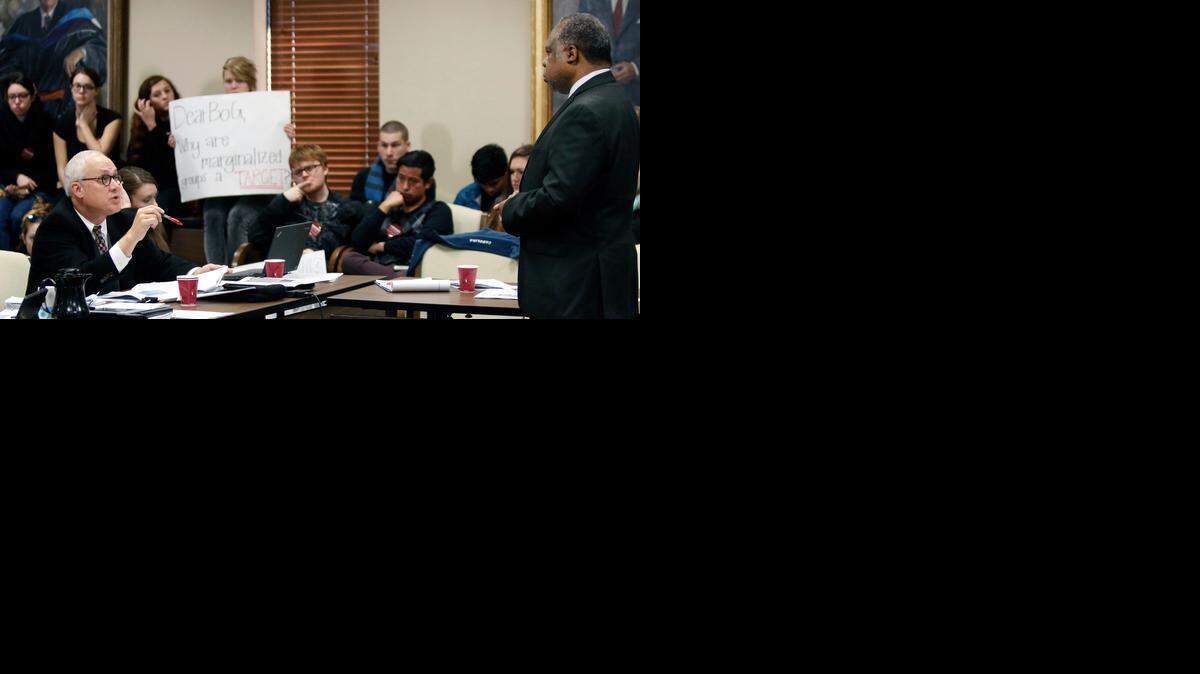
In a debate that at times veered into testy ideological exchange, UNC-Chapel Hill center directors mounted a vigorous justification of their work Thursday before a UNC Board of Governors panel reviewing more than two dozen centers and institutes.
The board working group hosted two days of presentations this week, hearing from nearly 30 such entities across the UNC system that face a detailed review. Thursday’s presentations featured seven from East Carolina University and nine from UNC-CH, including several that largely focus on minority and women’s issues.
Ted Shaw, director of the Center for Civil Rights affiliated with UNC’s law school, said recent protests across the United States underscore why civil rights law is not just a history lesson.
“People tell us that the civil rights era is over, the work is unnecessary, we’re in a post-racial colorblind America,” Shaw said. “Look at what’s happened over the last few weeks. We don’t resolve these issues best in the streets. We resolve them through courts of law.”
Shaw’s center, founded by the late civil rights icon Julius Chambers, trains law students by working on civil rights cases. It receives no state money.
But UNC board member Steven Long took issue with what he said was a lack of diverse points of view at the center. He questioned whether the university should be in the business of advocacy, and charged that the center was involved in marches.
UNC Law Dean Jack Boger said the center had been careful to keep its distance from the weekly demonstrations at the legislature, called “Moral Monday” by organizers.
“I’ve read your materials,” said Long, who was on the board of the conservative Civitas Institute, according to a 2013 news release. “There is no diversity of opinion in that center.”
Shaw responded: “We are unapologetically representing clients in cases ... We’re civil rights advocates. We have a point of view.”
Boger pointed out that the law school’s Banking Institute was created to support the banking industry in North Carolina. “We don’t ask that center to consider socialism as an alternative or to talk about the dissolution of large banks,” he said. Boger also pointed out that public health professors advocate against sugary drinks in the fight against obesity.
Poverty center
Gene Nichol, law professor and director of UNC-CH’s Center on Poverty, Work and Opportunity, said the center was “honored to be among the list of threatened centers.” The outspoken professor, who has written opinion pieces critical of Republican lawmakers and Gov. Pat McCrory, said of the board’s review: “It is hard not to worry that there is a potent ideological agenda at work.”
The poverty center has been in the cross hairs of lawmakers for some time. It was originally tied to former U.S. Sen. John Edwards, a Democrat.
Nichol said he had been called into the law school dean’s office three times during the last legislative session and told of threats by Republican politicians to fire him, shut down the center or move it to UNC Pembroke.
The center receives no state funds but has a $120,000 budget. If it were abolished, Nichol said, the university would lose a grant from the Z. Smith Reynolds Foundation and student jobs would be lost. “Most important, North Carolina’s understanding of its poverty challenges will be weakened,” he said.
Nichol said the center works especially in Eastern North Carolina and produces publications that describe and detail poverty in the state. He cited statistics that one-quarter of children in the state live in poverty, including 40 percent of children of color.
“This is what the agenda is,” Nichol said. “We think that people in North Carolina, people across the United States at the bottom aren’t getting a fair share, they aren’t getting a fair shake. That’s not a stunning conclusion. The United States is the richest, the poorest and the most unequal nation in the world. There’s at least a real question presented on that front.”
Long, the board member, said the center had posed legitimate ways to attack poverty, but there was a lack of different viewpoints on the complex issue. “That’s the criticism I have of your center,” Long said. “I see a point made, but not a counterpoint.”
In the background a student protester held a sign that said: “Where’s the diversity of perspective on the BOG?”
Other UNC-CH centers at Thursday’s meeting included the Sonja Haynes Stone Center for Black Culture and History and the Carolina Women’s Center. Christi Hurt, director of the women’s center, said it serves students who have suffered sexual assault or harassment – an issue that has been in the spotlight nationally.
Board members suggested that the center might need more resources to deal with an issue that affects one in five female college students, according to national research.
Cuts cited
UNC-CH Chancellor Carol Folt said the university’s centers and institutes were cut by about half in 2009 during the recession.
Across the UNC system, there are 240 centers and institutes with about $69 million in state funding. The legislature this year in its budget bill suggested that UNC could reallocate money from the centers to other priorities.
James Holmes Jr., the UNC board member who chairs the review panel, pointed out that many of the center leaders on Thursday said the review had been a healthy exercise that helped them sharpen their mission. About 10 centers will be dismantled by campuses who decided they were no longer necessary.
A report is due in January.
“I think you’ll see a more rigorous review process to be sure things are on point,” Holmes said. One of the things we do very poorly as a university system is to take credit for the good stuff we’re doing. That I hope is a by product of this as well.”
And, he said, the board will address the issue of advocacy by centers and likely recommend training for directors on the issue. “When you’re speaking on behalf of the institution in total, I think it’s really important that we voice both sides,” he said.
Andrew Powell, the student body president at UNC-CH, told the panel that many of the centers foster a more inclusive, supportive and vibrant campus.
He said he was personally influenced by the Center for Faculty Excellence. He had worked with the center’s faculty to help redesign economics and math courses to promote active learning. Powell said he had just taken a job to help an African university design its courses.
“It has had a huge impact on me,” Powell said.
This story was originally published December 11, 2014 at 6:00 PM.