
High gas taxes keep NC fees low for billboards and developers
North Carolina drivers pay one of the nation’s highest gasoline taxes to take care of roads and bridges – and their tax money also takes care of developers, utilities, outdoor advertisers and other business people who pay little or nothing for services that cost the state Department of Transportation millions of dollars each year.
DOT officials are recommending new fees that would scale back this taxpayer subsidy and shift the burden to businesses. They may face resistance from the 19-member Board of Transportation, which includes developers and real estate executives whose businesses make use of these services.
In some cases, DOT now collects modest fees to recover a fraction of what it spends on office reviews and field inspections to regulate billboards, issue business and subdivision driveway permits, and oversee the movement of oversize and overweight trucks.
But developers pay nothing for the DOT engineers who evaluate project plans, approve plats, and walk the streets of each new subdivision four times before adding them to the state-maintained road system. Nor do builders and utilities pay DOT to monitor their 10,000 encroachments – the installation of pipes and cables and other work – along state roads each year.
Local governments cover the cost of comparable services by collecting fees that can add up to thousands of dollars for a single subdivision. DOT draws instead on gas taxes and motor vehicle fees.
Officials promise final numbers this week, but preliminary figures suggest that these services could be costing DOT $7 million a year or more. As the department spends more of these tax dollars to subsidize business permits and services, it has less money to repair bridges and repave roads.
“It’s impacting our maintenance and what we can do,” said Joey Hopkins, who directs operations in Wake and six neighboring counties as DOT’s Division 5 engineer.
The taxpayer subsidies are coming to light as DOT responds to a mandate from the General Assembly to cut the use of tax dollars for these services. This week, the state Board of Transportation will consider recommending that the legislature approve new or increased fees set high enough to recoup these costs.
A need for revenue
A few board members were wide-eyed at an Oct. 1 meeting when Mike Holder, DOT’s chief engineer, recommended the new fees.
Among them was Jeff Sheehan of Raleigh, senior vice president for Duke Realty, whose properties include the 3-million-square-foot Perimeter Park office and industrial development near Research Triangle Park. Every time Duke Realty puts up more buildings and develops more acres at Perimeter Park, DOT engineers inspect new streets and review new traffic impact studies to make sure the existing roads can handle the expected addition to daily traffic loads.
Sheehan was surprised to learn that the agency does this work for free.
“I assumed we were already paying a fee,” Sheehan said in an interview. “When you submit these plans to the town of Morrisville, you pay a review fee. It’s what you do. It costs DOT time and resources to review these things.”
North Carolina’s motor fuels tax, 36.75 cents per gallon, is the highest in the Southeast and higher than the gas taxes in all but nine other states. But gas tax collections are waning here and across the country as drivers switch to more fuel-efficient cars.
Gov. Pat McCrory said in September he will recommend new revenue sources to the 2015 General Assembly – possibly in conjunction with a gas-tax cut – to address transportation needs expected to cost between $94 billion and $123 billion by 2040.
At DOT’s suggestion, the legislature’s 2014 budget law included a mandate for recommendations on new fees to cover the cost of services – and on other ways to cut costs or even generate extra revenue from private sponsors and marketers.
Fees for supersized loads
The most expensive areas where DOT now spends tax dollars for no-fee services are related to subdivision development and encroachments on state highway rights-of-way. DOT officials said last week they were still calculating their expenditures, but their preliminary figures suggest that taxpayers may be covering $2 million to $5 million in department costs here.
Gas taxes also subsidize the work of engineers who regulate the movement of tens of thousands of trucks that are longer, wider, taller or heavier than state standards. Permits are required, and in most cases the fees are nominal.
If the load you’re hauling is wider than 8 feet 6 inches, a $12 fee is good for 10 days – across the entire state. If it also is taller than 13 feet 6 inches or longer than 40 feet, add another $12. Weight standards vary, but an overweight permit also costs $12.
“You would need only one permit to haul a tank 14 feet tall, 14 feet wide and 90,000 pounds – that’s $36,” said Kevin Lacy, DOT’s chief traffic engineer.
Haulers start paying by the pound when weights hit the “superload” category – an extra $3 fee for every 1,000 pounds above the 132,000 pound mark.
DOT issues about 2,500 permits a year for superloads between 150,000 and 1 million pounds. This king-size cargo includes industrial machines, power generators, bridge girders, beer vats and nuclear vessels – sometimes heavy enough to damage roads and bridges.
“We might have to inspect all the bridges and culverts along a road, to see which ones we need to shore up to keep the culvert from cracking and caving in,” Lacy said. “A review can cost us several thousand dollars.”
DOT has recommended fee increases that could generate nearly $1.9 million more in yearly revenues from oversize and overweight trucks. The proposed new oversize-overweight fees would increase the cost of a permit from $12 to $17 for each dimension – height, width, length, weight – over state standards. The superload surcharge would increase to $4 per 1,000 pounds.
DOT engineers put in plenty of work in 2011 when the fuselage of an Airbus jetliner – from the historic USAirways Flight 1549, which made its final landing in New York’s Hudson River – rolled slowly from New Jersey to a museum in Charlotte, clogging interstate traffic along the way.
Lacy couldn’t find a copy of the permit but said that if the weight was less than 132,000 pounds, the jetliner fuselage fee would have been $48. Under the recommended fee increase, this would go to $68.
Even with those new fees, Lacy said, North Carolina still will be charging haulers less than they pay in other states for oversize and overweight loads.
“We don’t want to discourage industry from coming to North Carolina,” Lacy said. “But for those folks who move these heavy loads, the permit is probably the lowest-cost item they’ve got to deal with.”
‘Huge money’ in billboards
Outdoor advertisers might feel a bigger bite from the proposed higher fees. They pay $60 each year to renew their billboard permits – a fee DOT proposes to double for the nearly 8,000 billboards statewide.
A separate $200 permit, good for a year, is required for approval to cut down trees, shrubs and tall grass that block what outdoor advertisers call the “viewshed” for each billboard. DOT aims to triple that fee to $600.
Paul Hickman, president of the N.C. Outdoor Advertising Association, worries that the new fees will make business more expensive for the members of his trade group. As a Raleigh-based manager for Fairway Outdoor Advertising, Hickman himself handles 800 billboards in 30 counties.
He figures that, on average, he’ll need vegetation removal permits for half of his billboards each year. At that rate, the increased fees for permit renewals and vegetation removal would cost his operation more than $200,000 a year. If that rate held up statewide, the total new cost to North Carolina’s billboard industry would be as much as $2 million a year.
“It’s huge money,” Hickman said. “The industry certainly respects reasonable and fair permit fees. We definitely don’t think the department should be out of pocket. But it shouldn’t be a profit center, either.”
Outdoor advertisers and home builders expressed concerns about the recommended new fees, and several transportation board members met with DOT administrators to discuss them.
When Holder recommended new fees at the board’s Oct. 1 meeting, he said the taxpayer subsidies amounted to “several million dollars” and promised to bring more precise numbers back to the board this week. He said Thursday that the numbers were in flux, and that some of his October recommendations might be revised.
“We’ve been working with the board members and taking their comments, of course,” Holder said. “This is still a work in progress. It’s an exchange. It’s a collaboration.”
Neighborhood details
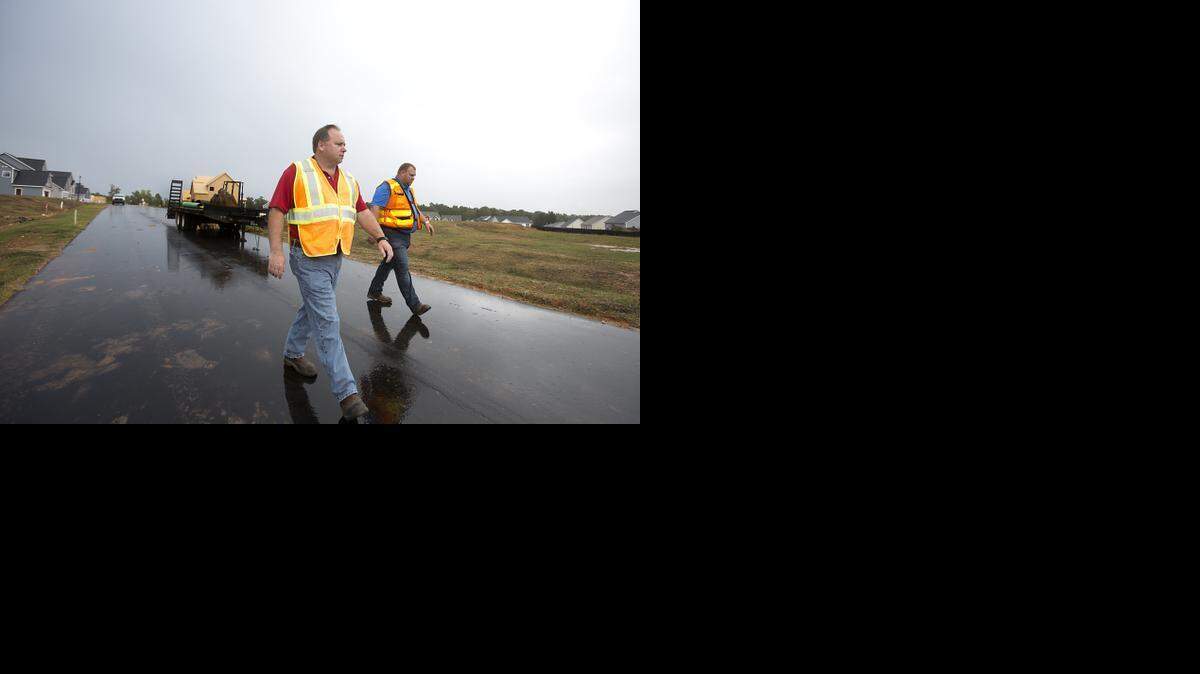
On a recent Tuesday, an engineer and an engineering technician from Wake’s busy district office took the first of several walks they will make in coming months along a few blocks of freshly paved Faucette Lane, in the next phase of a neighborhood called Avocet near Holly Springs.
These are professionals whose salaries work out to a combined pay rate of more than $57 an hour. Before the developer can get building permits for the houses that will line the street, DOT must certify that Faucette Lane has been built to state standards.
“We’re looking for deficiencies in the asphalt,” said Scott Wheeler, assistant district engineer. “We’re looking to make sure all the pipes are where they’re supposed to be, according to the subdivision plan.”
He finds a cracked drain that will need to be fixed later. On return visits Wheeler will scrutinize this neighborhood more closely to correct clogged ditches, grassy shoulders that shouldn’t block rainwater from running off the street, and pavement that has been damaged by heavy construction equipment.
Before DOT agrees to take over the maintenance of Faucette Lane – last winter, the area had so much snow that DOT plows were scraping subdivision streets like this one – Wheeler will count houses to make sure the project meets DOT’s density standards.
Wheeler’s office is heaped with new subdivision plans waiting for his attention. In the seven-county Division 5 area, DOT workers handled 1400 encroachments and driveway permits last year, most of them in Wake County.
“That staff time is going directly to our operations and maintenance budget,” Hopkins said.
Rob Weintraub of Cary, an independent land development manager, acknowledged that developers are accustomed to paying fees to local governments. But he said they get something for their money that they can’t always expect from DOT: a prompt response.
“If a developer submits plans to a town, they get comments back pretty fast,” Weintraub said. “When I’ve submitted a traffic impact analysis to DOT, it falls into a black hole. In the past, it’s taken months and months to get reviewed.
“When you say, OK, we’re going to start charging you a fee to review this, you’d better give me an answer,” Weintraub said.
A Charlotte real estate executive who chairs the transportation board is sensitive to Weintraub’s concern. Ned Curran, CEO of The Bissell Companies, said DOT officials should consider fees that would guarantee expedited service.
Curran said DOT needs to find new revenues to augment gas taxes. The proposed fee increases fit the “user pay” model that is growing in favor with state leaders: “The person who wants this service, it’s their choice, so there’s a fee associated with it.”
But he said he wants to keep new fees low, and to introduce them gradually.
“I don’t think we want to go too high on some of these things,” Curran said. “We’ll need an acclimation period, to maybe phase them in.”
This story was originally published November 1, 2014 at 6:00 PM with the headline "High gas taxes keep NC fees low for billboards and developers."