
NC Supreme Court sides with landowners on Map Act
The state Supreme Court has ruled in favor of landowners who challenged the Map Act, the law that allows the state Department of Transportation to reserve land for roads it plans to build in the future.
The court affirmed a decision by the N.C. Court of Appeals last year that found that when DOT invoked the Map Act in 1997 to create a “protected corridor” for a planned Winston-Salem beltway, it was effectively taking private property without paying for it. The law was meant to prevent development on the land that would make it more expensive when DOT is ready to buy it.
But landowners in Forsyth County and other places in the state, including southern Wake County, say the law unfairly leaves them in limbo for years, even decades, unable to improve or develop their property while they wait for the state to buy it.
The Supreme Court agreed.
“Upon NCDOT’s recording of the highway corridor maps at issue here, the Map Act restricted plaintiffs’ fundamental rights to improve, develop, and subdivide their property for an unlimited period of time,” the justices wrote. “These restraints, coupled with their indefinite nature, constitute a taking of plaintiffs’ elemental property rights by eminent domain.”
The extent to which property owners may be entitled to compensation would depend on the market value before and after DOT identified their property as being in a highway corridor, the court said.
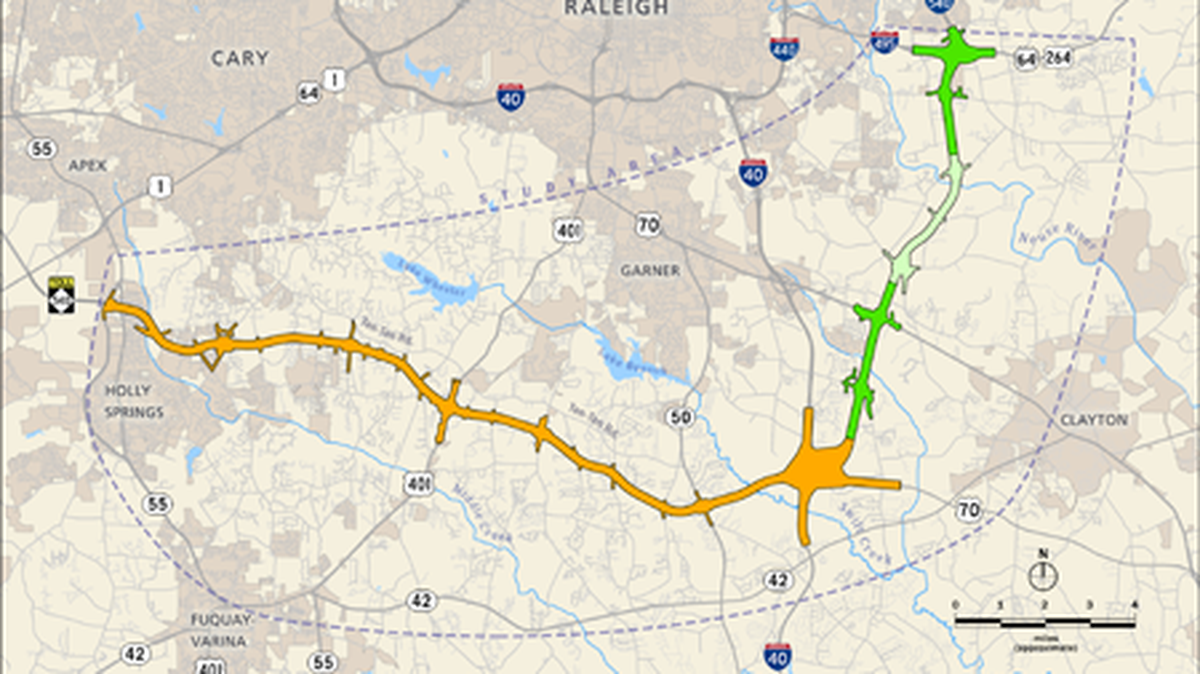
DOT created a protected corridor in southern Wake County in the late 1990s for an extension of the 540 Outer Loop that is still years away from construction. Map Act lawsuits in Wake and other counties have been on hold pending the Supreme Court’s decision on the Winston-Salem case.
Matthew Bryant, one of the attorneys representing the Forsyth County plaintiffs, said there are more than 300 Map Act lawsuits pending in six counties statewide, and that the court’s decision will make it very easy for judges in those cases to side with landowners.
“This case has been a long journey, but hundreds of North Carolina landowners now have their property rights protected,” Bryant said in a statement. “The state has acted in a misguided fashion in how it plans and acquires roads for over two decades. For those that have lost faith in our system, this case should restore some faith.”
About two dozen landowners in Wake County have sued over the Map Act’s effect on their property that lies in the 540 corridor across southern Wake County. DOT plans to build the remainder of 540 as a toll-road extension of the Triangle Expressway that now stretches for 18 miles from Research Triangle Park to Holly Springs in western Wake. DOT said it hopes to award a contract for the next leg of 540 – from N.C. 55 at Holly Springs east to U.S. 401 – in 2018.
John F. Maddrey, the state solicitor general, told the Supreme Court during oral arguments in February that the Map Act was similar to city and county zoning ordinances designed to limit development that might clash with local long-range plans. Maddrey also acknowledged then that legislators had not expected landowners to live under Map Act restrictions for as many years as they have.
A spokeswoman for DOT said department officials were reviewing the court’s ruling Friday and did not have any comment.
In addition to the hundreds of lawsuits, the Map Act has been under attack in the legislature as well. Last year, the House voted 114-0 to repeal the act, but the bill stalled in the Senate, where some senators were pushing a counter-proposal that would have modified the Map Act while leaving much of DOT’s power intact.
Richard Stradling: 919-829-4739, @RStradling
This story was originally published June 10, 2016 at 12:21 PM with the headline "NC Supreme Court sides with landowners on Map Act."