NC GOP promotes ‘incredible strides’ in education. Report says things have worsened.
North Carolina Republican lawmakers say they have transformed the state’s education system in the past decade. But a recently released independent report paints a gloomier picture of the state of public schools.
The report from WestEd, a non-profit research group, contends that insufficient state funding has contributed to an education system where student achievement is lagging, teacher quality is dropping and many students are being left behind. The report, which was publicly released in December, criticizes several of the education changes that the General Assembly has made since Republicans gained the majority in 2011.
“Cutbacks that began during the Great Recession, beginning in 2008, and much deeper legislative cuts over the last few years have eliminated or greatly reduced many of the programs put in place during the 1990s, and this has begun to undermine the quality and equity gains that were previously made,” according to the report.
Lauren Horsch, a spokeswoman for Senate leader Phil Berger, defended the GOP’s record, saying the state has made “incredible strides in education” since 2011. She said the report’s criticisms “fall flat” because the authors didn’t reach out to lawmakers or their education experts.
“It is impossible to get a comprehensive look at education funding and policy in the state without talking directly to the people who create the laws and allocate the money,” Horsch said in a statement Monday. “It seems to me that it’s awfully difficult to credibly analyze policy choices without ever speaking to the people who made those choices.”
A judge will use the report to help resolve the long-running Leandro school funding lawsuit’s efforts to ensure North Carolina public school students receive the state constitutional guarantee of a “sound basic education.”
Here are some of the issues raised in the WestEd report.
Public school funding
The state’s K-12 education budget in 2018-19 was nearly $2 billion larger than in 2011-12, according to House Speaker Tim Moore in a Dec. 31 news release. He says Republicans have increased public school spending an average of 3.3% a year over the past decade.
Moore also points to how North Carolina’s average teacher salary has jumped 18 spots since 2014 to 29th nationally. The state has the third-highest teacher pay raise in the nation over the past five years and an overall 20% pay increase over that time, according to Horsch.
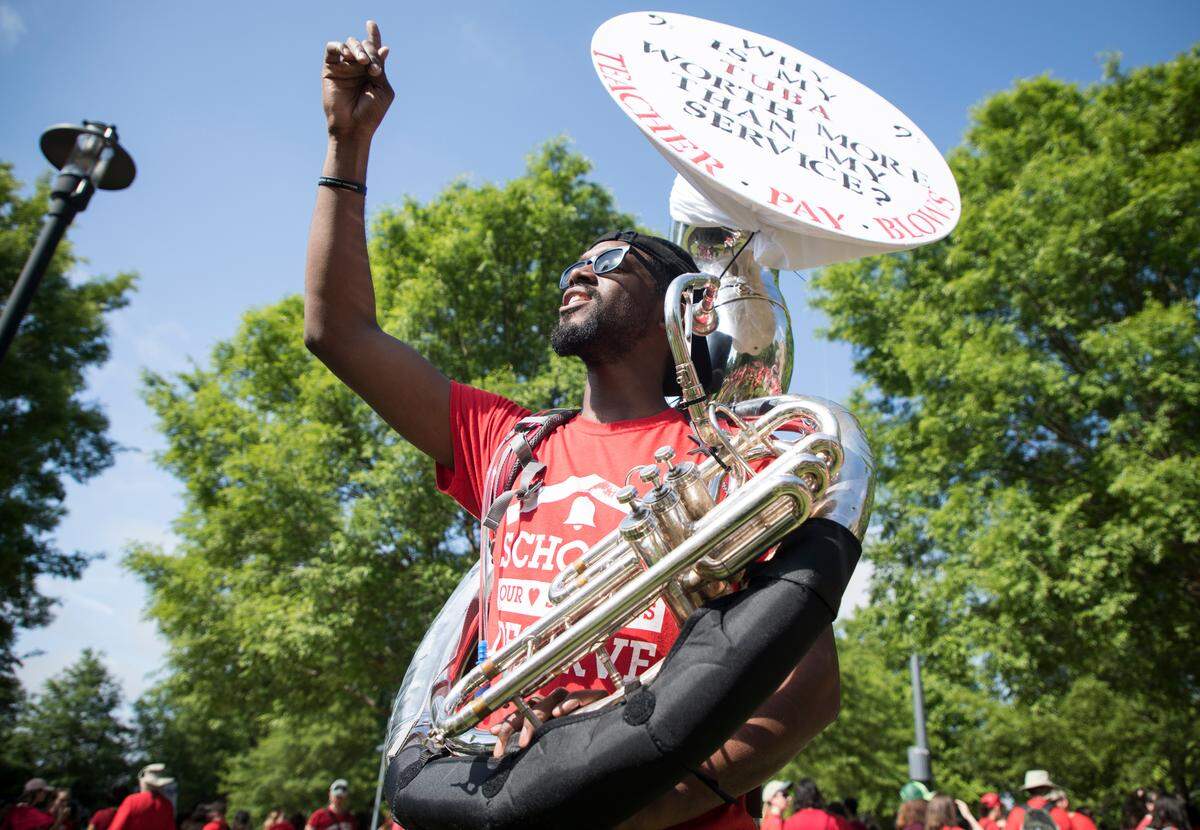
But WestEd says that when adjusted to 2018 dollars, per-pupil spending in North Carolina has declined about 6% since 2009–10. The report also says that, based on 2017 dollars, average salaries for the state’s teachers that year were lower than compared to 2003 or 2009.
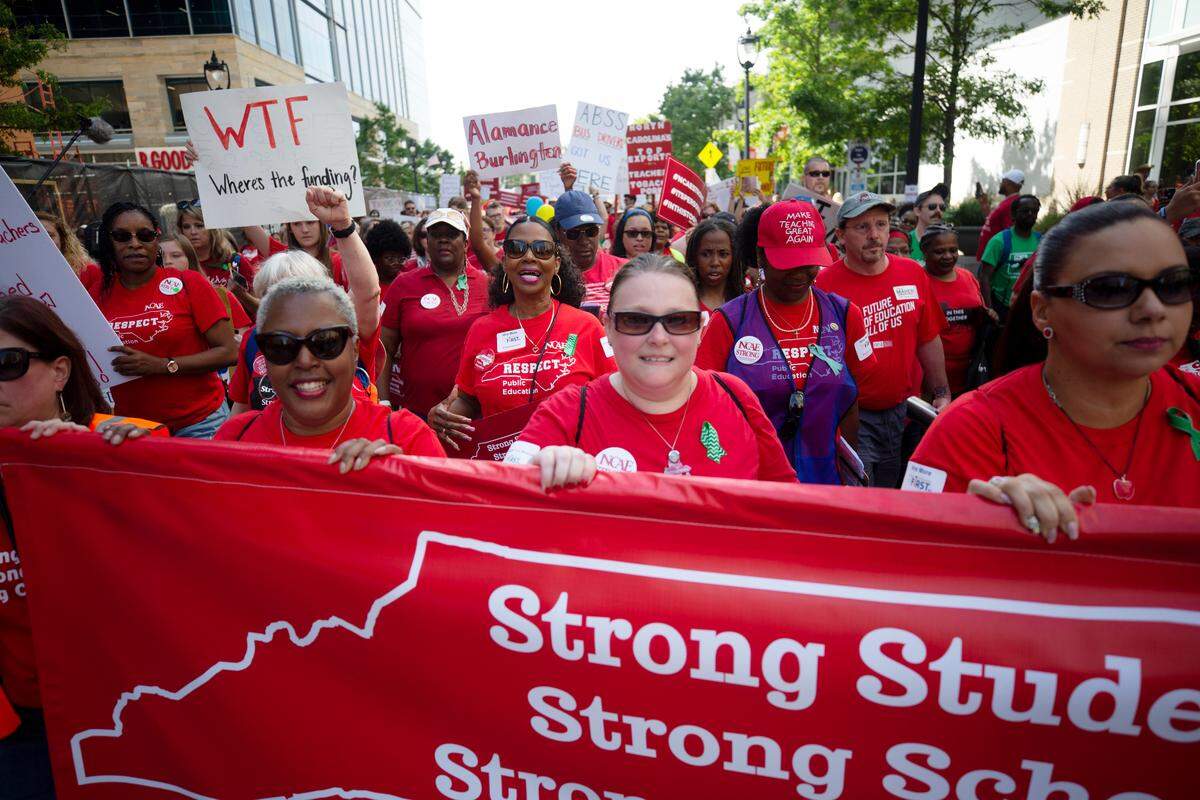
This level of education funding, according to the report, has led to problems such as fewer teachers employed, “stagnating salaries” and “underfunded” high-poverty schools.
“They try to address it, but unfortunately, funding is not there — that’s what we are told,” an unnamed middle school teacher says in the report. “For instance … we don’t have textbooks, we need to make copies of reading selections to teach those kids. We only get, like, 1,500 copies per nine weeks. … [W]e [use] our own money, we have to buy cartridges for our printers to print this.”
WestEd recommends increasing education funding by $8 billion over the next eight years. The report also recommends setting a goal of moving North Carolina to the national average salary for teachers by 2030.
Quality of NC teachers
In the 1990s, WestEd says North Carolina had virtually eliminated teacher shortages and had the greatest gains in students achievement. Since then, the report says the state has gone from “having a very highly qualified teaching force” to “one that is extremely uneven.”
WestEd points to factors such as how the legislature ended the N.C. Teaching Fellows Program in 2011 before bringing it back in a smaller way in 2017. The program provides scholarships to students who agree to become teachers.
Horsch defended the program’s redesign, which focused on the hard-to-hire subjects of science, technology, engineering, math and special education.
The report also points to cuts in state funding for training and support of teachers. As a consequence of the various changes, the report says disadvantaged students have less access to experienced and effective teachers.
“North Carolina can never succeed in providing a sound basic education for its children without vastly improved systems and approaches for recruiting, preparing, supporting, developing, and retaining teachers and for placing highly effective teachers where they are most needed to foster the academic growth of at-risk students,” the report says.
“The current teacher shortages and high turnover — particularly in high-poverty schools — are a function of uneven preparation and mentoring, inadequate compensation, and poor working conditions.”
Principals at low-performing schools
In 2017, state lawmakers switched from paying principals based on their years of experience to a new system that gives them bonuses based on how their students do on exams. Since 2016, principals have received an average 23.4% increase in pay, according to Horsch.
But WestEd says the new system means what principals make can vary from year to year. The report says this creates a disincentive for effective principals to work in underperforming schools, which often take more than one year to improve.
The report cites other changes, such as no longer paying principals for advanced degrees and not providing them — or any other state employees hired after Jan, 1, 2021 — with health benefits when they retire. WestEd says these changes make leading small and low-performing schools less attractive.
WestEd recommends revising the compensation system. If the authors had talked to lawmakers, Horsch said they would have learned about a new program to give up to $30,000 a year to qualified principals to relocate to low-performing schools.
DPI cuts at low-performing schools
For the past several years, lawmakers have ordered millions of dollars in budget cuts at the state Department of Public Instruction. Some of the deepest cuts have come in the division that works with the state’s lowest-performing schools.
WestEd says low-performing districts and schools are getting less support than they did in 2015. DPI is making changes in how it supports schools, but the report says the agency doesn’t have the capacity to support a large number of low-performing schools.
The report recommends rebuilding DPI’s ability to support low-performing schools.
System for grading schools
Since the 2013-14 school year, every North Carolina public school has received an A through F letter grade based largely on how many of its students passed state exams. This accountability model allows parents to know the quality of the school they’re sending their child to, according to Horsch.
But WestEd says basing the grading system on passing rates is biased and unfair because research shows high-poverty schools don’t do as well academically. The report says the letter grades have made it even more difficult for high-poverty schools to attract high-quality teachers.
“Focusing primarily on achievement to evaluate school performance biases the evaluation system against schools that serve large percentages of economically disadvantaged students and rewards schools with wealthier populations,” the report says.
WestEd recommends revising how schools are held accountable. Lawmakers passed a bill giving State Superintendent Mark Johnson and the State Board of Education until February to suggest potential changes to the grading system.
Charter school effects
Lawmakers lifted the cap on the number of charter schools in 2011 and are now providing vouchers to help families attend private schools. Now 20% of the state’s students attend charter schools, private schools or are homeschooled instead of attending a traditional public school.
“We’ll continue to support a parent’s power to choose the right school for their children — whether it be a public school or a charter school,” Horsch said. “Enrollment in charter schools continues to increase, and thanks to the state’s Opportunity Scholarships, families have a chance to send their kids to private school if they so choose.”
But WestEd says these policies “contribute to the effects of cumulative disadvantage” in high-poverty traditional public schools. The report says the loss of students to charter schools is costing school districts funding while leaving them with fixed costs, such as paying for buildings and transportation.
“In effect, charter schools can reduce the amount of funds available to HPSs (high poverty schools) through a loss of per-pupil allocations and district expenses for their operations,” the report says.
The report confirms what public school advocates have been saying for the past decade, according to Kris Nordstrom, senior policy analyst for the N.C. Justice Center’s Education and Law Project.
“This General Assembly is moving the state in the wrong direction,” Nordstrom said. “It’s nice that an outside panel of experts has confirmed what folks like the Justice Center, the Public School Forum have said all along.”
But Terry Stoops, vice present of research for the John Locke Foundation, argues that WestEd paints a picture of North Carolina doing a poor job educationally in order to justify the massive recommended funding increases.
“Certainly North Carolina should do everything in its power to improve schools,” Stoops said. “But a universal condemnation of the public schools in North Carolina in the report suggests they’re not looking at specific instantiates where schools with large numbers of low-income students are succeeding.
“They’re not looking, I believe, at charter schools that are creating excellent educational opportunities for kids.”
This story was originally published January 7, 2020 at 8:00 AM with the headline "NC GOP promotes ‘incredible strides’ in education. Report says things have worsened.."