NC hospitals still trying to persuade front-line workers to get COVID-19 vaccine
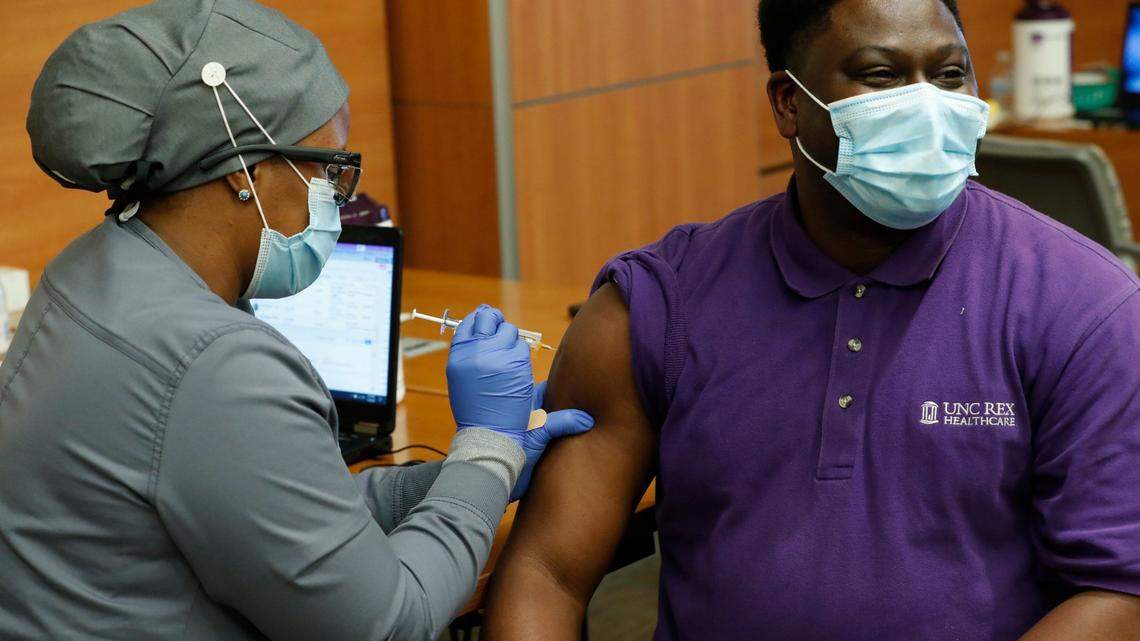
Nearly two months after the first COVID-19 vaccines arrived in North Carolina, the state’s hospitals are still trying to get employees at risk of exposure to the coronavirus inoculated against the disease.
The state does not yet know what portion of the 452,000 eligible health care workers have been vaccinated against COVID-19, according to the state Department of Health and Human Services. But Triangle hospitals report that 70% or more of their front-line workers have received at least their first shot, and that more are deciding to get vaccinated each week.
Hospital leaders are encouraging all their employees to get vaccinated against COVID-19 when their turn comes up. They’re pleased with the results so far, even if as many as one in four eligible workers remain unvaccinated.
Tony Lindsey, chief medical officer at UNC Health, said late last month that 78% of eligible employees across the 12-hospital system had received the vaccine.
“This is really good news,” Lindsey told members of the system’s board of directors. “Because initially our surveys of our employees showed quite a reluctance to receive the vaccine, so this is a remarkable number.”
Triangle hospitals are not requiring their employees to get vaccinated against COVID-19. Both the Pfizer and Moderna vaccines were developed and released quickly, by historical standards, and the Food and Drug Administration has allowed their use on an emergency basis, which means the extensive testing the agency normally requires has not been done yet.
“The vaccine is new, the experience is new,” said Rhonda Brandon, chief human resources officer at Duke University Health System. “We have a lot to learn and a lot to continue to study before we require something.”
Brandon said about 74% of Duke Health’s 9,000 eligible employees have chosen to get the COVID-19 vaccine so far, a number she calls “very positive.”
“We just have a bit more work to do to get to those last few that deserve the time, that deserve to take the time, to make it their decision,” she said.
Health care workers share some of the same questions the public has about the vaccine’s safety and side effects. For many, it was simply a matter of waiting to see how things played out among their co-workers.
“Initially, we did have a lot of hesitancy. People said, ‘Well, I’ll let others go first,’” said Amanda Edwards, who is leading the vaccination effort at WakeMed. “Now those folks are coming to us saying that they’re ready to receive their vaccination. A lot of co-workers have received it and done very well. And especially in this last few weeks as our COVID numbers were rising, our appointments were quite full.”
WakeMed estimates that 70% of nearly 18,000 of its employees and independent health care workers who reached out to the health system have received their initial dose.
How many need to be vaccinated to protect us all?
Early in the pandemic, scientists said vaccinating about two-thirds of a population would give it “herd immunity” from the coronavirus. Since then, scientists have become less certain, and both the World Health Organization and the U.S. Centers for Disease Control and Prevention say the portion of the population that must be vaccinated to protect everyone is not yet known.
The public’s willingness to get vaccinated appears to be growing over time. A survey by the Kaiser Family Foundation in mid-January found that 49% of Americans said they had already been vaccinated or would get it as soon as they could, up from 34% in mid-December. The portion who said they would definitely not get vaccinated or would only get it if required had declined slightly to 20%.
And an online Elon University poll of 1,455 unvaccinated North Carolinians in late January found about half said they would get vaccinated when they become eligible, up from 33% in October and 40% in December.
The first doses of the COVID-19 vaccine developed by Pfizer and its German partner BioNTech arrived in North Carolina on Dec. 14. The state’s plan for distributing the vaccine gave top priority to front-line hospital employees, including doctors, nurses and other medical workers but also people who transport patients or clean their rooms.
Orlando Reyes, director of environmental services at Rex hospital in Raleigh, said about 40% of the 150 custodial workers in his department had received the vaccine by early January. Many of the rest thought it had been released to the public too soon, Reyes said.
“They just don’t trust it,” he said Jan. 7. “They’re afraid of the side effects. That’s one of the biggest concerns, side effects. What is going to happen.”
Many who work in Reyes’ department are Latino, and he thinks it’s important that they get vaccinated to protect themselves and their families and to set a good example for their friends and neighbors. Hispanics account for about 22% of coronavirus cases in North Carolina, even though they make up only 10% of the state’s population.
“Our Latino community has been affected significantly, and my message to them is to get the vaccine and don’t be afraid,” Reyes said. “Because it’s going to be worse to be in the hospital or to get your family members sick.”
As of late last week, nearly two-thirds of environmental services workers at Rex had received at least their first dose, Reyes said.
“They’ve been waiting to watch reactions among those who are getting it,” he wrote in an email. “Based on the fact that there have only been a few minor side effects, more employees are now on the list to get vaccinated.”
Hospitals urge all eligible employees to get vaccine
Hospitals began encouraging their employees to get vaccinated even before the vaccines were available. In a video message shared with co-workers Dec. 3, UNC Health CEO Wesley Burks urged them to take time to consider what is best for them and their families but said he hoped they would choose to get inoculated.
“I hope that after you have time to consider all of the potential risk and benefits, you’ll come to the same conclusion that I have, that we are all safer if we are vaccinated against the COVID-19 virus,” Burks said.
Edwards at WakeMed said general concerns about the vaccine’s effectiveness and overall safety have given way to specific questions about a person’s individual situation. Should l get the vaccine if I’m pregnant or breast-feeding? What if I have a compromised immune system? She says she urges people to discuss these specific concerns with their doctors and refers them to FDA fact sheets and articles about the vaccines from the New England Journal of Medicine.
One challenge, said Duke’s Brandon, is that the internet is full of misinformation about the vaccine.
“I can turn on one channel, it will say one thing. I can turn on another and it will say something quite opposite,” she said. “So separating the myths from the facts — if we can just get the same sheet music for everybody, I think that would help.”
But even when everyone is working with the same facts, Brandon said, each person’s values and experiences are different. African-Americans, for example, may have a general distrust in the medical system that’s rooted in a history of discrimination and that makes some wary of the vaccines.
“We need to listen deeply first and understand where people are coming from, so we can meet them where they are,” she said. “And sometimes it’s one conversation at a time.”
This story was originally published February 10, 2021 at 6:00 AM with the headline "NC hospitals still trying to persuade front-line workers to get COVID-19 vaccine."