
Cooper criticizes Duke Energy carbon reduction plan, calls for more renewable resources
Gov. Roy Cooper this week detailed concerns about Duke Energy’s proposal to reduce emissions, saying the state’s largest electric utility is looking toward new nuclear when it should instead be leaning into solar and wind.
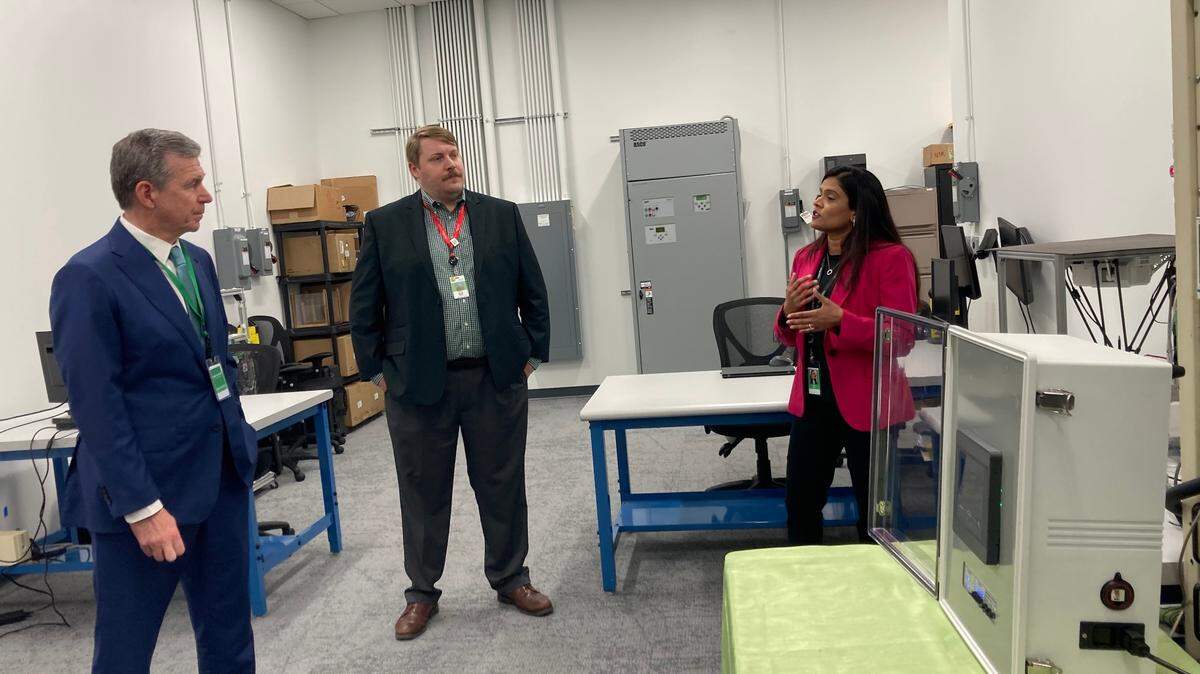
“Duke needs to do more to make sure that we get to our goals, and I hope the Utilities Commission will force them to go there,” Cooper said during an event Wednesday at Schneider Electric’s RaleighHub in Morrisville. The remarks were the first time Cooper has publicly addressed Duke’s updated plans to reduce carbon dioxide.
A 2019 law requires Duke to slash carbon dioxide emissions 70% from 2005 levels by 2030 and reach net zero by 2050. Those goals are guided by plans the N.C. Utilities Commission must approve every two years.
Environmental and renewable energy advocates criticized Duke’s second iteration of the plan, which was introduced this summer, arguing it relies too little on solar energy and offshore wind and too much on natural gas over the short-term and hydrogen and nuclear technologies that haven’t been built at scale to meet the 2050 goal.
Under the 2019 law, Duke’s resource plans must consider reliability and affordability in addition to the reduction of carbon emissions.
Duke has said any energy generation like solar or wind that depends on the weather must be balanced with a source of power that can be called upon when necessary such as a natural gas powerplant, battery storage or nuclear reactor. That balancing can account for both new resources, as well as those Duke is already using to generate power.
In response to Cooper’s remarks, Duke Energy spokesman Bill Norton said, “Governor Cooper is right that we need more resources to accommodate the exponential growth North Carolina is enjoying, which is why we’re focused on an ‘all of the above’ strategy to deliver reliable, affordable power that’s available 24/7 for our customers.”
Duke Energy’s plan
Duke’s proposal included three potential “pathways” for new energy generation resources. Under its preferred path, Duke’s new resources by 2035 would include: 11.9 gigawatts of new solar energy, 6.2 gigawatts of new natural gas, 4.3 gigawatts of battery storage, 2.1 gigawatts of onshore wind, 1.7 gigawatts of new pumped storage capacity and 0.6 gigawatts of small modular nuclear reactors. It also leaves open the option of developing as much as 1.6 gigawatts of offshore wind.
To meet the net zero goals, Duke projects spending between $119 billion and $139 billion by 2050, costs that will be passed along to customers across the Carolinas.
The filing is the first step in a process that will play out in Utilities Commission files and briefs over the coming months, eventually resulting in a lengthy hearing. The commission must approve the next version of the plan before the end of 2024.
“This carbon plan is a living, breathing thing and ... as it shakes out in the hearings to come, I hope the Utilities Commission will see the great advancements that are happening in technology and will push Duke toward more renewable energy,” Cooper said.
Under the resource plans, actions Duke proposes over the upcoming two-year period carry more weight. They are more concrete and often involve the Utilities Commission directing Duke to take steps like applying for permits that allow it to move forward with new power plants, procuring solar energy and studying how shifting new resources could impact the cost of energy.
Duke also describes steps it could take in the future, a part of the document that is primarily useful for understanding how the utility is thinking and where it believes the more concrete near-term actions could lead. That’s important with nuclear because Duke’s 2023 resource plan submission says it could end up building small modular nuclear reactors at as many as five sites across the Carolinas.
Building small modular nuclear reactors is one of two projects Duke can undertake that allows the Utilities Commission to agree to delay the 2030 carbon reduction goal while it is awaiting regulatory approval for or construction of the complicated projects. An offshore wind farm is the other project for which Duke can delay meeting the goals.
Small modular nuclear reactor debate
The plan Duke introduced this summer proposes to file an early site permit application in 2025 that would start the process of replacing the coal-fired powerplant at Belews Creek in Stokes County with a small modular nuclear reactor. Under the plan, construction could start there as soon as 2030 with the reactor beginning operations in 2034.
The utility also wants to build at least one more reactor at a North Carolina site that currently has a coal-fired powerplant. Doing that would help the utility meet its goal of retiring all of its coal facilities by 2035, helping it slash its carbon dioxide emissions.
By 2050, Duke projects that nuclear energy could be producing between 68 and 70% of its energy in the Carolinas, up from 46% today. For comparison, Duke projects that solar will be its second-most abundant energy source in 2050, responsible for between 20 and 22% of the energy it produces in the Carolinas.
Those proposed new nuclear reactors have caught Cooper’s attention.
“I think, certainly, that nuclear energy is one of the options that’s on the table, but to put a lot of your eggs in the basket of small modular nuclear power plants is not going to get us where we would need to be because we know how the not-in-my-backyard regulatory scheme works for that,” Cooper said.
Earlier this year, the U.S. Nuclear Regulatory Commission certified its first small modular nuclear reactor, a design that uses reactors about a third the size of a normal reactor and natural processes like convection and gravity to provide cooling. The first powerplant that uses the technology must achieve regulatory approval could come online in 2030, just four years before Duke is proposing its plant at Belews Creek will start operations.
Earlier this month, Cooper vetoed Senate Bill 678, legislation intended to make it easier for nuclear powerplants to receive regulatory approval in the state. The legislation shifted rules about how much carbon-free energy Duke must produce, allowing utilities to use nuclear energy to meet those goals for the first time.
It also removed a requirement that the Utilities Commission must deem new nuclear and coal facilities cheaper than renewable generation or energy efficiency efforts in order to be built. Instead, the commission must find that any new source of electricity is part of the least-cost path toward carbon reductions and improves electric reliability.
Cooper’s veto message said the bill was meant to boost the construction of “traditional power plants” and boost profits for utility companies, namely Duke, instead of exploring cheaper options like energy efficiency or renewable energy.
“We need to concentrate more on where this technology is going — more on energy efficiency, more on battery storage technology where we can leverage solar and wind. I think that’s going to help get us there,” Cooper said.
This story was produced with financial support from the Hartfield Foundation and 1Earth Fund, in partnership with Journalism Funding Partners, as part of an independent journalism fellowship program. The N&O maintains full editorial control of the work.
This story was originally published October 21, 2023 at 8:00 AM with the headline "Cooper criticizes Duke Energy carbon reduction plan, calls for more renewable resources."