Auditor says managed care groups are reaping excessive savings — is NC losing out?
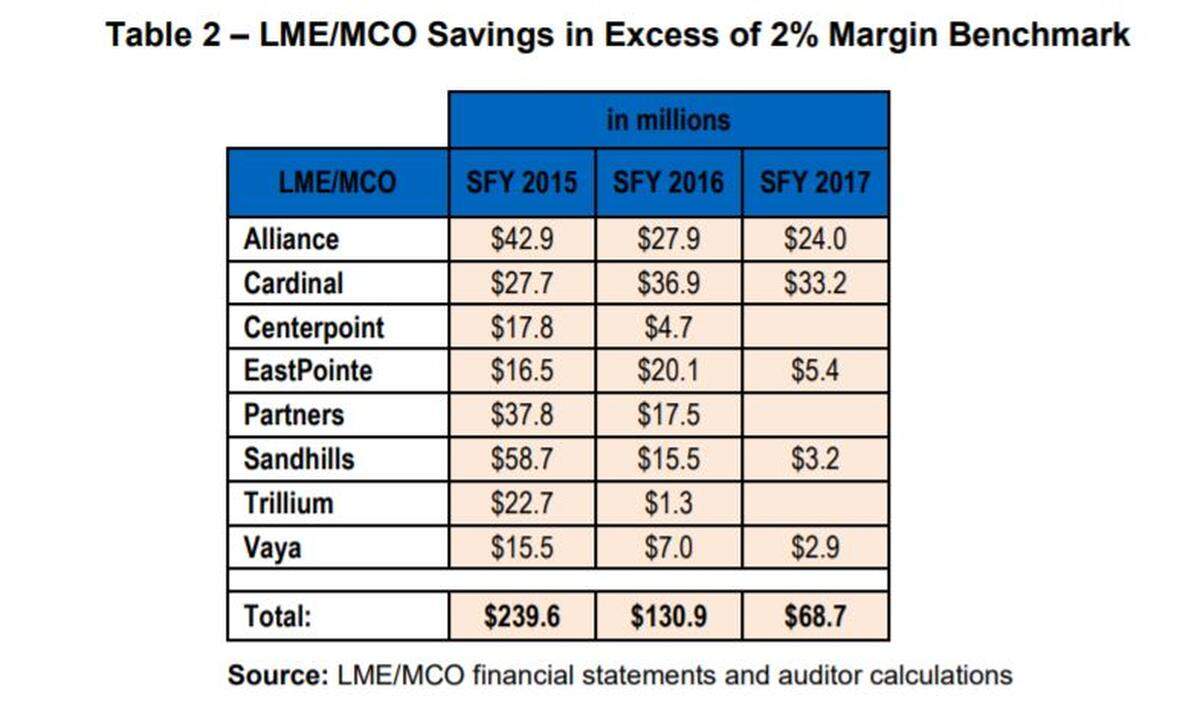
The managed-care organizations that handle behavioral health care for North Carolina’s Medicaid recipients had excessive savings of nearly $440 million over a three-year period, an audit published by the state auditor’s office says.
The audit, published in January and based on a three-year period from 2015 to 2017, reported that money that could have been used for additional medical care or other public expenditures has instead remained in the coffers of seven state-established and publicly funded managed-care organizations.
The savings were higher — nearly $800 million — if the scope of the survey had been extended, State Auditor Beth Wood, who was elected in 2009, said in a phone interview.
That’s “money that we could have used on schools, road construction and economic development,” Wood said, or as the report states, it could be used “to provide additional behavioral health services to North Carolina citizens.”
“There are people who need the services who are not getting them,” Wood added.
The money, which is meant to go toward treating Medicaid recipients with mental illness, substance abuse issues and other disabilities, may “have been moved outside of the state’s control” once it was considered savings, the auditor’s office found, because of a lack of laws or regulations around the savings. Wood’s report ultimately says it’s unclear whether the state can recoup the funds or even ensure that the funds are used to provide additional Medicaid services.
The report comes as the state begins to transition to a managed-care model for most of its Medicaid system for low-income, disabled and elderly residents.
The audit found that the excess savings for the seven local management entities/managed-care organizations (MCOs) that the state contracts with were due, in part, to the way that the state pays for Medicaid services, as well as a lack of contract terms or laws that limit excess savings by MCOs.
In response to the audit, the state’s Department of Health and Human Services said the level of savings at the MCOs was appropriate to provide flexibility for emergencies, shortcomings and to reinvest in the community.
But Wood said there hasn’t been much reinvestment so far.
“They are sitting on the savings,” Wood said. “They have spent down very little of the money.”
The state auditor’s office has previously criticized one of the MCOs, Cardinal Health, for having excess savings and spending too much money on things such as salaries, corporate events and travel, The News & Observer previously reported.
Wood’s report recommended that DHHS set new rates to lower the reserves MCOs control or that the N.C. General Assembly set parameters around savings levels.
Setting rates
In 2011, the state legislature voted to overhaul the state’s mental health care system, creating state-established managed-care agencies. Those seven MCOs operate like government-funded mental health insurance agencies, getting set amounts of money from federal, state and local governments to cover mental health services.
The state pays nearly $2.6 billion per year for mental health, developmental disability and substance abuse services through its Medicaid contracts. The amount of money each MCO gets each year is set through a “capitation rate,” an amount that is based on patient numbers, previous financial outlays and adjusted for expected changes.
The process is overseen by an actuary, and the insurers are expected to keep some savings for contingency, though no specific rate has been set for how much is retained. While the audit found the rates were actuarially sound, the lack of an explicit margin for savings resulted in excess savings, the report said.
Wood said that most nonprofit MCOs target savings rates of around 2 percent, and that any savings past that benchmark, her office considered excess savings. The North Carolina MCOs’ savings rates ranged from as high as 22 percent to losses on some occasions. In 2015, the average savings margins for the seven organizations was 11.3 percent or almost six times the 2 percent savings margin benchmark, the audit said.
In response to the audit’s recommendations, DHHS Secretary Mandy Cohen wrote that limiting retained savings can be a deterrent to efficient management of costs.
“When LME/MCOs manage expenditures more efficiently than anticipated, those savings translate into lower costs to the state over time as future capitation rates are developed based on past experience,” she wrote. “Over the three-year period reviewed, total LME/MCO savings averaged 5.12 percent of capitation payments. That level of savings is not atypical in the industry.”
However, Wood responded, even the 5.12 percent three-year average that DHHS cites is “more than 2.5 times the 2 percent industry average that the Society of Actuaries identified for nonprofit MCOs.”
The audit also listed as examples the state of Texas — which allows MCOs to retain all savings up to 3 percent, but then shares with the state any amount above that level — and Florida — which allows MCOs to keep up to 5 percent, with higher amounts shared with the state.
Managed-care transition
Wood said her office wanted to study the performance of MCOs in the state before that style of coverage is expanded across the state. Five private health insurance organizations were named last month to share in contracts totaling $6 billion a year to provide health care under a privatized state Medicaid program for low-income, disabled and elderly residents that is set to start providing health care coverage in November, The News & Observer previously reported.
The managed-care approach, already adopted by most other states, was mandated in North Carolina in 2015 by the state legislature in response to chronic budget overruns and alleged mismanagement.
“We have been in business since 2013 with these (nonprofit MCOs), the seven of them, and so we thought we will look at what we have been doing before we spend $6 billion” on these private MCOs, Wood said.
Corye Dunn, director of public policy at Disability Rights NC, said that while the savings rates were high for MCOs, they shouldn’t just spend money for the sake of it.
“I would agree that they have excess reserves,” Dunn said. “But we don’t want them to spend money to just spend money, we want them to buy high-quality services and we want to incentivize that as a state.
“I hope that we as a state have learned from the experience in the behavioral health world and apply that to the upcoming Medicaid contracts.”
This story was originally published March 27, 2019 at 3:34 PM.