As grocery prices continue climbing, here’s how NC farmers and consumers are dealing
READ MORE
The Cost of Living
Wages are increasing, but not at the same pace inflation is, causing a dilemma afflicting many middle-income earners. And this is exacerbated in the Triangle, where inflation exceeds the national average. Families with post-secondary school education and advanced occupations still can be impoverished. Their devalued dollars don’t do enough to cover the cost of life. The same is true for local farmers, who are forced to pass rising expenses along in the form of ever-higher food prices.
Expand All

When you can’t afford the cost of life: Redefining poverty’s parameters
As grocery prices continue climbing, here’s how NC farmers and consumers are dealing
Here’s where you’re spending your money each month if you live in NC

How much money does your family need to make to meet its basic needs in NC?
As Jack Pleasant hopped into his car in early May, he rattled off the list of price increases his company Sunset Ridge Buffalo Farms has seen in the past few months as if he were reading them from a list.
Processing rose up to $1.15 a pound from $1.05. Kill fees jumped $10 a head to $120. Hourly inspection fees rose to $66 from $59.
“That’s just since February,” he said.
Diesel fuel for his trucks and farm equipment has shot up. He’s having to pay workers more, with hourly wages up from $11 or $12 a couple of years ago to $14 or $15 today. Farmers market fees in Durham and Carrboro went up about $5 each.
“Fertilizer has gone from $250 to almost $800 a ton, so we didn’t put any out this year. That affects the quality of the hay that the animals get and the rate of growth of the grasses, but there’s no way to make the numbers work,” Pleasant said.
That has all combined to drive up prices, Pleasant said — a reality familiar to anyone who’s purchased food recently and paid attention to their receipts.
Grocery store prices are 10% higher than they were one year ago, according to the most recent data from the U.S. Department of Agriculture. Another 5% to 6% increase is anticipated by the end of 2022.
The USDA reports that for consumers, the biggest year-over-year jumps were seen in meats (up 15%), eggs (up 11%), oils and fats (up 15%), and fresh fruits (up 10%).
‘It’s inequitable’
Markus Denton lives within walking distance of DGX Raleigh, a downtown corner store at East Davie and Blount streets.
Between visits to larger grocery stores, Denton frequents DGX for its small produce section and “everyday essentials.”
The store’s name stands for Dollar General Xpress, but its wares haven’t escaped inflationary pressures.
”I don’t get much here,” Denton said. “But for sure my receipts have gone up a few dollars here and there. It’s not much, but that sort of thing adds up over time.”
Bernard Hedgepeth, a Food Lion shopper in Durham, said he too is seeing receipts add up.
“They are not running as many sales. The prices of everything have jumped,” he said.
Hedgepeth said it’s been particularly noticeable with meat, most prominently chicken, and household items like cleaning supplies.
“It’s inequitable for someone to be paying $65 for (one) month and today I just paid $85,” he told The News & Observer as he stood with one hand on his half-full cart. “I don’t blame the grocery stores. I blame the presidents of these food companies who want to keep profits high for their shareholders.”
From the corner store to the farmers market
Zatch Bell, a sales associate at downtown Durham grocery shop Bulldega Urban Market said it’s mostly meat and nonperishables that have shot up in price.
“It’s not just here. It’s all over the place,” he said.
Bell said customers, especially the regulars, are buying smaller portions.
“They’re kinda cutting down to stocking up for just the week ahead,” he said.
For Pleasant, whose farm is in Roxboro, the per-pound increases have ranged by product from 25 cents to $2. He said total sales haven’t really changed, but volume is down. They’ve been selling bison meat since 2006 after getting their farm going in 2001.
“Our product is not an inexpensive product to begin with, so we have a certain part of our clientele that price is not going to affect whether they want to buy or not,” he said. “What I see is more people buying two burgers when they’d normally buy four.”
He noted, however, that food stamps can be used at the farmers market, and those customers who use them are having to wrestle with price increases in different ways.
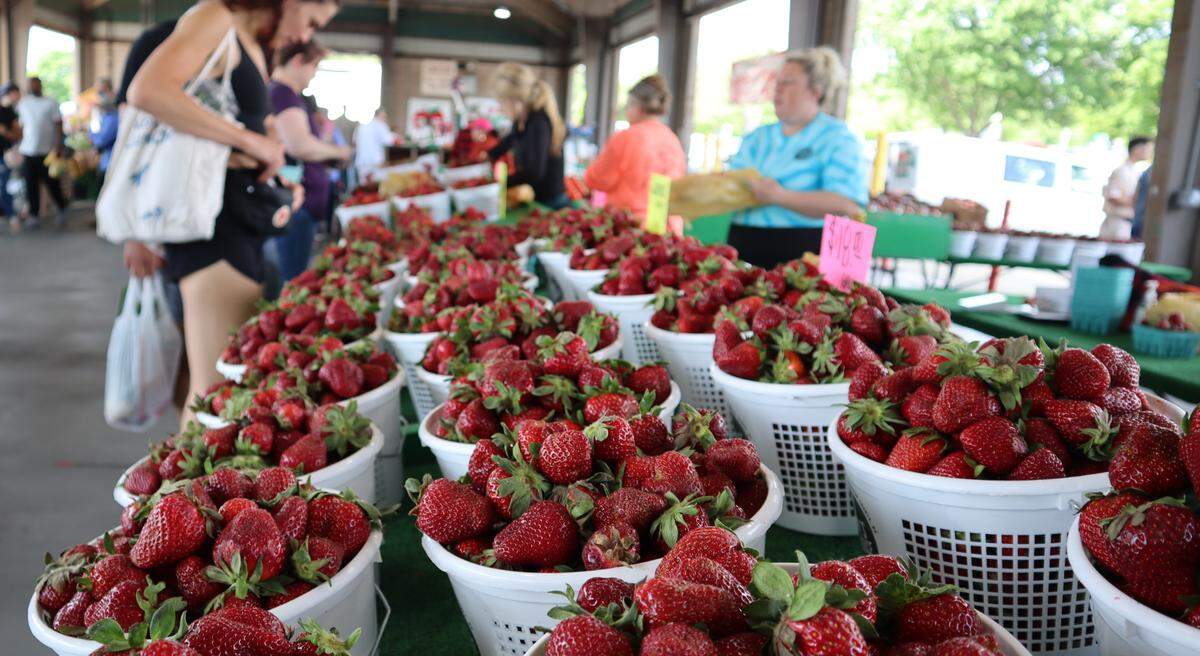
Celia Penny, whose Willow Spring farm Penny’s Produce sells strawberries at the State Farmers Market, said all her supplies have dramatically increased in price over the past couple of years.
“Everything. Your chemicals down to your packs of water,” she said.
White buckets of deep red, devilishly sweet berries that went for $15 last year were priced at $18 this year. She said customers are buying fewer strawberries this spring.
“People are having to cut back and spend their money elsewhere,” she said. “They are buying a lot less.”
This story was originally published May 8, 2022 at 6:00 AM.