Why more NC startups are raising money from the crowd

For most of the past century, the federal government barred all but higher-end earners from investing in private companies, including startups, fearing the general public wasn’t financially secure or aware enough to withstand the risk.
But a series of recent rule changes has opened up “Shark Tank”-style investing to the masses, and North Carolina founders are beginning to reap the benefits.
“It’s allowed people who want to support me, but who don’t have a lot of money, to still feel like they’re contributing,” said Brittney Barreto, founder and CEO of Femhealth Insights, a Raleigh-based startup that focuses on women’s health technologies.
FemHealth has raised $57,100 from 57 investors in an ongoing campaign on the crowd investing platform WeFunder, where a minimum investment of $100 can buy people a tiny stake in Barreto’s company.
Barreto recently joined other Triangle-area founders for a panel on the rise of crowd investing at the Capital Club Building in downtown Raleigh.
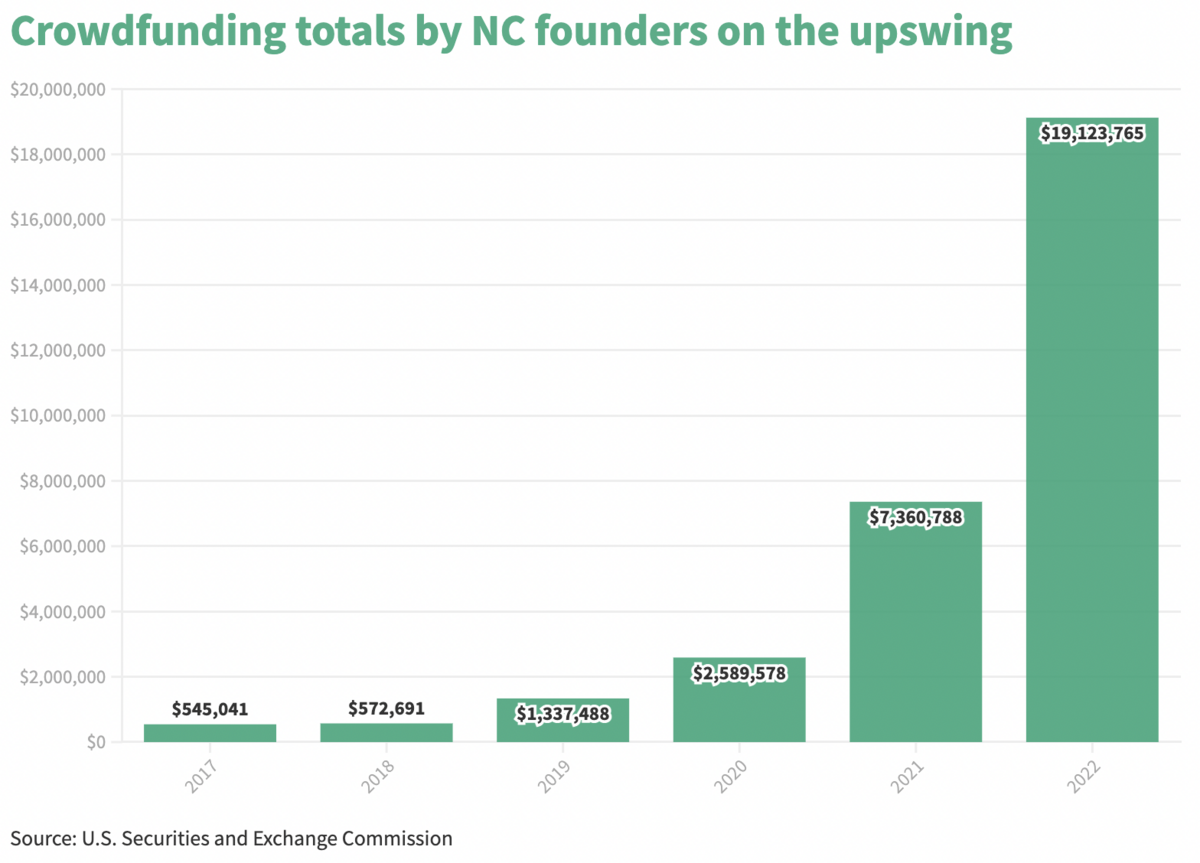
According to data collected from the U.S. Securities and Exchange Commission (SEC), North Carolina startups have crowd invested more than $19 million from 2016 to 2022, with last year seeing successful campaigns ranged from $11,484 to $3.4 million.
“We’re still small in terms of dollars raised,” said Will McGuire, CEO and founder of Incolo, a Raleigh-based firm that helps startups connect with the public. “But in terms of the growth rate, we’re getting faster.”
Seeking more than equity
During the Great Depression, the U.S. government restricted most Americans from funding private companies. For decades then, the only people who could put money into startups were what are called accredited investors, individuals with incomes of at least $200,000, joint incomes of at least $300,000, or who had net worths north of $1 million.
This restriction bothered McGuire, who didn’t understand why people could buy public stocks, bet in Las Vegas, or gamble on lottery tickets, but not back startups.
Then in May 2016, the accredited investor barrier came down when a provision in the Obama administration’s JOBS Act went into effect. Under the new rules, called Regulation Crowdfunding or Reg CF, non-accredited investors earning $107,000 or more could start investing up to 10% of their income, while those making less can put in at least $2,200 a year.
These changes allowed customers who enjoy using a startup to show their support in a new way, said David Shaner, the CEO of Offline, a Raleigh-based members-only restaurant club.
“When a crowdfunding investor is investing in your business, they’re not just doing it for the equity,” he said. “They’re doing it because they want to support your business.”
Shaner said around 70% of Offline funders are also customers, and the company’s Wefunder page is filled with comments from people who sound more like fans than grassroots venture capitalists.
This past summer, Offline raised more than $2 million from over 450 individual funders on Wefunder. The company has also raised capital from traditional investors in the past, including McClatchy, which owns The News & Observer.
Andy Zarick, a nurse in Durham, said his $100 crowd investment in Offline this summer was partially profit-seeking. “Like any investor, I hope to gain back what I put in, it not more, but I’d say 75% of it is because it’s a company I love and use,” he said.
Another major driver of crowd investing in North Carolina occurred in March 2021 when the SEC raised the annual limit businesses could raise from the general public from $1 million to $5 million. At the same time, the commission started allowing businesses to streamline how a company could record its’ equity holders (who might number in the hundreds or thousands) on a capitalization table.
This latter step, Shaner explained, made crowdfunding more organized and legitimate.
“That’s when it really started to accelerate,” he said. “It’s much easier now.”
This story was produced with financial support from a coalition of partners led by Innovate Raleigh as part of an independent journalism fellowship program. The N&O maintains full editorial control of the work.
This story was originally published February 21, 2023 at 7:00 AM.