Pendo CEO talks ‘founder mode,’ going public and his Raleigh software firm’s first profit
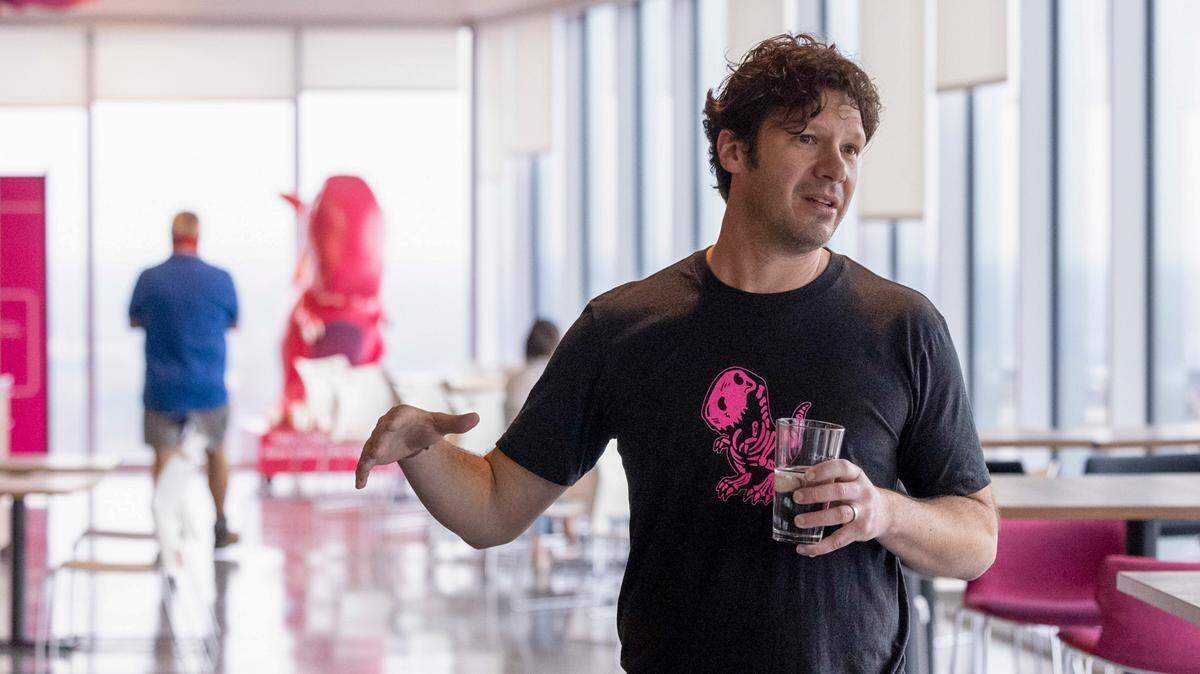
Seated backstage in a pink and white letterman jacket, Pendo CEO and cofounder Todd Olson reflected on the year his Raleigh software company went into the black.
It was the final afternoon of Pendomonium, the annual multi-day gathering of employees, customers and industry stakeholders Pendo hosted last week at the Martin Marietta Center for the Performing Arts.
Pendo makes software to help businesses better understand, and then improve, their own software. It ranks among the Triangle’s most valuable private tech companies — behind only Epic Games and SAS Institute. Founded in 2013, the business with a pink logo has grown from 100 employees to more than 850 today, becoming a rare local startup “unicorn” by eclipsing a $1 billion valuation.
Until recently, Pendo wasn’t profitable. That changed during the final quarter of last year when the company achieved positive cash generation for the first time (helped, in part, by record revenues and lower expenses following June 2023 layoffs). For the current fiscal year, Pendo anticipates being cash flow positive.
In a discussion with the N&O, Olson, 48, shared Pendo’s global growth trajectory, his views on going public, AI, the benefits of seeing a business coach, and whether he subscribes to the buzzy hands-on leadership style known as “founder mode.”
The interview has been edited for clarity.
The News & Observer: You started Pendo 11 years ago. How has your leadership style changed since then?
Olson: I think your leadership style evolves over time. There’s been a whole narrative in the press recently about this concept of founder mode. It was popularized after a talk by Brian Chesky from Airbnb. I will say that the whole narrative really resonates with me, because I do think I’m the kind of leader that leads like a founder. I mean, I’m very comfortable being in details. I think we tend to attract leaders who are unafraid of details.
N&O: What are areas where you continue to be hands on?
Olson: I’ve been really fortunate where I’ve had a (chief financial officer) in seat since 2017 who is in the details. So I kind of have a high degree of trust. So anything back office-related, delegated. But our (chief revenue officer) is one of our most recent hires, and before he joined about a year ago, I was very involved in running sales as an example.
N&O: What is bad advice you’ve gotten during your time leading Pendo?
Olson: When you’re scaling, all the advisers around you will start telling you, ‘You need to hire someone who’s been there and done that.’ And hiring someone who’s been there and who’s done that is someone that often hasn’t really had to be in the details. So now you bring this person into your organization, and things start going wrong, and then you realize very quickly that person’s never had to actually dive in and fix these problems.
And while we do hire scale executives that have seen (larger company) sizes, we try to also hire ones that have gotten their hands dirty and have had to fix things themselves, or be in the trenches a little themselves, or worked at smaller companies. So, when we think about our executive team, while a bunch of them have worked at bigger companies, a bunch have worked at startups.

N&O: During our interview last year, you said you wanted Pendo to do a better job of attracting international customers. How has that gone?
Olson: This is probably the highest year for air miles I’ve ever racked up in company history and most of it’s external. I spent the summer in Europe. 100 customer meetings in 30 business days. I went to Brazil and Hong Kong this year. I’m heading to Dublin next week. These are three cities I’ve never been to. I’m going to Helsinki. I went to Amsterdam with Pendo, Berlin with Pendo. Zurich. Pendo’s had no representation in these cities ever before.
We just hired our first team in Munich. I think being closer to customers, being able to do business in their native language, I think is absolutely going to help in the German market, eventually the French market. We don’t have teams there, but I can see us doing that in the future. And I think we’ve already reported that we have a Japan team. We have a Latin America team.
N&O: Pendo has aggressively integrated artificial intelligence into its platforms. In the nearly two years since ChatGPT debuted, how have you seen AI enthusiasm change the tech sector?
Olson: I mean, one, the technology is amazing. It has incredible amount of opportunity.
There’s a lot of ways it affected tech. One, it has sort of dominated the startup landscape. You look at Y Combinator classes, you look at funding rounds, the companies that are most successful in garnering funding at really high valuations are AI companies. So that’s obviously a change. If you’re not an AI company, you’re probably going to struggle with getting funding. You’re going to probably struggle getting high valuations.
I think the technology is changing very rapidly. Every time we go to use it, and something that doesn’t quite work the way we expect it, the next version is a little bit better, and the next version’s a little bit better. So, I think we can kind of see where the puck’s going on this one. The technology is going to perform some of these functions very, very well. Yet, we still see a lot of, you know, hallucinations. So, I think it’s a sort of reminder: It’s still very, very early days.
N&O: What challenges has Pendo faced integrating AI?
Olson: The interesting fact is I’ve had more meetings today where companies’ information security posture is one where they do not allow usage of a lot of these large language models or ChatGPT. While the promise is there — companies want to leverage generative AI — many of them disallow the usage of some of these technologies because there’s fear and uncertainty around where the data’s going.
What are the risks to the business? Our biggest customers, the ones that are here (at Pendomonium), tend to not have even our AI capability that we’ve built turned on, which is something we’re working through.
N&O: I read you have a personal coach. What aspects of your life does the coach help with?
Olson: It’s a little bit unique in that it’s a coach combined with sort of a group therapy session where they are always between five and seven CEOs in my group. I meet with my coach monthly. I meet with the entire group quarterly. We review our businesses, what’s working, what’s not working. We always do some level of deep dive on our business, and it’s something I’ve been doing for at least five years. One of the things about me is I really like cadence and consistency.
I used to go when we were 100 people. Now, we’re 800 and some odd people, I continue to work on my skills, my craft. These people know me well, so they can challenge me and push me in ways that maybe my board directors can’t.
N&O: Why is it helpful to have people who don’t know Pendo intimately give feedback on your choices leading Pendo?
Olson: What we’re doing is pattern matching. You’re seeing some situation, and you’re trying to apply something else you’ve seen in your career or in your experiences, and trying to say, ‘Well, in this situation, this is how we handle it, this is what worked and what didn’t work from that experience.’
N&O: You’ve discussed taking Pendo public in the past. But the company remains private. Do you look at an IPO (initial public offering) differently today?
Olson: I don’t think I’d look at it differently. I would have said five years ago, like, I say today, going public is a financing event. That’s the way to think about it. Yes, I know that probably more comes with it than a typical private financing, but it is a financing.
We’re sort of in a fortunate position where we announced at the end of last year that we crossed over to cash flow break even. So, we don’t necessarily need cash anymore. We are generating cash as a business. That’s a different posture than we’ve been before. And that’s more of a shift in the change in the economy post-zero interest rate days. It’s clear that the companies that are doing the best now have a good blend of growth and efficiency.
N&O: Efficiency means profitability?
Olson: Yes. And that is a change for us. Five years ago, did I think we had to get free cash flow positive before we became public? No. I was assuming to be bringing cash to an IPO. That likely won’t be the case.
N&O: So, no rush to go public?
Olson: Absolutely no rush. I don’t feel rushed. We continue to increase our level of preparation, you know, and but there’s no like, clock or timer or anything to that degree.
N&O: Do you think the standards for companies going public have shifted in recent years?
Olson: I believe the companies (going public) need to be bigger. I think you need to have a better story around the balance between growth and efficiency. I think we still are kind of working out what those numbers need to look like in order to maximize this as an opportunity for the company.
(In 2020 and 2021,) the market was rewarding very high growth, regardless of what you were spending. Now it’s like, ‘We need to look at both.’ So, you still need to grow. Growth is still valued at like two to three times more than efficiency or profitability. But you have to have a good story around profitability. The good news is we do now.
This story was originally published October 16, 2024 at 12:28 PM.