Open Source: NC’s growth ingredients | IBM explains H-1B visa use | Net neutrality nixed

I’m Brian Gordon, tech reporter for The News & Observer, and this is Open Source, a weekly newsletter on business, labor and technology in North Carolina.
Asked this week what distinguishes North Carolina from the other states in his region, Tom Barkin, president of the Federal Reserve Bank of Richmond, pointed to geography and appetite.
First, North Carolina’s three largest urban centers are unencumbered by major bodies of water or mountains, allowing nearly 360-degree development around the Triangle, Charlotte and the Triad.
“I’ve been in Clayton. I’ve been in Wilson. I’ve been in Smithfield. I was in Asheboro,” Barkin told reporters after the Raleigh Chamber’s economic forecast event Tuesday. “There’s a lot of land in these places, and the land’s buildable. That really matters.”
Second, Barkin noted North Carolina still wants to expand — which isn’t true everywhere.
“It’s a community that is still welcoming growth,” he said. “And there are many communities I go to in my district, Northern Virginia and Maryland, where the communities, the neighbors, they’re not welcoming more housing. They’re not welcoming more business, more traffic.”
During his main remarks, Barkin described a strong, if cautious, U.S. economy entering the new year, propelled by high U.S. consumer spending, greater productivity, and low firings (but also low hirings). Plus inflation is now below 3%, not far from the Fed’s target of 2%.
H-1B debate intensifies
Does the H-1B visa program substitute U.S. workers with less expensive foreigners who have little leverage to advocate for better pay and new jobs?
Or does it strengthen America by bringing top tech talent to fill important positions, paving the way for more bright individuals (and their families) to work, learn and innovate here for generations to come?
Yes.
The visa program turns 25 this year, and it’s been in the news as some Trump supporters (and Bernie Sanders) criticize the policy while other Trump supporters, like Elon Musk and Vivek Ramaswamy, say even more H-1B visas should be awarded.
As a tech hub, the Triangle is home to many H-1B workers. Most come from India. They receive a three-year work visa that can be renewed once. After six years, they must leave or enter the green card process — which for Indian nationals lasts more than a decade. During this period, they are able to work in the U.S. — but their status is tied to their employer.
One of the top recipients of H-1B visas in North Carolina is IBM. In an email last year, the company said it had been “scaling back” its use of the program. But Big Blue remains a top beneficiary of the program, receiving the 10th-most nationally, despite recently conducting layoffs.
Hiring H-1Bs while cutting jobs is a major criticism of the H-1B policy. Asked about this dynamic, IBM said in an email Thursday it “remains deeply committed to investing in its U.S. workers.”
“When we do utilize H-1B workers, these are highly skilled individuals who are hired to fill skills gaps in order to meet IBM and our clients’ needs,” the company’s media team said.
Positioning the visa debate as a competition over limited jobs does feel incomplete. During an audience poll at this week’s Raleigh Chamber economic forecast event, respondents picked “attracting and retaining talent” as the largest workforce challenge they faced in 2025.
As U.S. birthrates decline, employers say there is a need for more labor across the skills spectrum. Employers want workers. People want to come here. It seems like there should be a solution that protects U.S. employees and foreign talent.

Net neutrality and North Carolina
The Federal Communications Commission can no longer choose to classify internet service providers as common carriers, an all-Republican appellate court ruled last Friday. It was a blow to the Biden administration and net neutrality advocates who want to keep providers like Comcast, Spectrum, AT&T and Verizon from tilting internet speeds in favor of clients who may pay more or be owned by the internet companies themselves.
Congress can still grant the FCC authority to regulate internet service providers (ISPs) as common carriers, like railroad or airline companies, under Title II of the Communications Act.
“Consumers across the country have told us again and again that they want an internet that is fast, open and fair,” FCC Chair Jessica Rosenworcel said in a statement after the ruling. “With this decision it is clear that Congress now needs to heed their call, take up the charge for net neutrality, and put open internet principles in federal law.”
But that’s unlikely to happen while the GOP is in control.
In 2023, U.S. Sens. Thom Tillis and Ted Budd of North Carolina joined dozens of fellow Republicans in opposing stronger FCC regulation. Tillis has long objected to federal net neutrality rules. “The last thing we need is the government to tell cable providers or internet access providers, how fast or how slow their content should be,” he said in 2014 during a GOP Senate debate.
The latest appellate ruling doesn’t restrict states from setting their own net neutrality laws. In 2017, North Carolina Democratic State Sens. Jay Chaudhuri and Mike Woodard filed a bill that would prevent internet service providers doing business in North Carolina from engaging “in practices inconsistent with net neutrality principles.” It did not pass.
Today, ISPs caution against states tackling net neutrality.
“We support an open Internet, as well as federal legislation to adopt national bright-line net neutrality laws that protect against blocking, throttling and paid prioritization,” AT&T spokesperson Alex Byers said in an email. “State laws run the risk of creating 50 separate sets of rules — instead of one national framework — which causes confusion and deters investment. The internet does not stop at the state boundary.”
California is one of the few states to have its own net neutrality law. And its regulation seems to have made an impact; The Los Angeles Times reported that before this law went into effect, AT&T allowed its phone customers to stream the service Max — which AT&T owned — “without counting usage against a customer’s data cap.” At the same time, AT&T did count streaming services it didn’t own toward the cap. After the state’s net neutrality law took effect, AT&T dropped this Max benefit.
For states thinking about setting strict net neutrality protections, it’s worth noting the Trump administration sued California over its regulation.
Clearing my cache
- Toyota expects to ship the first batteries from of its massive new Randolph County plant in March. By capital investment, the site is the largest state-backed economic project in North Carolina history.
- Union elections at Amazon warehouses are rare, but one is coming next month to the company’s 4,300-worker facility in Garner. Amazon is opposing the effort.
- The multibillion-dollar fintech startup Plaid will open a corporate hub in the Triangle. Its CEO has North Carolina roots.
- The $650 million Charlotte is giving to renovate Bank of America Stadium was named the “Worst Economic Development Deal” of last year by The Center for Economic Accountability. The nonprofit bestows the annual “winner” with a graphic of a shovel stuck in a pile of poop.
- A contract drug manufacturer that specializes in gene therapies is laying off 120 workers at its Durham facility near RTP.
- Emeritus Duke Professor Ingrid Daubechies received the National Medal of Science last week for her career advancements in image-compression technology. In 2021, The New York Times called her “The Godmother of the Digital Image.”
- Tavros Therapeutics, a Durham cancer treatment startup cofounded by a Duke graduate, has been acquired by Vividion Therapeutics (which itself is a subsidiary of Bayer AG).
- More Amazon news. The company announced Thursday it had opened a same-day delivery facility in Kannapolis (north of Charlotte) plus plans for four more “last-mile facilities” elsewhere in the state.
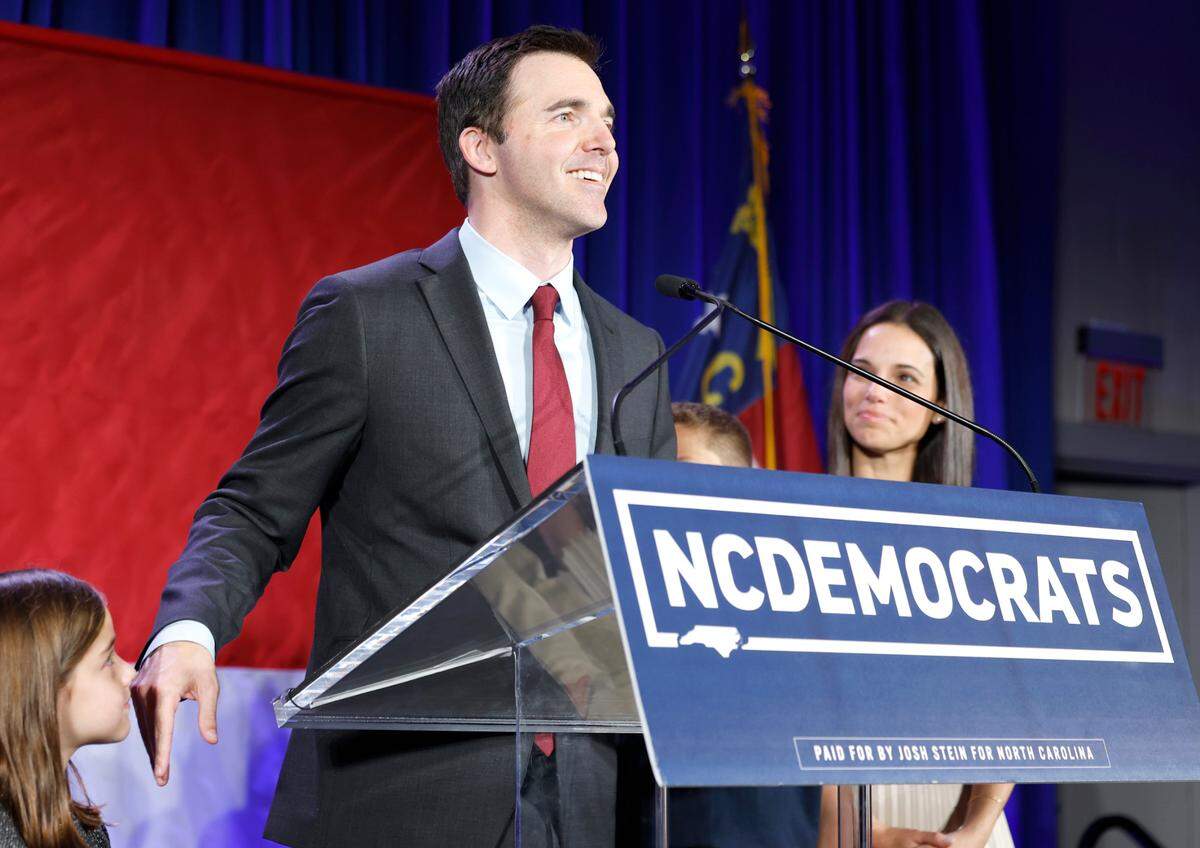
- Attorney General Jeff Jackson’s first lawsuit targets six landlords who allegedly used the real estate software company RealPage to elevate rents. Some of the defendants, like Greystar Real Estate Partners, own many apartment units across Raleigh and Durham.
National Tech Happenings
- In a controversial move, Meta will stop partnering with third-party U.S. factcheckers on Facebook and Instagram. CEO Mark Zuckerberg said their work frequently led to “censorship.”
- Nvidia CEO Jensen Huang said quantum computing’s practical applications are likely 20 years away, a prediction that sent quantum computing stocks tumbling. This included shares of IonQ, a company with Duke University roots that had been enjoying a strong stock market run.
- Want a sense of the AI frenzy? Last year, the Amazon-backed AI startup Anthropic was valued at $18 billion. Now, the OpenAI rival is fundraising at a valuation of $60 billion, The Wall Street Journal reports.
This story was originally published January 10, 2025 at 8:28 AM.