UNC, Duke doctors sound off on RFK Jr.’s claims about mRNA vaccines
I’m Brian Gordon, tech reporter for The News & Observer, and this is Open Source, a weekly newsletter on business, labor and technology in North Carolina.
When COVID-19 cases were surging, Dr. David Wohl saw patients “hungry for air” fill UNC hospital wards. What most saved lives, he said, were vaccines developed with unprecedented speed using mRNA technologies.
“These vaccines really do work,” Wohl, an infectious diseases professor who co-lead UNC’s clinical pandemic response, said. “It’s ridiculous to even be talking about this given the profound difference we saw once the vaccines became available.”
Wohl spoke on Thursday, two days after Health and Human Services Secretary Robert Kennedy Jr. cancelled close to $500 million in contracts and grants for mRNA vaccine development. The Department of Health and Human Services said it would also not fund any new mRNA-based projects under the Biomedical Advanced Research and Development Authority, which launched in 2006 to treat public health emergencies. And in May, the health department ended a $590 million contract with Moderna to create an mRNA-based vaccine for bird flu.
“As the pandemic showed us, mRNA vaccines don’t perform well against viruses that infect the upper respiratory tract,” Kennedy said in a video Tuesday.
This statement, multiple UNC and Duke University medical researchers told me, is patently false. “Completely untrue,” Wohl said. “The COVID-19 virus, SARS-CoV-2, infects the upper airway.”
Dr. Charles Carter, a professor of biochemistry and biophysics at UNC, called the Trump administration’s retreat from mRNA technology its “most impactful long-term decision.”
“There’s absolutely no basis for Kennedy’s decision,” he said.
In contrast to traditional vaccines that introduce weakened or deactivated viruses, mRNA (or messenger RNA) treatments teach bodies to ward off diseases by making proteins that activate immune responses. Though known for decades, mRNA was first used in vaccines by Moderna and Pfizer against COVID-19.
Researchers say mRNA quickened vaccine development by bypassing the lengthy step of growing viruses. Beyond COVID, it has also shown promise in the emergence of influenza and cancer treatments. Scientists locally have embraced the technology: UNC patients participated in Moderna’s COVID-19 vaccine trials, CSL Seqirus has worked on self-amplifying mRNA vaccines at its flu vaccine plant in Holly Springs, and Dr. Barton Haynes of Duke University credited mRNA with advancing his team’s HIV vaccine.
“It takes two years to make a protein that’s safe enough and go through all the hoops to be tested and have the FDA approve it to get it into humans,” Haynes told The N&O in June. “That’s two years per protein. Whereas we can make an mRNA, just as safe, but we can get it done in six months.”
CSL Seqirus was one of the drugmakers the federal government listed this week as having its mRNA-related work cut. In an email to The N&O, a company spokesperson said its mRNA programs cited by HHS aren’t active and thus “this decision has no impact on our research.”
In his video Tuesday, Kennedy said “mRNA only codes for a small part of the viral proteins, usually a single antigen.”

“One mutation, and the vaccine becomes ineffective,” he continued. “This dynamic drives a phenomena called antigenic shift, meaning that the vaccine paradoxically encourages new mutations and can actually prolong pandemics.”
Kennedy’s description, Wohl said, “is all incorrect and a misunderstanding of how vaccines work.” He explained that while viruses do evolve, the vaccines remain effective because the evolved virus still shares proteins with the original.
“Of course, a new variant can come along that’s completely different,” Wohl said. “All the more reason why mRNA technology is important. Because you can quickly re-engineer the vaccine to respond to that.”
Canada invited hundreds of NC H-1B workers. It now doesn’t want more.
In July 2023, Canada encouraged 10,000 workers in the United States on high-skilled H-1B visas to relocate north. This unprecedented attempt to attract tech talent proved popular as visa holders filled all available slots within two days.
Among the applicants were 428 North Carolina residents, Canada’s immigration office told The N&O last year. Only six states had more. Counting family members, nearly 600 people were given the option to leave North Carolina for Canada.
But how many have actually gone?
According to new data provided by Immigration, Refugees and Citizenship Canada, around 1,780 H-1B workers nationwide moved to Canada in the two years since the program launched. This is 18% of the original applicant pool and includes around 45 workers who listed North Carolina as their primary address. And these numbers don’t tell whether the workers stayed.
Such low participation suggests many visa holders viewed Canada as a backup. And it’s unlikely more slots will open soon given our northern neighbor’s shifting attitudes toward immigration.
“There’s been a complete pendulum reversal from what we were seeing between 2022 and 2023,” said Daniel Mandelbaum, an immigration attorney in Toronto.
Canada introduced its H-1B program at a time the country aggressively courted temporary foreign workers. Its three-year open permits offered several advantages to U.S. H-1B visas: Workers weren’t tethered to specific employers, their spouses had an easier time starting jobs, and in Canada, many professionals saw a shorter path to permanent residence.
But over the past 12 months, the Canadian government has implemented “highly restrictive immigration policies,” Mandelbaum says, as many in the country link temporary workers to rising home prices and strains on health care.
It’s not that demand from U.S. visa holders has dissipated. “We’re getting tons of calls from Americans,” said Daniel Kingwell, an immigration lawyer in Toronto. “People in the States, in universities or workers, want to come to Canada. But our programs, they’ve really clamped down. There’s not a lot of opportunity right now.”
Clearing my cache
- NCInnovation has a $500 million endowment that both North Carolina General Assembly chambers now look to claw back. The nonprofit’s CEO tells The N&O why it should be given more time.
- Microsoft still won’t say what it plans to do with the Person County megasite it purchased last year. “Unfortunately, we have nothing to share at this time,” the company said in an email this week. Be surprised though if the plans don’t involve data centers.
- The White House told my colleague Danielle Battaglia it has frozen $108 million in federal funding for Duke University.
- More than 150 employees at two Sibelco quartz plants in Mitchell County have filed to unionize, with elections scheduled next month. Sibelco’s North Carolina quartz mines are considered critical to the global supply of semiconductors.
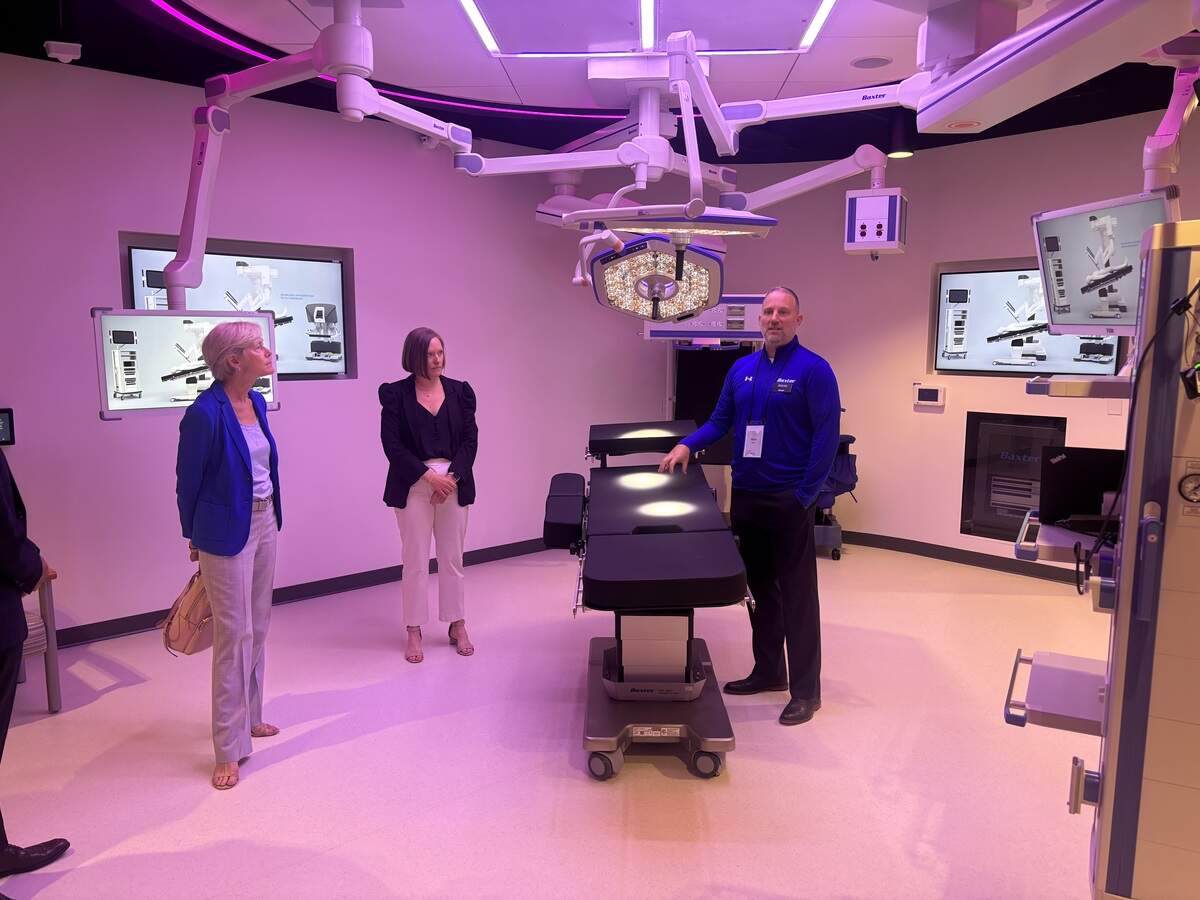
- Medical tech firm Baxter International opened its Customer Experience Center this week in Raleigh, where the company has more than 200 employees. “The area that we want to focus on mostly is bringing in software engineers, bringing in more (Internet of Things) engineers,” said Donny Patel, Baxter’s president of connected care.
- Staff at the North Carolina State Treasurer’s Office saved more than 30 minutes a day using ChatGPT, a commissioned report on the OpenAI pilot program found.
- Holly Springs residents can now get Google Fiber. Will they make T-shirts?
- Bankrupt Durham semiconductor supplier Wolfspeed named industry veteran Bret Zahn to head its automotive division.
- The Catawba County-based company CommScope has sold its connectivity and cable solutions division for $10.5 billion to the fiber cable manufacturer Amphenol.
- REI has reached a national bargaining structure for first contracts with its unionized stores, including the outdoor recreation chain’s Durham location.
National Tech Happenings
- At the White House this week, Apple said it would invest another $100 billion in the United States — bringing its domestic commitment to $600 billion over the next four years. Its announcement didn’t mention any spending on the company’s promised and postponed Research Triangle Park campus.
- Palantir, an analytics software company that’s garnered favor during the second Trump administration for its Defense and Homeland Security work, has surpassed $1 billion quarterly revenue for the first time.
- OpenAI will offer its premium ChatGPT Enterprise platform to U.S. federal agencies through 2026 for the price of $1.
Thanks for reading!
This story was originally published August 8, 2025 at 5:00 AM.