Triangle firm raises $65 million to combat China’s control of rare earth magnets
A Research Triangle Park startup that looks to loosen China’s control over rare earth magnets has announced its first major funding round.
With $65 million in Series A funding, Vulcan Elements plans to ramp up production at its Durham facility in an effort to reignite U.S. manufacturing of these critical magnets.
“This supply chain is China’s most painful chokehold over the U.S. economy and American national security,” Vulcan’s CEO and cofounder John Maslin said in a statement Monday.
Rare earths are a collection of 17 elements with unique luminescent and magnetic traits crucial to modern technologies. They produce permanent magnets, which keep their magnetic properties without an electrical current. This makes them essential in an array of products like refrigerators, wind turbines, camera lenses, weapons systems, MRI machines and rechargeable batteries.
Over decades, the United States has ceded output of rare earth magnets to China, which dominates around 90% of production today.
Founded in 2023, Vulcan aims to claw back this market at a time of high U.S.-China geopolitical tensions. Amid a volley of tariffs earlier this year, China had placed more restrictions on exports of rare-earth material.
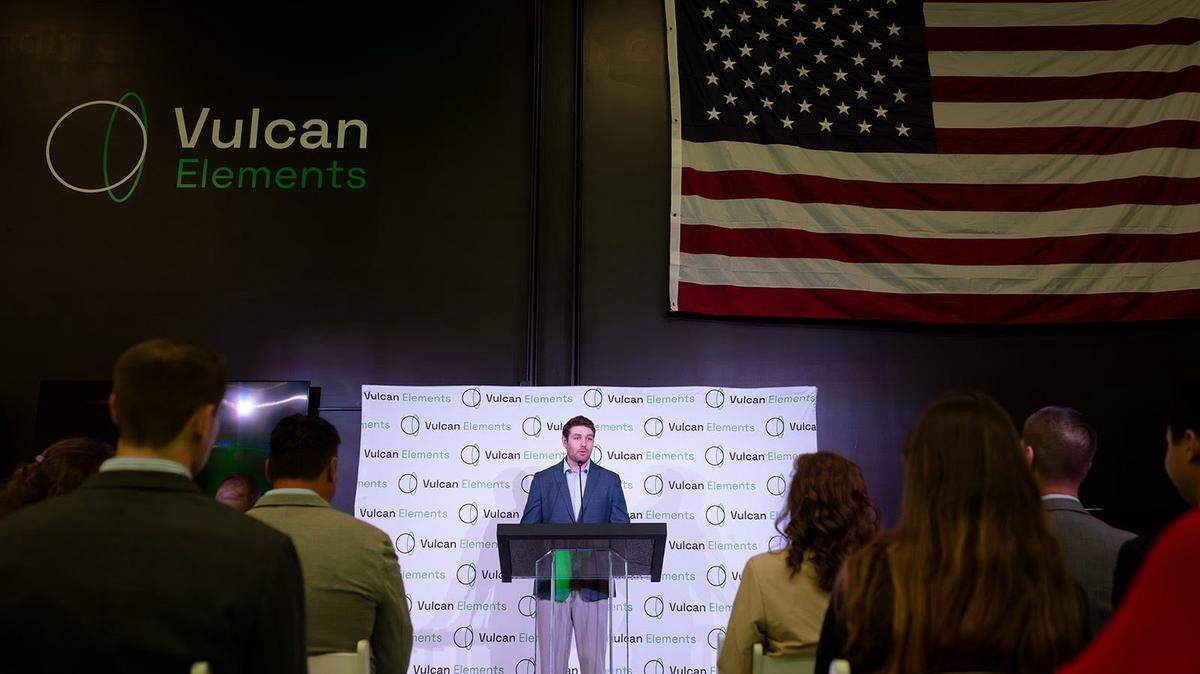
Maslin, a former financial manager in the Navy, formed the company while studying at Harvard Business School. He and cofounder Piotr Kulik opened their first manufacturing facility this spring, in Research Triangle Park. U.S. Rep. Pat Harrigan and Durham Mayor Leonardo Williams were among those who spoke at the plant opening.
“The Chinese Communist Party could cut us off at any moment,” Harrigan, a first-term Republican from Hickory, said at the event.
Vulcan last year raised about $9 million in an initial round and secured additional money from the U.S. Army, Navy and Air Force. On Monday, Vulcan said it will deliver magnets to each U.S. military branch in the coming months.
Boston investment firm Altimeter Capital led the Series A funding round, with the New York City-based One Investment Management having “significant participation,” Vulcan said.
Vulcan’s difficult mission
There are two common types of rare earth magnets, neodymium and samarium cobalt. Vulcan Elements focuses on the former through a process known as the powder metallurgy method. The company emphasizes its process uses materials and equipment sourced from the U.S. and allied countries.
Breaking China’s grip on rare earth magnets won’t be easy, experts say.
“You may have done a few things in a lab or on a pilot scale, but it’s a very different challenge to meet the quality requirements at scale,” John Ormerod, a rare earths magnetic consultant based in Tennessee, told The News & Observer in April. “It’s a really difficult challenge to produce consistent results.”
“You’re going up against a 900-pound gorilla,” said Ed Richardson, president of the US Magnetic Materials Association. “There are a lot of carcasses along the way.”
Other U.S. companies are striving to bring manufacturing of rare earth magnets to the country. On Monday, the U.S. Department of Defense gave Las Vegas-based MP Materials a $150 million loan to increase its rare earth production. And under a deal signed last month, the defense department agreed to pay MP Materials a minimum price above current market levels.
Unlike MP Materials, Vulcan Elements is just launching its effort to carve into China’s battery control. It now has the cash to begin.
This story was originally published August 11, 2025 at 1:51 PM.