Fiber turns Corning into one of NC’s hottest employers as union vote called
I’m Brian Gordon, tech reporter for The News & Observer, and this is Open Source, a weekly newsletter on business, labor and technology in North Carolina.
In 1966, around the same time IBM relocated its first northern workers to the fledgling Research Triangle Park, a company from the other side of New York State opened its inaugural North Carolina campus. That would be Corning Inc., from Corning, New York, a 100-plus-year-old glass and materials manufacturer that started a Tar Heel State site in Wilmington.
For most of the past 60 years, Corning was a steady if subtle presence — adding 5,000 employees across multiple facilities statewide. But that low-profile has recently been obliterated, much to the company’s delight.
Fiber optic cables are suddenly in high demand.
The company’s share price has more than tripled in the past year. It expects to hire 3,500 more North Carolina workers in the coming years after this week announcing a contract with a third Big Tech player. Its new deal with Amazon follows contracts with Nvidia and Meta. You can probably guess what’s driving these multibillion-dollar agreements; artificial intelligence has created wild demand for data centers, and the GPU servers within them rely on Corning’s fiber optic cables.
Hyperscale data centers are swapping out copper cables for fiber, jumping from a material that transmits information through electrical current to one that carries data faster via light pulses. Nvidia’s Blackwell chips need 16 times more fiber than traditional computing server racks, Corning vice president John McGirr (who lives in Durham) said late last year.
Corning workers call a union vote
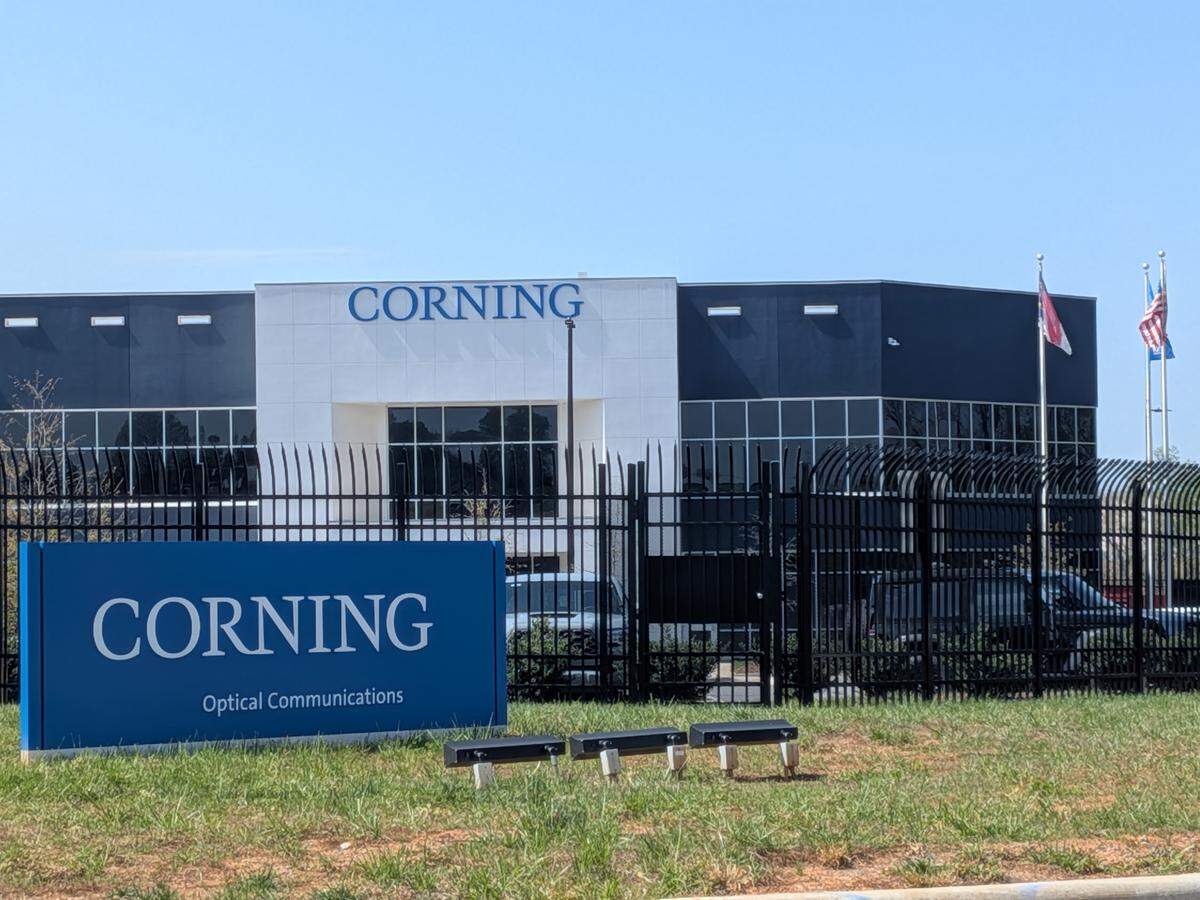
North Carolina is key to the company’s optical fiber supply chain. Corning manufactures the material in Wilmington and Concord, then bundles these glass strands into cables in Hickory. There’s also a distribution center in Winston-Salem and a facility for its life sciences division in the Triangle. Charlotte is home to the company’s optical communications headquarters.
Through Amazon, Meta and Nvidia, Corning is responsible for three of the biggest North Carolina jobs headlines of 2026 so far. Its Tar Heel State workers have generated a recent headline, too, with employees at the Winston-Salem distribution center last week filing for a union election.
“Right now, they get raises when management wants to give them raises, there’s no guarantee,” said Chris Salm, an assistant organizing director on the campaign with United Steelworkers. “So, I think that they would like some predictability.”
He added that workers should be guaranteed benefits from the “tremendous investment” Corning is bringing to the state. Salm and other union leaders in North Carolina have accused the company of “union busting,” and have filed unfair labor practices around management conduct at the 400-worker center in Winston-Salem.
Corning’s Wilmington workforce is already unionized while workers two years ago voted against organizing a company distribution center in the Edgecombe County seat of Tarboro.
“For several decades, Corning has had a relationship with labor unions, including a strong partnership with the United Steelworkers (USW), working closely with Union representatives to build relationships rooted in trust, respect, and shared success,” Corning wrote in a statement Thursday to The News & Observer. “We prioritize our employees’ well-being, professional growth and contributions, and we respect their right to choose representation.”
A union election date has not yet been set.
NC downzoning fix? Not so fast.
In last week’s Open Source, North Carolina House members suggested they might amend the controversial and uniquely strict prohibition on downzoning in this year’s state budget. This law, passed two years ago under some mystery, prevents local governments from reducing the number of uses in an area or from creating “nonconformities” by banning, say, future data centers while grandfathering in existing ones — unless property owners approve.
“Important planning initiatives in cities and towns big and small across our state have come to a screeching halt,” Durham council member Nate Baker said earlier this year. Durham is not alone in pausing its comprehensive rezoning efforts due to the law — though the Bull City may have actually inspired it in the first place.
Anyway, municipal leaders hoping for a legislative fix this year may be disappointed. In an interview this week at his General Assembly office, Sen. Bob Brinson (R-Craven) told me any comprehensive downzoning relief may not come until 2027.
“We have chosen specifically to address several topics in the short session, and the larger topics we’re essentially kicking to the long session next year,” he said.
In 2025, the state Senate unanimously approved a bill returning more downzoning authority to cities and towns. Brinson referred to that as a “conversation starter.” In lieu of statewide action, he cosponsored legislation last month that would restore downzoning powers in the Eastern North Carolina "military counties” he represents.

Clearing my cache
- What promises to be the biggest private jobs project North Carolina has ever seen is scheduled to start construction Monday, as the aviation startup JetZero holds a groundbreaking ceremony in Greensboro. Its plane, still a prototype, looks like a flying squirrel or manta ray.
- JetZero’s ultimate goal remains 14,500 North Carolina jobs, but the company last month requested its first hiring benchmark be pushed back a year, to 2028, citing the delayed state budget (which is expected to include site funding for JetZero).
- Raleigh’s Red Hat and parent IBM have a $5 billion plan to help customers protect the open source software we interact with every day. It involves AI, believe it or not.
- Founded by two former SpaceX engineers, the Granville County grass-powered materials startup Plantd expects to double its nine-figure valuation later this year while pondering what a headquarters in a bigger city might mean.
- A developer has applied to build a 90-megawatt data center southwest of the Triangle in Lee County, multiple local news outlets reported. Lee County hasn’t passed a data center moratorium like some of its neighbors, opting instead to integrate noise and building limits into its zoning codes.
National Tech Happenings
- First SpaceX. Then Anthropic. Now, OpenAI has confidentially filed to go public. On SpaceX, the company’s imminent IPO is expected to create a few thousand millionaires (and at least one multi-billionaire).
- Meta is launching a program to train data center construction workers. Its “America’s Workforce Academy” will start in four cities: Columbus, Baton Rouge, Indianapolis and Houston.
- President Donald Trump is talking about finding ways for the public to get some of the immense wealth AI companies are generating, a general concept supported by progressives like Sen. Bernie Sanders.
Thanks for reading!
Thank you for supporting local journalism. If you liked it, consider sharing it with a friend. If it was forwarded to you, sign up here to subscribe.
This story was originally published June 12, 2026 at 9:44 AM.