‘Great housing reset’ in 2026: Prices set to fall in Triangle. See where, by how much
AI-generated summary reviewed by our newsroom.
- Realtor.com forecasts Triangle prices will drop in 2026; Raleigh falls 3.7%.
- Chapel Hill-Durham will see sales rise 1% and prices climb about 2.9%.
- Nationwide 2026 outlook: modest recovery, 6.3% mortgage rates, inventory up.
The housing market is poised to begin a long-awaited reset in 2026.
As mortgage rates ease, incomes rise and a surge of new construction floods the market, conditions are slowly improving for buyers, experts say, and the Triangle is likely to feel the impact sooner than other regions.
But it depends on the submarket.
In Raleigh-Cary, home sales are expected to drop 4.4% year over year, while prices are forecast to slip 3.7%, according to Realtor.com’s 2026 Housing Forecast released on Wednesday. That’s the fourth-largest expected decline of any metro in the country, the forecast says, and the others in the top five are all in Florida or California.
Browse through the site’s dedicated page for Raleigh homes with price reductions, and several listings currently show price cuts. Among them: a 3,112-square-foot home in Raleigh’s Legacy Farms listed for $575,000 after a $15,000 price drop.
Other markets with the biggest decrease in home prices in 2026 are predicted to be Fort Myers (-10.2%) and Sarasota (-8.9%), Florida; Stockton, California (-4.1%); and Tampa, Florida (-3.6%).
On the flip side: In Chapel Hill-Durham, home sales are expected to rise 1% year over year, while prices are expected to jump 2.9%.
Why the divergence?
The markets face slightly different supply and demand dynamics, Jake Krimmel, a senior economist at Realtor.com, told The News & Observer. And those differences could be magnified as interest rates come down slightly.
At present, Raleigh is approaching “buyers’ market territory” with inventory building well above pre-pandemic levels and sales remaining slow, he said.
By contrast, Durham is smaller and traditionally more constrained when it comes to new construction.
In 2025, high mortgage rates kept both markets in check, Krimmel said, but when rates eventually ease, “that pent-up demand will likely benefit Durham and Chapel Hill more than Raleigh.”
Statewide, Greensboro-Highpoint are expected to take the biggest hit, with home sales expected to plummet 10.9%. Prices are forecast to rise 4.4%, data showed.
In Charlotte-Concord-Gastonia, home sales are expected to drop 2.4%, while prices are forecast to rise 1.1%.
After several years defined by affordability strains, limited inventory and a sharp slowdown, “2026 should offer a welcome, if modest, step toward a healthier housing market,” said Danielle Hale, chief economist at Realtor.com.
But it’s not a dramatic reset, she added, and the recovery is expected to be slow. Existing-home sales remain “well below normal,” and the broader political dynamics and economic risks leave the outlook “somewhat fragile.”
Other predictions for 2026?
According to Realtor.com, buyers and sellers can expect:
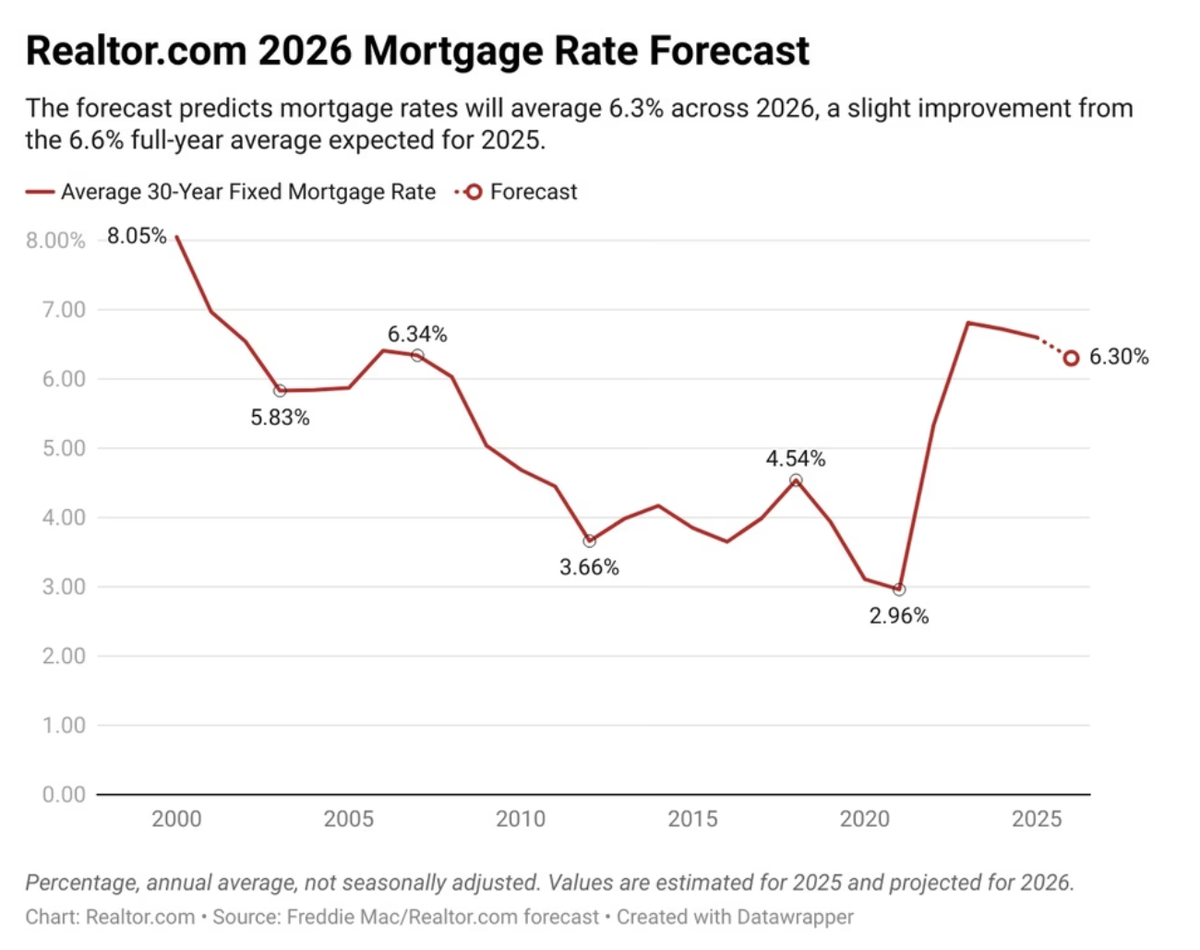
- Average 30-year mortgage rates of 6.3%, “as slowing economic growth and the end of the Fed’s quantitative tightening offset rising U.S. government debt and inflationary pressure that’s expected to be temporary.”
- Home prices will grow by 2.2% nationally
- Rents will drop slightly, by 1% nationally. Rents in the South and West could see larger declines.
- An 8.9% increase in existing home inventory continuing the trend from the past two years.
- Single-family new home starts will grow by 3.1%, reaching 1 million homes, a slight increase from 2025 starts.
- Home sales will grow 1.7% year over year to 4.13 million.
- Affordability improves modestly as the monthly payment to buy the typical home is expected to slip to 29.3% of median income, its first year under the 30% affordability threshold since 2022.
- Balanced market: The national housing market will remain in balance in 2026, averaging 4.6 months of supply across the year.