How UNC is using AI to encourage people to follow COVID-19 policies at football games
As UNC-Chapel Hill welcomes fans back into Kenan Memorial Stadium, the university is deploying a new artificial intelligence tool it hopes will improve fans’ adherence to COVID-19 safety policies.
At the entrances to Kenan, fans will now be greeted by digital displays that detect whether someone is wearing a mask and following social distancing guidelines.
The technology, called Health Greeter Kiosks, was designed by the UNC Reese Innovation Lab and was first deployed at the UNC-Virginia Tech football game on Oct. 10.
The kiosks will be deployed again for this weekend’s matchup with rival N.C. State University.
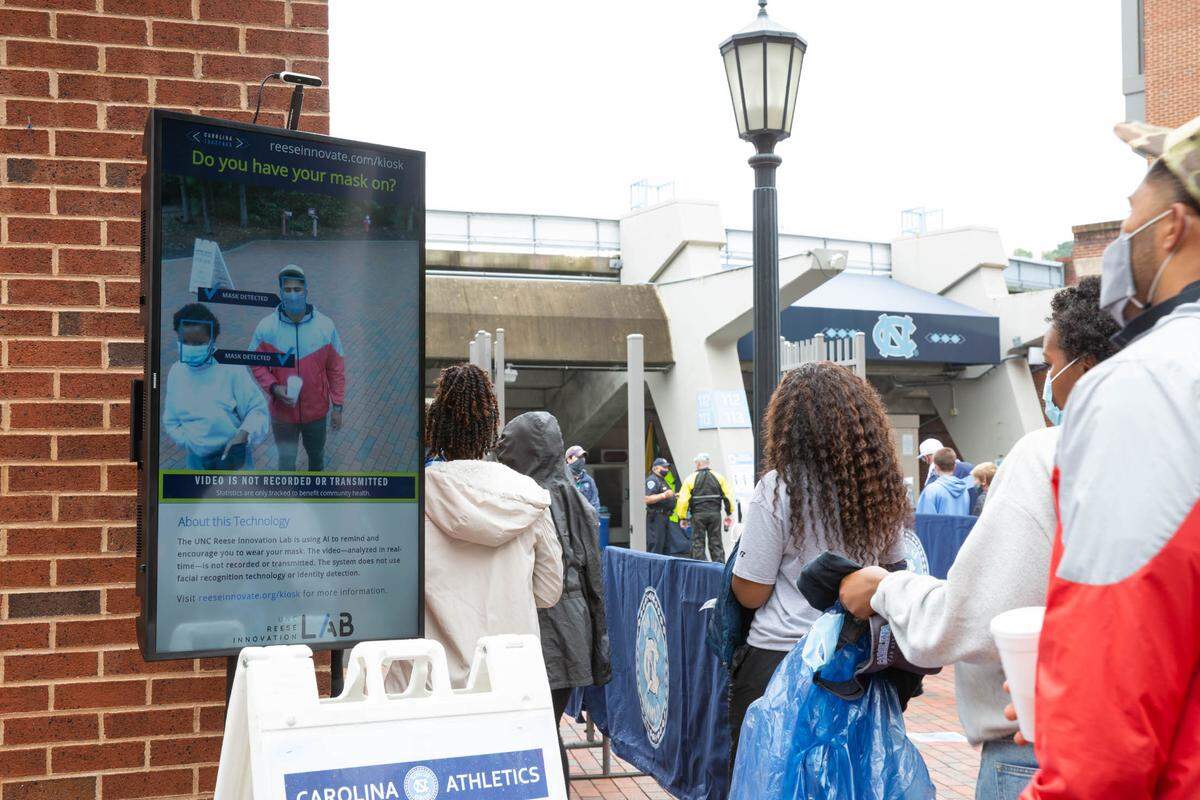
Using machine learning and real-time analysis from cameras, the kiosks can determine if a visitor is wearing a mask and keeping proper distance. The policies, like the limited number of fans allowed in the stadium, are meant to slow the spread of COVID-19. The number of coronavirus cases is once again increasing in North Carolina.
If the kiosks determine someone is not wearing a mask or keeping distance, it alerts the visitor to correct their behavior by lighting up with a red X. A visitor wearing a mask and maintaining social distance is rewarded with a green check.
“The main goal is to encourage people in the moment,” Steven King, the chief innovation officer of Reese, said in a phone interview. “One thing we found in our research is that being able to encourage people to use masks and social distance was probably the most effective thing we could do.”
The kiosks do not save or transmit any images, the school says, and the data they collect is fully anonymous. Video images are deleted as soon as they are generated, which is 30 times every second.
“This is not facial recognition. It is face detection,” said King, who is also a professor of emerging technologies at the UNC Hussman School of Journalism.
The machines do collect aggregate data, though, like the percentage of people who were not wearing their masks correctly or how far apart individuals were. “Decision makers could use that (data) to make better decisions about events,” King said.
At its first outing, the developers said the kiosks proved they could be effective.
“We knew it worked but we hadn’t seen it in the wild,” King said. “It was like taking your child out and hoping it did everything you taught it do. It held up. People interacted with it.”
In one instance, King said, he watched as someone walked across the campus without a mask. Once they reached the kiosk, they were alerted their mask was off and they adjusted it. It was a perfect example of how the tool could be effective, he said.
The UNC Reese Innovation Lab is housed within the UNC Hussman School of Journalism. The lab brings together students and faculty to experiment with new technologies, like augmented reality and artificial intelligence. King, the lab’s chief innovation officer, was formerly the director of video at The Washington Post.
The lab began working on the kiosks at the start of the semester, and it worked with Lenovo, the Chinese laptop maker that has a large presence in Morrisville, to create them.
Lenovo’s AI Innovation Center was instrumental in the machines’ creation, helping turn the Reese software into a practical tool for live events. Specifically, the Reese team was struggling to get the software to work smoothly on computing devices that were small enough to fit in the kiosk.
Robert Daigle, Lenovo’s AI and business innovation leader, was able to provide small enough machines that were powerful enough to handle the job. The computers used in the kiosks can do the analysis themselves, rather than rely on cloud computing, an ability that is transforming the future of AI projects.
“What we have seen is it really is a robust system,” Daigle said of the kiosks. “It works in different lighting, at different angles. I have worked on a lot of AI projects and ... I am thoroughly impressed with the work that has been done.”
The data collected will also be used to improve the accuracy of the machines. As they collect more information over time, artificially intelligent technologies can improve their outcomes as they train themselves. The hardest thing to teach the AI, King said, was not that people were wearing masks, but that they were wearing them properly.
That could be important if the kiosks are deployed on campus if and when students return, or if the technology is used at other in-person events. But there could also be a future where this is used in other situations, like on corporate campuses or in retail shops. Lenovo even tested the kiosks out at its campus.
“We see this as the starting point of wider deployment with opportunities to refine and customize the technology,” King said. “From campus hallways to outdoor events, these kiosks will help us better understand human behavior and encourage safe behavior, and I’m excited to see how we evolve and adapt this AI-powered solution.”
This story was produced with financial support from a coalition of partners led by Innovate Raleigh as part of an independent journalism fellowship program. The N&O maintains full editorial control of the work. Learn more; go to bit.ly/newsinnovate
This story was originally published October 22, 2020 at 9:00 AM.