All but two NC counties are at highest COVID risk ahead of Christmas, Harvard data show
North Carolina is a sea of red on a COVID-19 risk map developed by researchers at Harvard University, indicating much of the state has reached a “tipping point” ahead of Christmas.
The map tracks the severity of the coronavirus pandemic by state and county according to the seven-day moving average of new cases per 100,000 people.
At least 98 of North Carolina’s 100 counties were in the red zone as of Tuesday, meaning they had 25 or more cases per 100,000 people, according to the Harvard Global Health Institute. Researchers say stay-at-home orders are necessary in red-zone areas.
The number of counties in this “critical” category more than doubled since last month, when 42 were red ahead of Thanksgiving.
State health officials have said North Carolina is “now seeing the results of more community spread from Thanksgiving gatherings,” and they are urging residents to stay home for Christmas.
On Wednesday, N.C. hospitalizations reached a new high of 2,811 patients. The rate of positive test results was 12.5%, “as high as it has been during the pandemic,” The News & Observer reported.
A breakdown
Clay County in Western North Carolina and Chatham County near Chapel Hill were the only two counties designated orange by Harvard researchers as of Tuesday. Those counties are experiencing “accelerated spread.”
Clay County had 17.8 new cases per 100,000 people, and Chatham had 24.6, data show.
The state’s two largest counties — Mecklenburg and Wake — were in the orange zone at Thanksgiving but have since turned red on the Harvard map.
Mecklenburg had 57.2 new cases per 100,000 people, and Wake had 43.5.
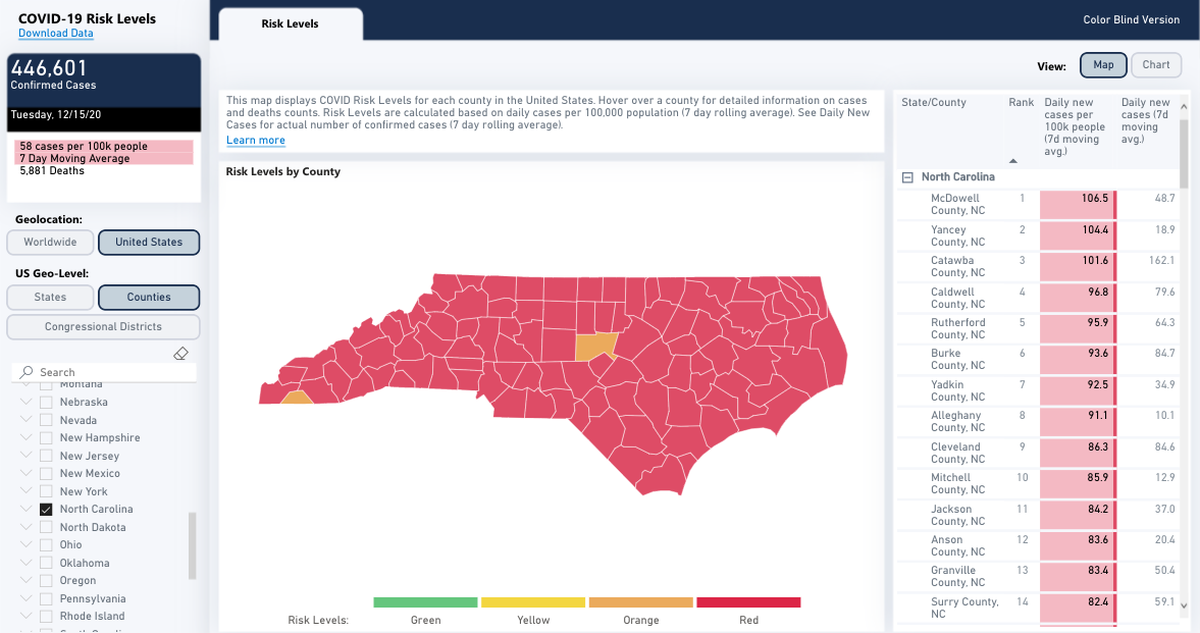
McDowell and Yancey counties in Western North Carolina as well as Catawba County outside Charlotte had the highest incidence rates as of Tuesday, marking more than 100 new COVID-19 cases per 100,000 people.
Caldwell and Rutherford counties were close behind, followed by Burke, Yadkin and Alleghany counties. Cleveland and Mitchell counties round out the top 10, according Harvard researchers.
The color-coded map is based on what’s known as incidence, or the number of new COVID-19 cases per day proportional to population — which epidemiology experts say is a better metric for comparing areas with varying population sizes.
COVID Act Now, a nonprofit developed in conjunction with the Georgetown University Center for Global Health Science and Security, the Stanford University Clinical Excellence Research Center and the Harvard Global Health Institute, defines a critical incidence rate as more than 25 new COVID-19 cases per 100,000 people.
Statewide alert system
The data from Harvard paints a bleaker picture of the COVID-19 pandemic in North Carolina than a statewide risk map created by the N.C. Department of Health and Human Services.
The state’s map, which places counties in one of three tiers based on case rate, percentage of positive tests and hospital impact, showed 48 counties were red as of Dec. 8 — meaning “critical community spread.”
The seven-day average of new coronavirus cases statewide was hovering around 5,000 at the time. That figure has since climbed closer to 6,000, according to data compiled by DHHS.
Gov. Roy Cooper and Dr. Mandy Cohen, secretary of DHHS, have cautioned against holding gatherings during the holiday season. The governor instituted a 10 p.m. curfew last week that remains in effect until Jan. 8 in the hopes of curbing further spread.
“The stakes are dire,” Cooper said in making the announcement. “This is truly a matter of life and death.”
This story was originally published December 17, 2020 at 12:07 PM.