
Triangle Expressway 'the epitome of bad policy,' lawsuit says
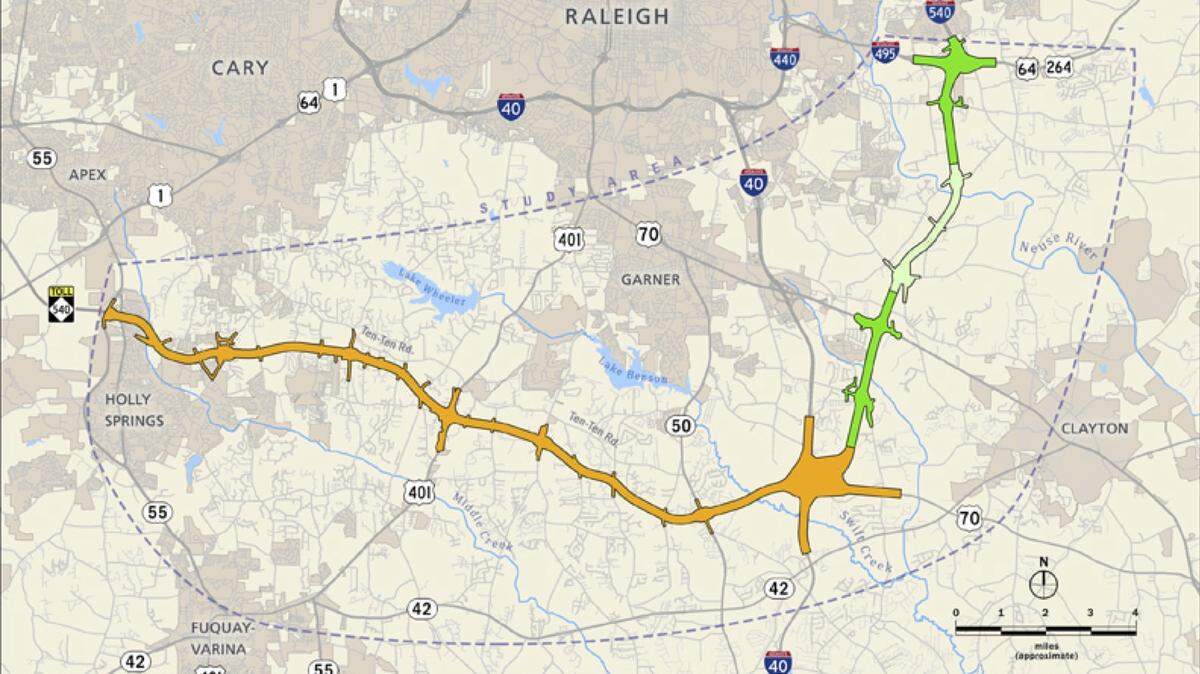
The environmental groups suing to stop construction of the Triangle Expressway across southern Wake County have expanded their lawsuit to include additional state and federal agencies and new claims for why the groups believe the highway should not be built.
N.C. Department of Transportation officials hope contractors can begin building the six-lane toll road from Holly Springs east toward Interstate 40 early next year. The Federal Highway Administration gave its final approval for the route of the $2.24 billion highway earlier this month, allowing the state to pursue environmental and other permits it needs to begin construction.
The Southern Environmental Law Center and three other organizations had already sued the U.S. Fish and Wildlife Service in federal court, claiming the agency should have blocked construction of the highway because of its potential harm to two species of mussels that are protected under the Endangered Species Act.
Now the law center has amended that suit to include NCDOT, the Federal Highway Administration and the National Marine Fisheries Service. The suit also makes new claims about the potential environmental damage, beyond the threat to the mussels. It says the highway will encourage sprawl in southern Wake County that will result in more air and water pollution and greenhouse gas emissions that will contribute to climate change.
In a press release, the law center and the three other groups — Sound Rivers, the Center for Biological Diversity and Clean Air Carolina — cited Gov. Roy Cooper's signature on a pledge to cut North Carolina's greenhouse gas emissions to meet targets set under the international Paris Accord.
"Unfortunately, this $2.2 billion NCDOT toll project undermines the governor's commitment and locks residents into an outdated product of the past," Kym Hunter, an attorney with the law center, wrote in a statement. "Expensive loop highways around cities that lead to sprawl, increased driving, and contribute to a low quality of life. Complete 540 is the epitome of bad policy."
The lawsuit also assails the state for planning a toll road that would limit access "for low-income members of the Raleigh area who nonetheless will be forced to endure the pollution and ancillary traffic that the project generates."
NCDOT officials declined to respond to the details of the lawsuit on Monday. In a brief statement, they noted that finishing N.C. 540 is a top priority for Wake County governments.
"While we cannot speak specifically about active litigation," the statement concludes, "NCDOT and the N.C. Turnpike Authority are continuing to work toward delivering the project as requested by the local communities, while balancing the protection and conservation of our environment and natural resources."
Earlier this year, the environmental groups proposed an alternative to completing N.C. 540 that they say would do better at relieving congestion at a fraction of the cost. The plan, which they called Access2040, involves widening three existing east-west roads across southern Wake — N.C. 42, Ten-Ten Road and Tryon Road — and building new roads to connect them to existing highways on either end. It also involves converting U.S. 64 into a six-lane freeway between U.S. 1 and N.C. 55 in Cary and Apex and converting two intersections along N.C. 55 near Holly Springs into interchanges.
Most of the changes are ones that local transportation planners already hope to complete by 2040 anyway. The additional proposals, including several road extensions, would cost about $294 million.
NCDOT has been planning the extension of N.C. 540 across southern Wake since the 1990s. The Final Environmental Impact Statement, a report that spells out the possible effects of the final 28.4 miles of the Triangle Expressway on the natural and human environment, was released Dec. 22, and NCDOT has noted that it considered several alternatives to building N.C. 540 during the federal environmental study.
This story was originally published June 25, 2018 at 12:00 PM with the headline "Triangle Expressway 'the epitome of bad policy,' lawsuit says."