Hindu temple’s plans loom large over rural NC area, with a god as tall as a lighthouse
A Triangle-based Hindu group plans to build a temple that will help preserve its ancient culture and language, while embracing a modern American ideal: It will be huge.
The temple will feature the world’s largest statue of Lord Murugan, the principal deity of Tamil Hindu followers.
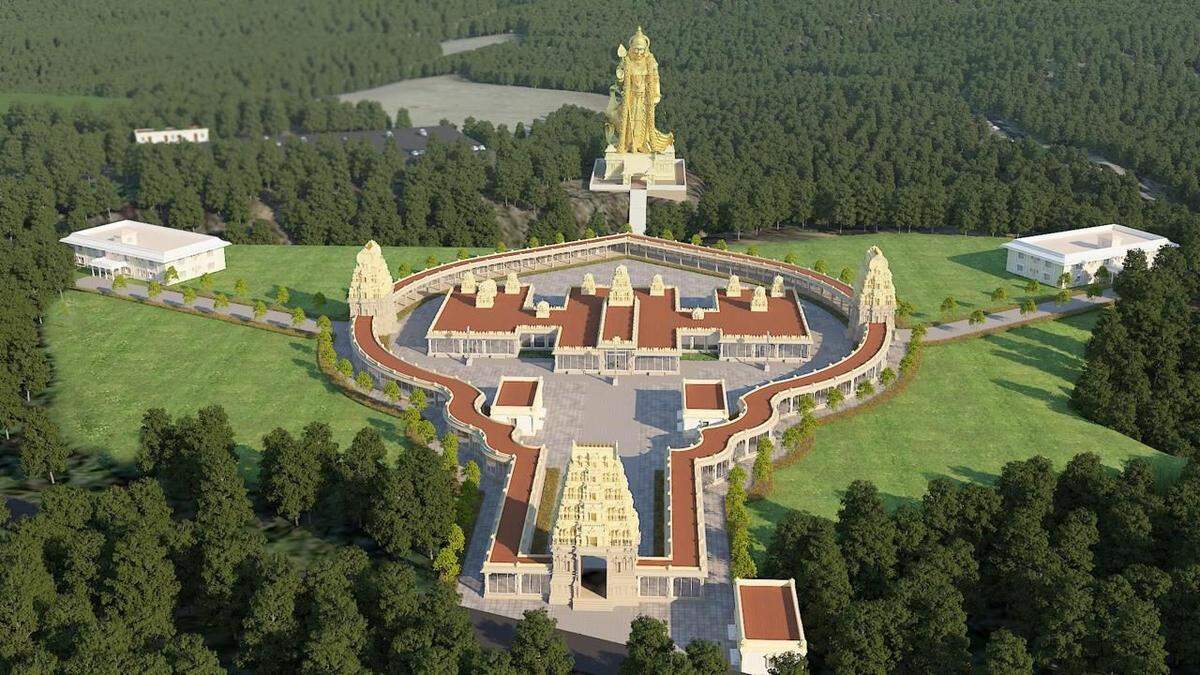
The likeness of Murugan (Mer-OOH-gun), the warrior god who fights evil in Tamil Hindu tradition, would soar above the pines on a 130-acre tract of land in Moncure, in eastern Chatham County. The statue itself would be 155 feet tall, mounted on a 35-foot base, with the structure topping out at 190 feet, according to plans.
To get an idea of Murugan’s scale, compare it to the Statue of Liberty in New York Harbor, which is 151 feet 1 inch tall from the top of the base to the torch, according to the National Park Service.
The Cape Hatteras Light Station, on the North Carolina Outer Banks, measures just under 198 feet 6 inches from the bottom of the foundation to the pinnacle of the tower, according to the Park Service. N.C. State University’s bell tower is 115 feet tall; UNC’s is 172 feet.
The new giant statue would be part of a Carolina Murugan Temple complex that would include the temple itself and buildings that would house a library, museum and other functions. Temple organizers also plan to include a soccer field, wedding venue, community garden and a hiking field on the property, which borders the Deep River.
‘Anyone can come’
Radha Ravi Varma of Cary, chief secretary of the Carolina Murugan Temple, said the temple would serve Hindu people in the Triangle area and beyond who are of Tamil Heritage. But it will be open to the public as well.
“Anyone can come,” Varma said in a telephone interview with The News & Observer this week. “We want people to know they can come there with their family. They can get married there. They can play and have a picnic. If they want to go to the temple, they can go. If they want to use the library, they can. We are thinking this will be a unique place.”
There are Hindu temples in Cary and Morrisville and others across the state. Their membership has grown with the influx of people from India, where Hinduism is a major religion. The American Immigration Council estimates that in 2015, North Carolina had more than 60,000 residents who came originally from India. Some of them are of Tamil heritage. The largest portion of people moving into North Carolina from non-U.S. locations were from India, according to 2018 statistics from Carolina Demography.
Tamils originally were of southern India, and now have settled in other countries. The Tamil language is believed to be one of the oldest surviving languages on Earth.
Varma and other organizers proposed the Carolina Murugan Temple to the Chatham County Board of Commissioners last year. They have tentative approval for the project, Varma said, though no permits have been issued yet and nothing built.
Kaali Dass of Cary, chairman of the temple’s board of directors, said in a phone interview that the group began planning the project and raising money for it around 2017. It bought the land in 2019 for more than $430,000.
The property is off Old U.S. 1 in the rural community of Moncure, a late 1800s railroad settlement that now has about 700 residents about 30 miles southwest of Raleigh. Neighbors say the property the group acquired is forest and former tobacco farmland that has sat unused for years.
Other places of worship in Chatham
Chatham County Manager Don LaMontagne said in a statement that places of worship are common throughout rural Chatham County, including in residential areas like the one where the temple is to be built.
The county approved the project last year.
“It will be built in phases, starting with the temple,” Dass said. Phase 1 is expected to cost about $7 million, for which organizers are accepting donations now, he said.
LaMontagne said the county has not received a timeline for construction but expects that some modular units may be set up on the property this year. Chatham County ordinances that restrict the height of buildings don’t apply to church spires, monuments, belfries and certain other structures, meaning Lord Murugan will be exempt. The statue also will come in under Federal Aviation Administration height restrictions designed to prevent flight-path obstructions, according to the FAA website.
Even with its soaring height, organizers say, the statue won’t be visible from far away because it will be set near the middle of the property, whose pine trees and gently undulating topography will shield it, according to the temple board.
Models and architectural drawings show buildings strikingly different from the humble white-clapboard Haywood Bible Church that dominates the residential neighborhood closest to the temple site.
Dass said plans are to leave as many trees as possible on the site, while developing the property in the shape of a huge spear tip. Statues of Lord Murugan show him with a spear, the point of which symbolizes knowledge and wisdom, according to Hindu tradition. The buildings would lie within the outline of the spear tip. The statue would lie outside it.
The rectangular temple would be about 5,000 square feet, with ornate columns. From there, visitors could follow a walkway and steps leading to the statue.
The statue will be built on-site, Dass said, starting with a steel skeleton that would later be covered in a concrete skin. Drawings show the statue finished in gleaming gold, but Dass said, “We don’t know what color it will be. That will be up to the designers.”
Some fear traffic
Neighbors have been wondering about the temple and the statue since it was proposed. Access to the property now is by way of two-lane Haywood Road off old U.S. 1, and then 1st Road, a gravel route about a land and a half wide.
“Traffic,” neighbor Merlon Hill said, is what she’s worried about. “There’s only one way in here and one way out.”
Dass said the property will be used the way other Hindu temples are. It will have set hours, typically opening in the morning and closing at night, during which visitors can come and go to pray briefly at the temple or walk around the property, usually a few at a time. Hindu temples don’t hold regular weekly worship services. Except for special occasions, Dass said, there will rarely be large gatherings at the site.
Dass said he hopes the temple and oversized statue will draw tourists to Chatham County, which may be best known for its recent midnight removal of a Confederate monument from the grounds of its historic courthouse, or for the photogenic belted Galloway cows that graze at the Fearrington Village development. The county also touts biking, access to Jordan Lake, golf, an agriculture and conference center, and the shops and restaurants of Pittsboro, Siler City and Fearrington.
At the moment, the largest statue of Murugan is outside the Bantu Caves in Malaysia. Unveiled in 2006, it stands 140 feet tall and took three years to build. It soon will be surpassed by a 145-foot Murugan statue under construction in the town of Vazhapadi in southern India.
Carolina Murugan’s statue will be 5 feet taller still.
“Because we’re in America,” Varma said.
This story was originally published January 30, 2020 at 6:11 PM.