
Raleigh protesters hold candlelight vigil after visiting site of 2016 shooting by police
Protesters on Sunday marched through Raleigh to the site where Akiel Denkins was shot and killed by a Raleigh police officer in 2016.
Denkins was killed behind PJ’s Grill & Groceries. When protesters reached the area Sunday evening, they saw a home across the street that had black balloons floating from its fence. Denkins’ brothers and friends awaited the protesters, and together, they honored the slain man.
Many in the crowd Sunday were wearing shirts that said “RIP Lockman,” Denkins’ nickname. Some protesters formed the letter L with their fingers and thumbs. Biggie Smalls’ music played from speakers as the crowd of about 250 people stood in the street.
To go to that neighborhood, at the height of tensions between police and African Americans across the country and in Raleigh, was huge, said one protester.
“That was top tier,” Plvto Sana said. “They invited us, they loved us in their neighborhood. We loved being in their neighborhood. It was beautiful to be able to honor Akiel Denkins in his neighborhood with his brother, with his family, with his friends and to actually bring folks from everywhere to celebrate that life and fight for justice, that’s huge and I’m really proud of Raleigh today.”
While Raleigh’s protesters have persistently called for justice for George Floyd and Breonna Taylor throughout the last nine days, Denkins’ death also has been raised repeatedly. Lorrin Freeman, the Wake County District Attorney, determined that Officer D.C. Twiddy was justified in shooting Denkins four times while trying to arrest him for failure to appear on a felony drug charge.
When Denkins was killed, it was the first death at the hands of a Raleigh Police officer in seven years.
According to Twiddy’s version of events, The News & Observer has reported, the men were struggling near a chain-link fence when Twiddy felt Denkins reaching for a revolver. Twiddy told investigators he ordered Denkins to drop the gun, then fired his service weapon twice. Then, Twiddy said, he stepped back and fired additional rounds.
Ultimately, Twiddy fired his gun seven times in 10 seconds, hitting Denkins four times, including once in each arm, once in his chest and once in his right shoulder.
At a vigil in the spring of 2016, after Freeman determined Twiddy would not be charged, Denkins’ mother said she was hurt but not surprised. “We’ve seen this before,” Rolanda Byrd said. “This time it just happened to be my son.”
Gary Morgan, one of the organizers of Sunday’s protest, said, “Yes, George Floyd has died, but we have to march where our brothers and sisters in Raleigh have been killed. We haven’t forgotten about y’all.”
After marching to where Denkins died, the protesters on Sunday moved back to the State Capitol Grounds for a candlelight vigil.
A long weekend trek
Before Sunday evening’s protests started, one of the leaders took to Instagram to say there wouldn’t be much marching because a large group had marched from the Capitol through Glenwood South to Cameron Village and back on Saturday — the second time this week that protesters have undertaken such a trek.
“Yesterday was a lot,” Amari Yasmine wrote. “The turnout was amazing. I’m still shocked. We’ll be doing a small march and a candlelight vigil @ 6 pm today. ... Bring flowers, candles, and yoga mat or blanket because we’re going to sit and chat for a bit.”
The protesters initially marched through Southeast Raleigh on Sunday, marching out of downtown on Hargett Street before heading north on Tarrboro and using East Edenton Street to return to the area around the Capitol. The group marched down Hargett chanting the now-familiar, “Get out of your homes and into the streets.”
Gary Morgan, who helped organize the protest, said the neighborhoods that protesters marched through have been affected by racial inequities.
”If we say, ‘We are Raleigh’ and that ‘we are the people,’ we have to march through these areas. It is safe. It is OK,” Morgan said.
After more than a week of protests, marchers say they’re staying strong. Genesis Hill, who was marching for the second straight day on Sunday, called the protests “amazing.” When asked how many days she would return, Hill did not hesitate.
“Thirty,” she said.
Hill, who brought two family members to Sunday’s event, said she feels like protesters’ voices are being heard.
“We need all of this. We need more,” Hill said. “This (peaceful protest) is better, it’s more powerful. I think we are sending a message.”
Shortly before 8 p.m., the large group of protesters returned to Capitol grounds. It was then, as the sun set, that a smaller group of about 40 people approached the Capitol, all wearing black shirts with “I can’t breathe” written across the front in red letters. Members of the larger group stood and applauded.
Then both groups merged and started marching down Hillsborough Street.
Downtown Durham was quiet Sunday evening. At CCB Plaza on Corcoran Street, a popular gathering spot for protesters, two cases of bottled water remained largely untouched.
Art and protest
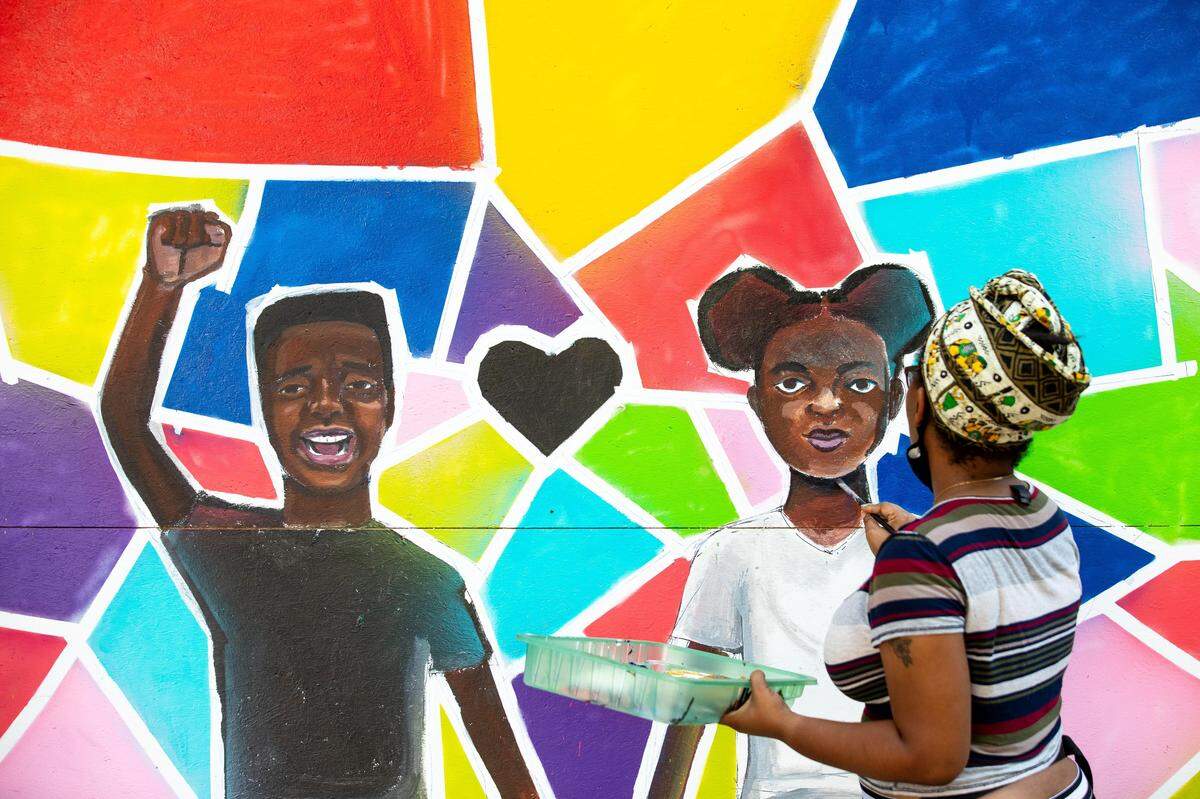
People taking pictures of the protest art decorating the plywood boards covering downtown windows greatly outnumbered the one person who stood at the corner of Chapel Hill and Corcoran streets with an illuminated sign that said, “History is watching.”
Saturday, the CCB Plaza hosted about 400 protesters at an event The News & Observer reported was organized by Beautiful Green and Morgan Johnson, a pair of 13-year-old friends. Earlier, a gathering of 300 physicians, medical workers and supporters held an event at Durham’s Central Park that sought to call attention to racial inequities in health care.
Before Sunday’s march started in Raleigh, a group painted “End Racism Now” on Martin Street by the Contemporary Art Museum in yellow letters as large as 20 feet across. Charman Driver, a former CAM chair who sits on the board, led the effort.
Driver told the News & Observer the group painted the message in support of the removal of Confederate monuments from the State Capitol grounds. There are three Confederate monuments on Capitol grounds, as well as others featuring slave owners.
Over the last nine days, protesters have often gathered at the base of the Confederate Soldiers Monument near the Salisbury Street side of Capitol grounds.
When the marchers finished visiting the site of Denkins’ death, they returned to Capitol grounds for the candlelight vigil. At one point, protesters held candles aloft for 8 minutes and 46 seconds in memory of how long a Minneapolis police officer who has since been charged with second-degree murder knelt on Floyd’s neck.
Protesters began to disperse around 9:45, just before Raleigh’s 10 p.m. curfew.
This story was originally published June 7, 2020 at 7:10 PM.