
Here are the Confederate statues and references on North Carolina Capitol grounds
Gov. Roy Cooper ordered the removal of three Confederate monuments from the state Capitol grounds Saturday, June 20 — memorials that have stood for more than a century.
A law has been on the books since 2015 that restricts officials from moving Confederate statues on government-owned property. All the Confederate monuments on the North Carolina Capitol grounds were placed there at least 30 years after the Civil War ended.
But Cooper, who has expressed support for finding them new homes, said June 20 that these three needed to be removed in the interest of public safety.
The announcement came less than 24 hours after protesters pulled down two bronze soldiers from the 75-foot North Carolina Confederate monument at the Capitol on Juneteenth.
Cooper said he ordered the removal of the Wyatt Monument, the Women of the Confederacy statue and the remainder of the North Carolina Confederate monument.
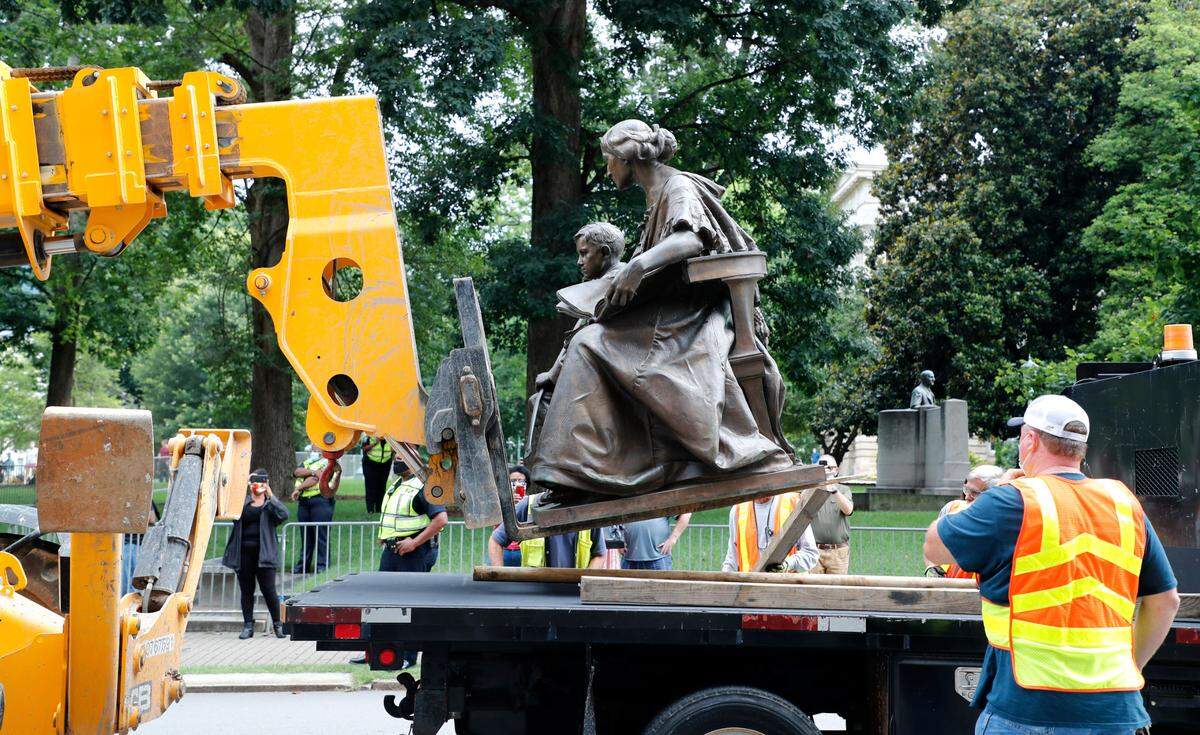
Saturday, crews removed the Wyatt Monument and the Women of the Confederacy statues Saturday morning.
Sunday, it was time to remove the biggest of them all — the Confederate artillery soldier holding a gun that has stood over Hillsborough Street for 125 years.
“I am concerned about the dangerous efforts to pull down and carry off large, heavy statues and the strong potential for violent clashes at the site,” Cooper said in a statement Saturday afternoon. “If the legislature had repealed their 2015 law that puts up legal roadblocks to removal we could have avoided the dangerous incidents of last night.
“Monuments to white supremacy don’t belong in places of allegiance, and it’s past time that these painful memorials be moved in a legal, safe way,” Cooper said.
In August 2018, the North Carolina Historical Commission voted to keep three Confederate memorials on the Capitol grounds — the three that Cooper ordered to be removed.
But there are more than just three references to the Confederacy there. Here are the statues and monuments on the grounds now that are connected to the Confederacy, slave owners and white supremacy:
▪ Confederate Soldiers Monument: At 75 feet, this is the tallest monument on the grounds. A Confederate soldier statue tops a column. On two sides of the base stand two more Confederate soldiers statues. Below them are two cannons. It was dedicated May 20, 1895.
▪ Confederate Women’s Monument: Dedicated June 10, 1914. The monument is a scene of a seated woman and a child — a boy holding a sword. It faces the street, and has two stone benches facing each other, flanking the monument. It was donated by Ashley Horne, a Confederate veteran and one-term state senator.
▪ Henry Lawson Wyatt: First North Carolina Confederate volunteer soldier to be killed in battle during the Civil War. The Edgecombe County native was killed at the battle at Bethel Church in Virginia on June 10, 1861. The statue of Wyatt depicts him standing, leaning forward and holding his gun across the front of his body. The statue was dedicated on June 10, 1912, according to the N.C. Department of Cultural Resources, which keeps a list of state Civil War monuments.
▪ Charles Aycock: Former state senator and governor. The statue was unveiled March 13, 1924. Aycock’s family were also slave owners, and Aycock campaigned in the late 1890s on a white supremacy platform.
▪ Zebulon Vance: Confederate officer and slave owner who was elected governor during the Civil War, and later became a U.S. senator. His statue faces the Aycock statue after being relocated in 1949 from a pedestal elsewhere on the Capitol grounds to make room for the N.C. presidents monument.
▪ Samuel Ashe Monument: Ashe is memorialized not by a statue, but rather a large horizontal rectangle with a bronze plaque showing his face, U.S. and Confederate flags and a paragraph describing him. Ashe was a Confederate soldier in the Civil War and went on to become a historian, legislator and newspaper editor. He died in 1938. It was unveiled on Sept. 13, 1940, which would have been his 100th birthday.
▪ Presidents: Three roads dead-end at Union Square, which is what the Capitol grounds block is called. Hillsborough Street ends at the Confederate soldiers statue, while the two other roads end at statues of U.S. presidents. At the end of Fayetteville Street is the country’s first, President George Washington. The three presidents claimed by North Carolina — James K. Polk, Andrew Jackson and Andrew Johnson — face New Bern Place. Washington, Polk, Jackson and Johnson were all slave owners.
This story was originally published June 21, 2020 at 8:00 AM.